Bank of Korea, Report on 'Characteristics and Implications of South Korea's Housing Market as an Asset'
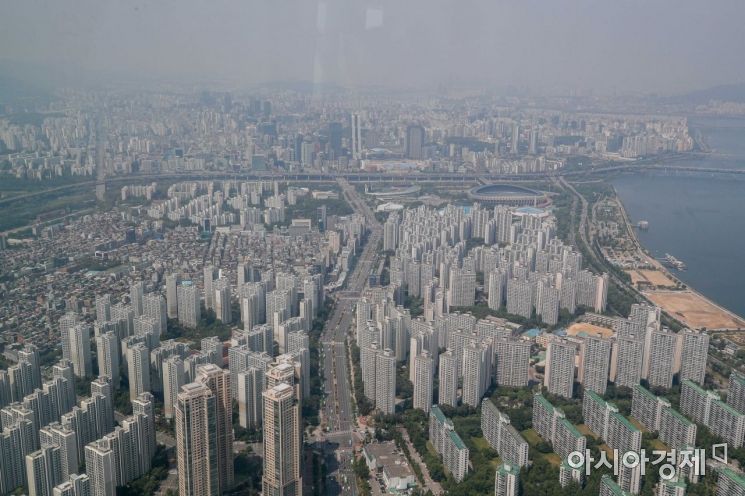 On the 17th, a view of apartments from Lotte World Tower Seoul Sky in Songpa-gu, Seoul. The Korea Real Estate Board announced that the actual transaction price index for apartment sales in Seoul in March was 175.1, up 1.4 points from the previous month (173.7). This marks the first time in five months since October last year, when the Seoul apartment sales actual transaction price index recorded 180.0, that the index has turned upward again. Photo by Jinhyung Kang aymsdream@
[Asia Economy Reporter Seo So-jeong] The easing of loan regulations, such as the upward adjustment of the loan-to-value ratio (LTV), has been found to increase the asset value of apartments in the Seoul area while decreasing the asset value of apartments in other regions. Since policies managing demand, such as interest rates and loan regulations, can have different effects depending on the region, it is pointed out that to stabilize housing prices, it is important to suppress the rise in asset values through consistent supply policies.
On the 23rd, the Bank of Korea released an analysis in its report titled "Characteristics and Implications of the Korean Housing Market as an Asset."
According to the report, compared to major countries, Korean housing shows relatively low volatility and high price growth rates. By region, Seoul, and by type, apartments showed higher price growth relative to volatility. Additionally, the market is characterized by high homogeneity, making transactions easier. The proportion of apartments in Korea ranked first among 37 OECD member countries as of 2019.
The Bank of Korea explained, "The reason apartments are perceived as excellent assets is due to stable demand from urbanization and agglomeration, expected gains from redevelopment and reconstruction, insufficient inventory levels, frequent transactions, and the unique characteristics of apartments being jointly managed."
In particular, the high preference for primary and secondary education was identified as a cause for the sustained demand for apartments in Seoul. According to the OECD, Korea's education expenditure as a percentage of gross domestic product (GDP) was 5.5% in 2019, ranking first among 42 countries. Not only is the overall scale large, but the proportion of primary and secondary education, which is more influenced by residential location than higher education, is high. The high dependence on private education in primary and secondary levels also contributed to the preference for apartments in Seoul and the metropolitan area.
Furthermore, the Bank of Korea analyzed the impact of changes in housing market-related policy variables on housing asset values and found that the effect of housing supply was clearly evident.
The impact of rising procurement costs on asset values was significant only in Seoul, while the easing of loan regulations such as the upward adjustment of the LTV increased the asset value of apartments in Seoul but decreased the asset value of apartments in other regions. The improved borrowing conditions for purchasing apartments in Seoul due to the LTV adjustment acted as a factor that suppressed demand for apartments in other regions.
The Bank of Korea emphasized, "While demand management policies (interest rates and loan regulations) show different effects depending on the region, the effects of supply policies are relatively clear. Through supply policies, if Korean housing becomes more important as a durable good rather than just an asset and the variety of preferred areas diversifies, it will contribute to stabilizing housing asset values."
It added, "The apartment-centered supply policy in Korea has the advantage of supplying a large quantity in a short time, but as housing market homogeneity intensifies, it fails to satisfy diverse demands for residential services. Therefore, it is necessary to explore ways to increase housing diversity."
© The Asia Business Daily(www.asiae.co.kr). All rights reserved.
![Clutching a Stolen Dior Bag, Saying "I Hate Being Poor but Real"... The Grotesque Con of a "Human Knockoff" [Slate]](https://cwcontent.asiae.co.kr/asiaresize/183/2026021902243444107_1771435474.jpg)















