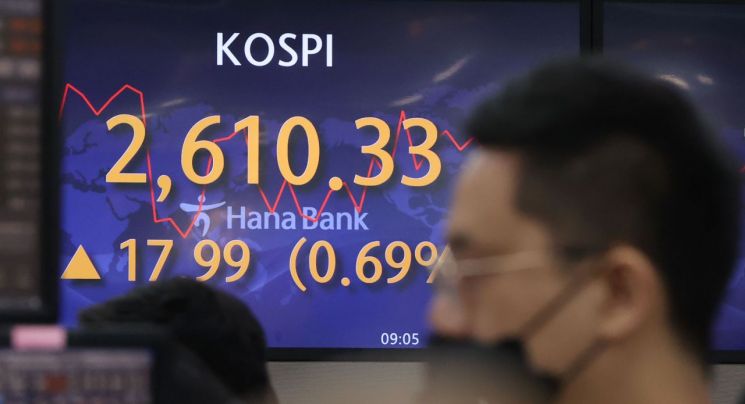
[Asia Economy Reporter Lee Seon-ae] This week (23rd-27th), the domestic stock market is expected to be influenced by the release of the minutes from the U.S. Federal Open Market Committee (FOMC) meeting and the monetary policy moves of both South Korea's Bank of Korea Monetary Policy Committee and the United States.
On the 22nd, the securities industry set the upper band of the KOSPI at the 2650 level. It was anticipated that the volatile market conditions would continue.
NH Investment & Securities forecasted that the KOSPI would move between 2599 and 2650. The stock market remains vulnerable to inflation and economic outlooks, and concerns over a resurgence of COVID-19 in the U.S. could also act as a negative factor. Accordingly, given the high external uncertainties, a strategy focusing on the profitability and momentum of individual companies is necessary. Expectations for the lifting of the Shanghai lockdown in China and valuation merits are seen as factors that could drive gains.
Researcher Kim Young-hwan of NH Investment & Securities stated, "We are paying attention to the momentum in sectors such as semiconductors, automobiles, and secondary batteries following U.S. President Joe Biden’s visit to Korea," adding, "Another key point to watch is whether regulatory improvements, such as tax credits for local investment companies and easing of various protectionist trade regulations, will be implemented to encourage Korean companies’ investments in the U.S."
The U.S. personal consumption expenditures (PCE) data for April, to be released later in the week, is also expected to play an important role in the future stock market. On the 27th (local time), the April PCE and core PCE, which excludes the highly volatile food and energy sectors, will be announced. The PCE index is the inflation indicator preferred by the Federal Reserve. When the March PCE index rose 6.6% compared to the previous year, reaching the highest level in 40 years, the three major U.S. stock indices all sharply declined.
Researcher Park Hee-chan of Mirae Asset Securities predicted, "Since the market has already been shocked by the Consumer Price Index (CPI) shock, if the PCE aligns with market expectations, it should not pose a significant burden on the stock market."
Daishin Securities suggested a strategy of 'increasing weight' at the KOSPI 2600 level and 'actively increasing weight' below 2600. Investors who increased their holdings during the recent low-level fluctuations may find the battle against time tiring, but it is not a trend to worry excessively about.
SK Securities anticipated that volatility would continue until the June FOMC meeting. While the KOSPI’s net profit forecast for this year has been revised upward, the market has been sluggish, causing the 12-month forward price-to-earnings ratio (PER) to fall to 9.6 times. This corresponds to an undervalued state within the bottom 3% range over the past three years. Therefore, the stock market is expected to engage in a tug-of-war between bargain hunting rebounds and inflation concerns.
© The Asia Business Daily(www.asiae.co.kr). All rights reserved.
![Clutching a Stolen Dior Bag, Saying "I Hate Being Poor but Real"... The Grotesque Con of a "Human Knockoff" [Slate]](https://cwcontent.asiae.co.kr/asiaresize/183/2026021902243444107_1771435474.jpg)















