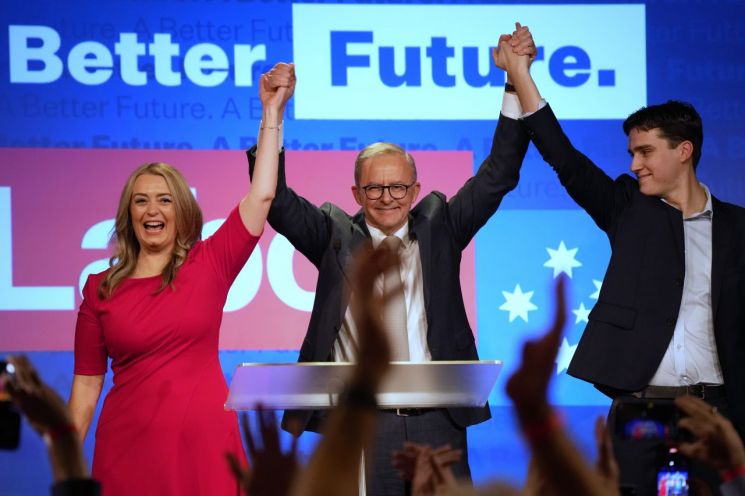
[Asia Economy Reporter Hyunwoo Lee] Amid reports that the Labor Party won a landslide victory in the Australian general election, Anthony Albanese (59), leader of the Labor Party, has emerged as the frontrunner for the next prime minister.
According to the UK’s BBC on the 22nd, with 66.3% of the votes counted in the Australian general election, the Labor Party secured 72 seats in the House of Representatives, defeating the Liberal-National Coalition which won 55 seats, thus becoming the majority party. In this Australian general election, 151 members of the House of Representatives and 40 members of the Senate are elected. If the Labor Party gains 4 more seats or secures more than 76 seats through a coalition, Albanese is expected to become Australia’s new prime minister.
As the Labor Party effectively confirmed its majority status, Albanese said at a victory celebration, "It is a great honor," adding, "Our Labor Party will work every day to unite Australia, and I will lead a government worthy of the Australian people." He mentioned that he was born and raised as "the son of a single mother receiving disability pension in public housing," emphasizing, "I will unite the Australian people, invest in social welfare projects, and end the climate war."
In an interview with the BBC, he stated, "I strongly support the security alliance between the US, UK, and Australia, known as AUKUS, and hope to become a global leader in climate action." The BBC reported that he is expected to take the oath of office as prime minister as early as that day and attend the Quad summit meeting in Japan on the 23rd, where the US, Japan, Australia, and India will discuss countering China.
If he becomes prime minister, he will be Australia’s first non-Anglo-Celtic prime minister, as he is of Italian descent. Albanese was elected to the House of Representatives in Sydney at the age of 33 in 1996 and has served as a member of the House for 25 years. When the Labor Party came to power in 2007, he became Minister for Infrastructure and Transport, and in 2013, he was appointed Deputy Prime Minister but resigned after 10 weeks following the Labor Party’s defeat in the general election.
Although he voiced progressive left-wing opinions within the Labor Party, the BBC reported that after becoming party leader in 2019, he shifted toward the center. In fact, he took a tough stance on national security amid conflicts with China and supported aggressive policies related to climate change, though he later withdrew some of those policies.
© The Asia Business Daily(www.asiae.co.kr). All rights reserved.
![Clutching a Stolen Dior Bag, Saying "I Hate Being Poor but Real"... The Grotesque Con of a "Human Knockoff" [Slate]](https://cwcontent.asiae.co.kr/asiaresize/183/2026021902243444107_1771435474.jpg)















