- Confirmation of Joint Denuclearization Goal, ROK-US Alliance Evolves into Economic Security
- President Yoon: "Deterrence against North Korea is crucial... Also discussed timely deployment of strategic assets"
- President Biden: "ROK-US alliance stronger than ever... Strengthening supply chains to maintain competitive edge"
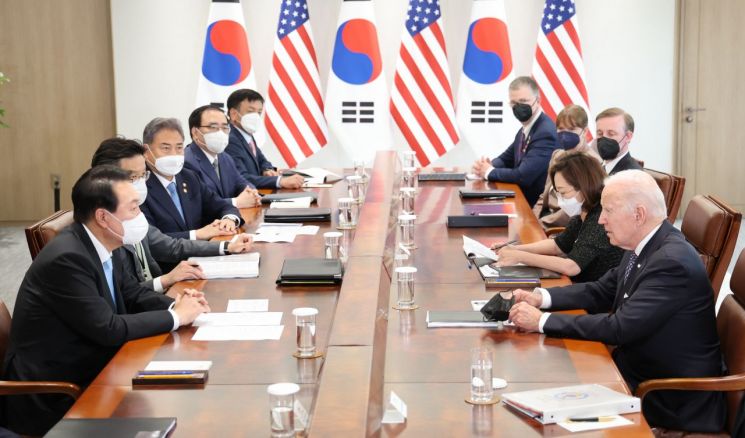
[Asia Economy Reporters Baek Kyunghwan, Lee Gimin] The Republic of Korea and the United States announced the results of their summit meeting centered on strengthening practical extended deterrence against North Korea, economic security cooperation based on the ROK-US alliance, and establishing regional order through the Indo-Pacific Economic Framework (IPEF). The two leaders agreed to build a new ROK-US alliance relationship focused on economic security and to jointly respond to market shocks arising from changes in the international order. To this end, they decided to establish an economic security dialogue between their presidential offices to facilitate frequent communication and cooperation in economic security areas such as supply chains and advanced science and technology.
In particular, President Yoon Suk-yeol emphasized, "We shared the goal of developing the ROK-US alliance into a global comprehensive strategic alliance." He stated, "We now face new challenges such as the long-standing task of North Korea's denuclearization, the pandemic crisis, changes in trade order and supply chain restructuring, climate change, and the crisis of democracy," adding, "As a comprehensive strategic alliance, we will jointly respond to these challenges."
During the summit, the two leaders reaffirmed their commitment to extended deterrence against North Korean provocations and agreed to reactivate the high-level Extended Deterrence Strategy and Consultation Group (EDSCG). President Yoon described this as "the first step being participation in the Indo-Pacific Economic Framework (IPEF)," to which U.S. President Joe Biden responded, "Now is the time when the ROK-US alliance is stronger and more vibrant than ever."
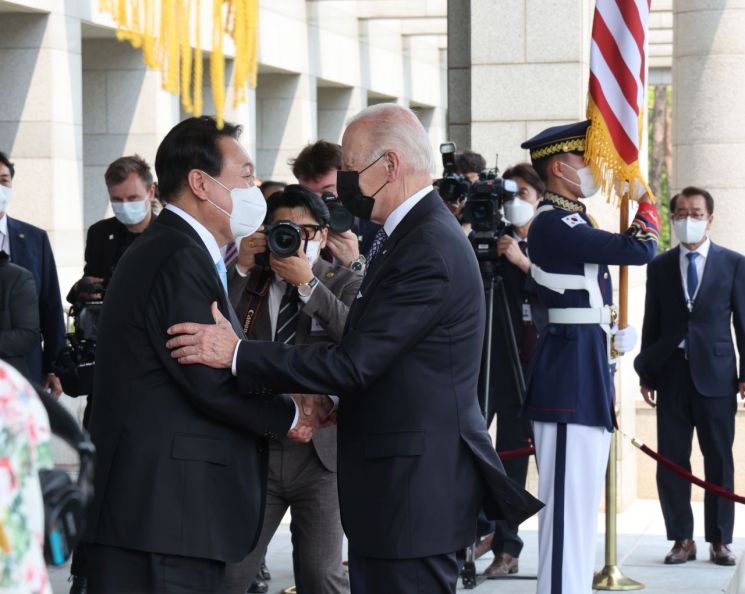
◆ Complete Denuclearization... Reaffirmation of Joint Goal= On the 21st, President Yoon, during his remarks at the expanded ROK-US summit meeting held at the presidential office in Yongsan, stated, "Our two leaders reaffirmed the shared goal of the complete denuclearization of North Korea," and added, "We agreed on the shared recognition that security is never negotiable and that strong deterrence against North Korea is of utmost importance."
President Yoon also emphasized, "President Biden confirmed the firm ROK-US defense and practical extended deterrence commitments." He further stated, "If North Korea takes practical steps toward denuclearization, we will prepare a bold plan to cooperate with the international community to dramatically improve North Korea's economy and the quality of life of its people," adding, "Regarding the current COVID-19 crisis, we are willing to provide active support on humanitarian and human rights grounds, separate from political and military issues."
In a Q&A session with reporters, President Yoon explained the 'action plan' for extended deterrence, saying, "There was also discussion about the need for various forms of joint exercises between the two countries to prepare for a nuclear attack." He added, "We also discussed the timely deployment of various strategic assets, including fighter jets and missiles, not just the nuclear umbrella," and explained, "If necessary, we will coordinate the timely dispatch of U.S. strategic assets and continuously confirm additional measures."
◆ ROK-US Leaders Strengthen Cooperation in ‘Semiconductors, Nuclear Power, and Bio’... Establish ‘Economic Security’ Channel= President Biden referred to his visit to the Samsung semiconductor plant in Pyeongtaek with President Yoon the previous day, highlighting the importance of supply chain cooperation between the two countries. President Biden said, "Through innovation in Korea and the U.S., the world's best semiconductors are being developed," and explained, "Companies like Korea's Samsung are currently investing billions of dollars in the U.S." He continued, "Through this, we will become closer and cooperate more closely," adding, "We will strengthen our supply chains and prepare for shocks to maintain our competitive edge."
To this end, the ROK and the U.S. agreed to newly establish an 'Economic Security Dialogue' between their presidential offices to facilitate frequent communication and cooperation in economic security areas such as supply chains and advanced science and technology. Additionally, both countries' nuclear power industries will work together to develop and promote the export of new reactors and small modular reactors (SMRs). They also agreed to initiate consultations on the 'Defense Mutual Procurement Agreement,' which can be considered an FTA in the emerging defense sector.
Plans were also made to expand space exploration cooperation and to resume the 'ROK-US Civil Space Dialogue' to develop bilateral cooperation beyond space technology into the space industry. The U.S. also confirmed its willingness to support the development of the 'Korean Positioning System (KPS)' during the summit. President Yoon explained, "By regularizing the ROK-US Civil Space Dialogue, we expect to discover various cooperation agendas in fields such as space technology exchange."
The two leaders agreed, "The ROK-US Free Trade Agreement (FTA), which marks its 10th anniversary this year, remains the foundation of the economic relationship between the two countries," and stated, "We will jointly respond to market distortion practices based on the shared values of fair and market-based competition."
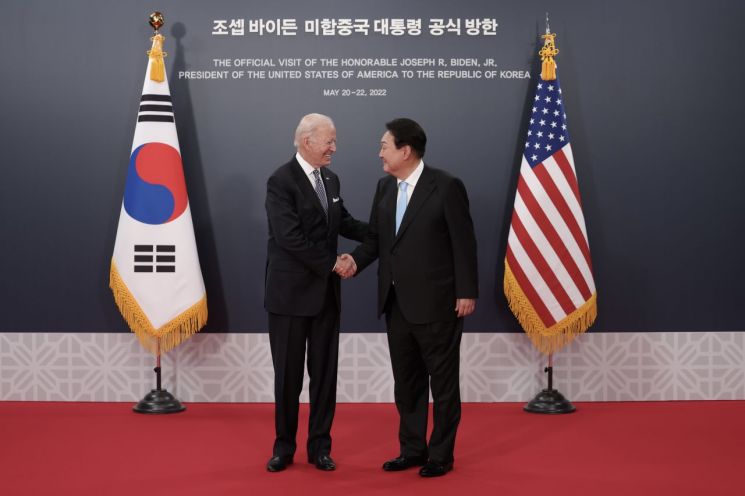
◆ "Strengthening Comprehensive Strategic Alliance"... Officialization of ROK’s Participation in IPEF= The ROK and U.S. leaders officially confirmed South Korea's proactive participation in the U.S.-led Indo-Pacific Economic Framework (IPEF) on this day. President Yoon said, "The Indo-Pacific region is important to both the ROK and the U.S.," adding, "By participating in the IPEF, we will create strategies to expand our regional contributions and roles."
President Biden also commented, "There is a growing consensus among democratic countries in the Pacific region that closer cooperation is necessary," and explained, "We discussed expanding cooperation not only among the U.S., Japan, and Korea but also to the South Pacific and the broader Indo-Pacific region."
They plan to strengthen public-private cooperation to protect and promote core and emerging technologies, including artificial intelligence (AI), quantum technology, and biotechnology. Through expanded human resource exchanges, investment promotion, and research and development cooperation, they aim to expand their technological alliance through partnerships related to core and emerging technologies.
Despite supply chain and market shocks caused by changes in the international order, such as the war in Ukraine, the ROK and the U.S. intend to actively respond. President Yoon emphasized, "As a first step in responding to market shocks, we established an 'Economic Security Dialogue' between our presidential offices to facilitate frequent communication and cooperation in economic security areas such as supply chains and advanced science and technology."
The two leaders pledged to strengthen cooperation not only in economic collaboration but also in shaping the international order by raising global health and climate goals through this summit.
President Biden explained, "Cooperation between the U.S. and Korea is very important for strategic development. We will fight the pandemic, strengthen health and security to address global health crises," adding, "We will also enhance climate change goals, develop electric vehicles, fight for our democratic values, and respond to various threats to uphold a rules-based international order."
© The Asia Business Daily(www.asiae.co.kr). All rights reserved.
![Clutching a Stolen Dior Bag, Saying "I Hate Being Poor but Real"... The Grotesque Con of a "Human Knockoff" [Slate]](https://cwcontent.asiae.co.kr/asiaresize/183/2026021902243444107_1771435474.jpg)

















