Promotion of Phase 2 Installation Project for 'Total Phosphorus Treatment Facility' to Purify 4.98 Million Tons of Sewage per Day
Phase 1 Installation of 2.04 Million Tons Completed in Jungnang, Tancheon, and Seonam... Nanjido Scheduled for 2023
[Asia Economy Reporter Lim Cheol-young] The Seoul Metropolitan Government will install advanced phosphorus treatment facilities, known as ‘Total Phosphorus Treatment Facilities,’ at 100% capacity in four water reclamation centers across Seoul by 2027 to improve the water quality of the Han River and ensure stable sewage treatment. This will enable the complete treatment of the approximately 4.98 million tons of sewage generated daily in Seoul more cleanly.
On the 23rd, Seoul announced that by June 2023, it will complete the first phase of installing Total Phosphorus Treatment Facilities capable of processing 2.04 million tons of sewage per day at the four water reclamation centers, and will proceed with the second phase to accommodate and treat the remaining 1.63 million tons.
Through facility modernization projects, the city has already installed Total Phosphorus Treatment Facilities with a capacity of 810,000 tons per day. In the first phase, 1.6 million tons per day were installed last year at the Seonam, Jungnang, and Tancheon Water Reclamation Centers, and by June 2023, an additional 440,000 tons per day will be installed at Nanji. In the second phase, the capacities to be installed at each water reclamation center are 230,000 tons per day at Jungnang, 420,000 tons at Nanji, 450,000 tons at Tancheon, and 530,000 tons at Seonam.
The city explained that although the water reclamation centers currently meet the legal discharge water quality standard (0.5 mg/L), it decided to fully introduce Total Phosphorus Treatment Facilities to further strengthen the discharge water quality. The goal is to reduce the total phosphorus concentration in discharge water from the water reclamation centers from the current 0.5 mg/L to 0.2 mg/L by 2030.
When sewage treated through the Total Phosphorus Treatment Facilities is discharged, it is expected to improve the water quality of the Han River and contribute to the restoration of the aquatic ecosystem’s health. This will enable stable sewage treatment not only during normal times but also in winter, when microbial activity decreases due to lower temperatures, causing difficulties in sewage treatment. The reduction in total phosphorus concentration will alleviate algal blooms and eutrophication in rivers, while also further lowering organic matter (BOD) and suspended solids (SS).
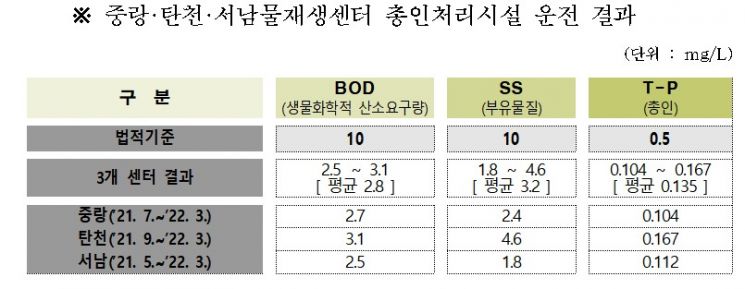
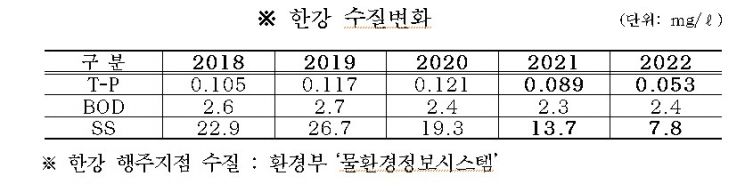
In fact, after operating Total Phosphorus Treatment Facilities for about a year at three water reclamation centers, the total phosphorus concentration was found to be 73% lower than the legal standard (0.5 mg/L), ranging from 0.104 to 0.167 mg/L, with an average of 0.135 mg/L. Additionally, the total phosphorus concentration in the main stream of the Han River at the Haengju point decreased from 0.105 mg/L in 2018 to 0.053 mg/L in 2022.
Furthermore, the city expects that the improvement in Han River water quality will lay the foundation for transforming 75 small streams and natural waterways throughout Seoul into citizen leisure and cultural spaces, known as the ‘Seoul-style Waterfront Sensibility City.’ As cleaner Han River water flows into these streams, citizens will be able to enjoy more pleasant water routes throughout their neighborhoods.
To promote the second phase, Seoul plans to start a feasibility study and basic plan establishment service in April this year and complete it by the first half of 2023. Afterward, the city will complete the basic and detailed designs and sequentially proceed with construction from 2025, aiming for completion by December 2027.
Han Yoo-seok, Director of the Water Circulation Safety Bureau of Seoul, said, “Once the second phase Total Phosphorus Treatment Facilities are fully installed at the four water reclamation centers, the entire daily sewage volume of 4.98 million tons generated in Seoul can be purified once more.” He added, “We expect that not only Han River users but also citizens visiting small neighborhood streams through the ‘Seoul-style Waterfront Sensibility City’ will be able to enjoy diverse leisure and cultural activities in much cleaner waterfront environments.”
© The Asia Business Daily(www.asiae.co.kr). All rights reserved.
![Clutching a Stolen Dior Bag, Saying "I Hate Being Poor but Real"... The Grotesque Con of a "Human Knockoff" [Slate]](https://cwcontent.asiae.co.kr/asiaresize/183/2026021902243444107_1771435474.jpg)
















