Korea-US Business Roundtable... Biden's Visit to Korea as an Opportunity
‘Korea-US Supply Chain and Industry Dialogue’ Elevated to Ministerial Level... Held Annually
Request to US for 'Steel Section 232' Improvement... "Necessary for Supply Chain Stability"
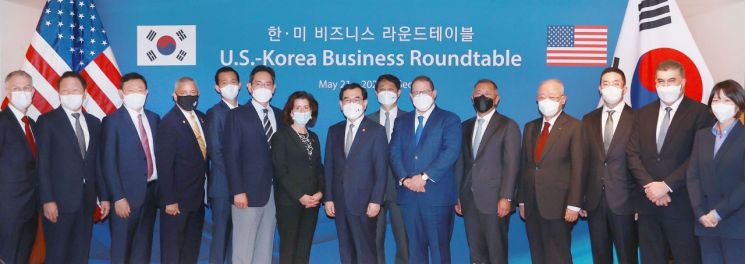 The Korea-US Business Roundtable held on the occasion of U.S. President Joe Biden's visit to Korea. Attendees at the event included Lee Jae-yong, Vice Chairman of Samsung Electronics; Chey Tae-won, Chairman of SK Group; Chung Eui-sun, Chairman of Hyundai Motor Group; and Koo Kwang-mo, Chairman of LG Group.
 [Photo by Ministry of Trade, Industry and Energy]
[Asia Economy Sejong=Reporter Lee Jun-hyung] South Korea and the United States will elevate the Korea-US supply chain communication channel to the ministerial level in conjunction with President Joe Biden's visit to South Korea. The government also requested negotiations to improve Section 232 of the Trade Expansion Act from the US.
The Ministry of Trade, Industry and Energy announced that Minister Lee Chang-yang held talks with US Secretary of Commerce Gina Raimondo on the 21st and signed a Memorandum of Understanding on the "Korea-US Supply Chain and Industry Dialogue." Taking this meeting as an opportunity, the two countries agreed to upgrade and expand the existing director-general level Korea-US supply chain communication channel to the ministerial level. The Ministry of Trade, Industry and Energy and the US Department of Commerce plan to hold the Korea-US Supply Chain and Industry Dialogue once a year to discuss economic security issues such as ▲digital economy ▲advanced manufacturing and supply chain resilience ▲export controls.
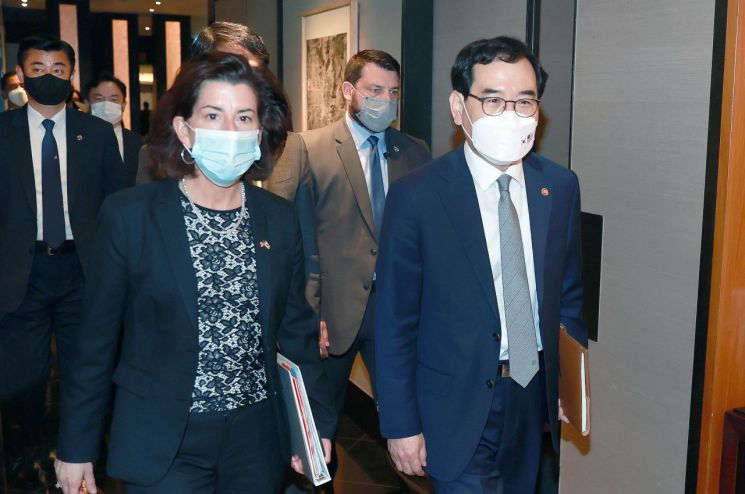 Gina Raimondo, U.S. Secretary of Commerce (left), and Lee Chang-yang, Minister of Trade, Industry and Energy (right), attending the Korea-U.S. Business Roundtable.
 [Photo by Ministry of Trade, Industry and Energy]
Supply chain cooperation between Korea and the US was also a significant topic at the meeting. The two ministers reportedly reached a consensus on the urgent need for cooperation among allied countries due to the global supply chain crisis and intensified competition in advanced technologies.
Minister Lee also emphasized the necessity of semiconductor cooperation. He stated, "Semiconductors are a core area of supply chain and economic security cooperation," and requested, "The Department of Commerce should pay special attention to providing non-discriminatory benefits to our investment companies as well as support for small and medium-sized enterprises that have entered jointly with large corporations." Furthermore, he proposed actively utilizing the "Korea-US Semiconductor Partnership Dialogue," agreed upon last November, and the Korea-US Supply Chain and Industry Dialogue to discuss semiconductor supply chain and technology cooperation.
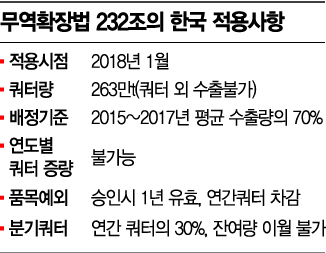
The government also requested negotiations to improve Section 232 of the Trade Expansion Act. Previously, the US imposed high tariffs of over 25% on imported steel products based on Section 232 of the Trade Expansion Act in 2018. Although South Korea avoided high tariffs through negotiations, the annual export volume to the US was limited to 2.63 million tons, which is 70% of the average export volume from 2015 to 2017 (3.83 million tons). Minister Lee said, "It is necessary to improve market access conditions for Korean steel from the perspective of supply chain stability," and added, "Please increase the flexibility of Section 232 measures to stabilize steel supply and demand for US demand companies and Korean investment companies located in the US."
After the meeting, Minister Lee Chang-yang and Secretary Raimondo co-hosted the "Korea-US Business Roundtable." Attendees included Samsung Electronics Vice Chairman Lee Jae-yong, SK Group Chairman Chey Tae-won, Hyundai Motor Group Chairman Chung Eui-sun, and LG Group Chairman Koo Kwang-mo.
Korean and American business leaders participating in the event discussed cooperation measures for supply chains in key industries such as semiconductors and batteries. Specifically, they reportedly discussed recent supply chain situations, responses to surging demand for semiconductor equipment, expansion of clean energy distribution, and digital economy cooperation.
Minister Lee said, "As the global economic environment changes, cooperation and joint responses between the government and companies are essential to enhance industrial competitiveness," adding, "In particular, cooperation combining Korea's manufacturing capabilities and the US's technological capabilities is necessary."
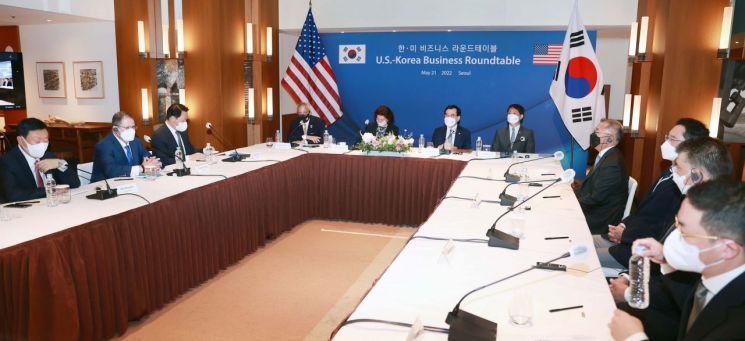 Participants are discussing at the Korea-US Business Roundtable.
 [Photo by Ministry of Trade, Industry and Energy]
Meanwhile, on the same day, Ahn Deok-geun, Director General for Trade Negotiations at the Ministry of Trade, Industry and Energy, signed a Memorandum of Understanding on Korea-US investment cooperation with global bio company Thermo Fisher Scientific. Thermo Fisher Scientific plans to consider South Korea as a major investment destination for bio raw material production plants following the signing of the MOU.
Director General Ahn said, "Thermo Fisher Scientific's investment will greatly contribute to fostering South Korea as a global vaccine hub," and added, "Attracting foreign advanced industries is a key strategy for stabilizing supply chains."
© The Asia Business Daily(www.asiae.co.kr). All rights reserved.
![Clutching a Stolen Dior Bag, Saying "I Hate Being Poor but Real"... The Grotesque Con of a "Human Knockoff" [Slate]](https://cwcontent.asiae.co.kr/asiaresize/183/2026021902243444107_1771435474.jpg)


















