Average Nationwide Jeonse Price Increase Rate of 27.69% After Contract Renewal Request and Rent Cap System Implementation
Jeonse Price Increase Rates Rise in the Seoul Metropolitan Area, Chungcheong Region, and Gyeongnam... Relatively Low in Jeonnam, Gangwon, Jeju, and Daegu
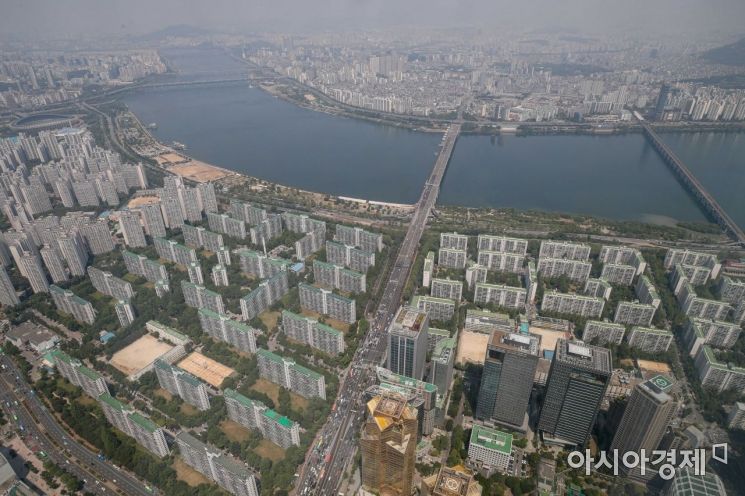 View of apartments from Lotte World Tower Seoul Sky in Songpa-gu, Seoul on the 17th. Photo by Asia Economy
[Asia Economy Intern Reporter Kim Se-eun] It has been confirmed that for apartments in Seoul with lease contracts renewed under the right to request contract renewal and the price ceiling system, an average of about 120 million KRW is required upon contract renewal.
According to a price survey by Real Estate R114 Labs (REP) on the 21st, the nationwide increase rate of jeonse prices was 27.69% from July 31, 2020, when the right to request contract renewal and the jeonse/rent price ceiling system were implemented, until the 20th of this month.
If tenants renewed their contracts applying the 5% cap of the jeonse/rent price ceiling system during this period and consider contract renewal thereafter, they must prepare in advance for an increase corresponding to a price gap of about 22 percentage points starting from August.
During the same period, the jeonse price increase rates by region were highest in Gyeonggi at 32.98%, Incheon 32.77%, Chungbuk 30.64%, Daejeon 28.29%, Gyeongnam 26.69%, and Seoul 26.66%, in that order.
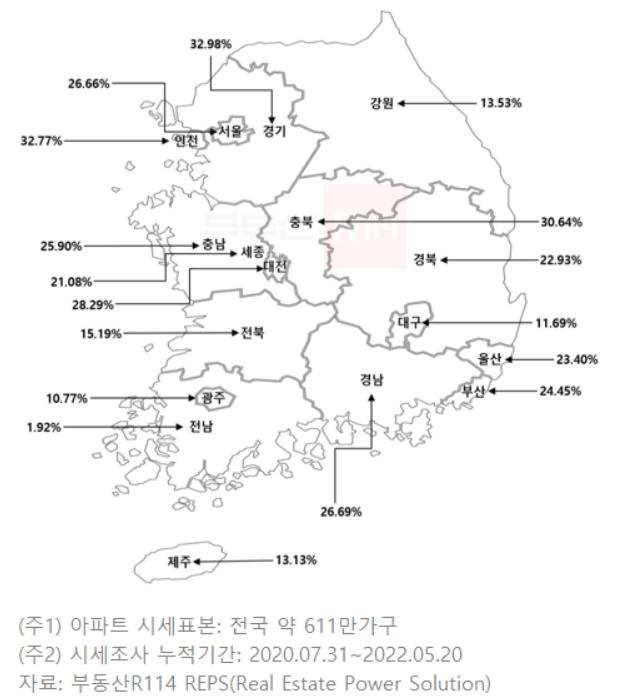 A table showing the rate of increase in Jeonse prices by region nationwide after the revised Lease Protection Act was implemented. Photo by Real Estate R114, Yonhap News Agency
Yoon Ji-hae, chief researcher at Real Estate R114, explained, "Usually, whether to renew a lease contract is negotiated between the landlord and tenant starting three months before the contract expires," adding, "From August, when contracts convert to new agreements, tenants' burdens will increase mainly in these regions."
On the other hand, regions such as Jeonnam showed relatively low jeonse price increases at 1.92%, Gwangju 10.77%, Daegu 11.69%, Jeju 13.13%, and Gangwon 13.53%.
As of July 31, 2020, when the so-called 'Three Lease Laws' including the right to request contract renewal and the jeonse/rent price ceiling system were implemented, the average jeonse price per household nationwide was 309.97 million KRW. Applying the 5% cap results in an average amount of 325.47 million KRW.
Meanwhile, as of the 20th, the average amount is 407.9 million KRW, and the difference between the capped renewal amount and the current market price is 75.32 million KRW.
However, there are regional variations.
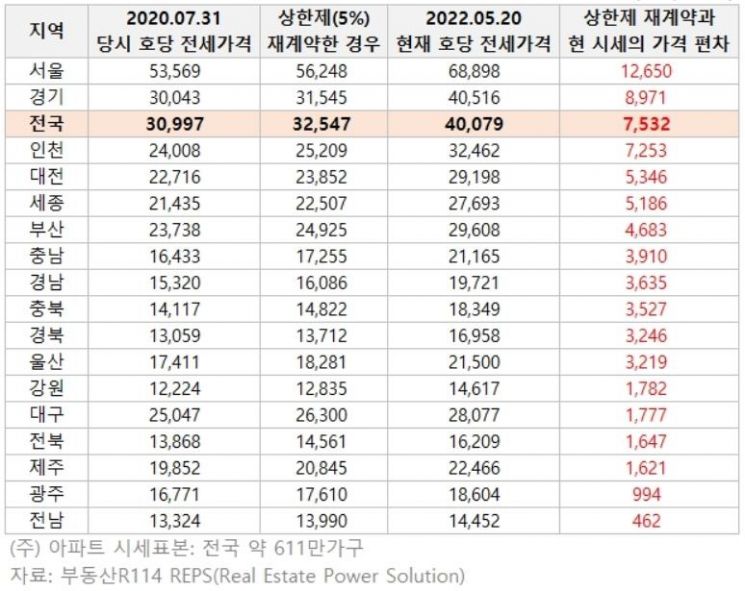 A table comparing the change in jeonse prices per household by region after the revised lease law was implemented. Photo by Real Estate R114, Yonhap News Agency
In Seoul, when apartments that applied the price ceiling system convert to new contracts, an average jeonse price increase of 126.5 million KRW is expected, and in Gyeonggi, 89.71 million KRW is anticipated. Both figures are higher than the average.
This is only an average increase amount, and the actual increase perceived by tenants may be greater depending on each contract.
Especially in Seoul, where jeonse and rent prices are unstable, the expected move-in volume for the second half of this year is 8,326 households, which is about 60% of the 13,826 households in the first half, showing a decrease.
Chief researcher Yoon urged, "With about two months left until the expiration of the two-year contract renewal right, the new government should implement differentiated policies such as preferential tax treatment for 'good landlords' who apply rent increases below market prices according to unstable conditions in individual regions."
© The Asia Business Daily(www.asiae.co.kr). All rights reserved.



















