Organic Sandwich Panel Must Pass Experiment... Burden of Cost Due to Lack of Space
"No Such Regulations for Large Corporations... Government Only Increasing Unnecessary Certifications"
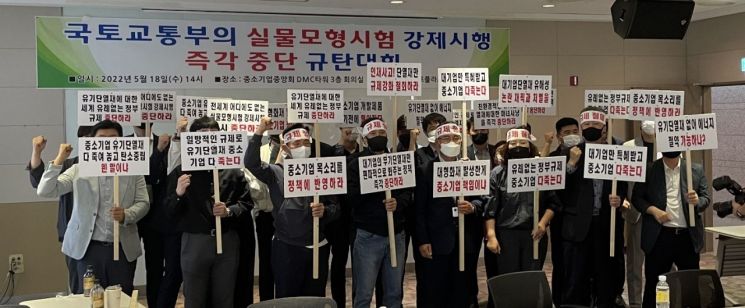 The Korea Expanded Plastic Industry Cooperative is holding a protest on the 18th at the Small and Medium Business DMC Tower in Sangam-dong, Mapo-gu, Seoul, urging the repeal of regulations on organic insulation sandwich panels.
[Asia Economy Reporter Donghyun Choi] The government's irrational regulations are strangling small and medium-sized enterprises (SMEs). Despite lacking sufficient conditions for implementing the system, the government is creating patchwork laws by riding public opinion, and there are complaints across the industry that unnecessary certifications are being excessively produced to expand the authority of government agencies.
"Losses due to rising raw material prices? The damage caused by the government's hasty administration is far more critical." This is the lament of Kang Minseong, chairman of the National Flame Retardant Branch, whom we met recently at the Korea Federation of SMEs DMC Tower in Sangam-dong, Mapo-gu, Seoul. He stated, "The government is demanding excessive performance tests for organic insulation sandwich panels, which are mainly produced by SMEs," and criticized, "Meanwhile, inorganic insulation materials produced by large corporations are given unilateral privileges without such regulations."
Sandwich panels used as building materials are made of composite materials (steel plate + insulation + steel plate). The insulation material inside the steel plate is broadly divided into organic and inorganic types. Organic materials are petroleum-based products such as urethane or Styrofoam. Inorganic materials are artificial mineral fibers made by melting glass raw materials or minerals into fiber form. As can be inferred from the raw materials, organic materials burn easily and emit toxic gases. In contrast, inorganic materials are non-combustible fireproof materials. Organic materials have been identified as the main cause of major disasters in large logistics center fires in recent years, and regulations were strengthened through the amendment of the Building Act on December 23 last year.
The core of the newly established regulation is that from now on, when producing organic sandwich panels, they must pass the "Physical Model Test for Sandwich Panels (KS F 13784-1)" and the "Physical Model Test for Exterior Wall Insulation (KS F 8414)." Previously, only a cone calorimeter test was conducted by burning samples about 10 cm wide and long to rate them as flame retardant, semi-noncombustible, or noncombustible. However, now, in addition to this, only materials that pass additional tests conducted in spaces similar to actual buildings can be used.
The problem is that there are far too few testing locations. Currently, only two institutions in Korea can conduct these tests: the Korea Institute of Construction Technology, affiliated with the Ministry of Land, Infrastructure and Transport, and the Samcheok Testing Center of the Korea Conformity Laboratories (KCL), a private institution. Chairman Kang lamented, "Not only are there only two places in the country where tests that take from two weeks to nearly a month can be conducted, but the performance standards and criteria for passing the tests are also ambiguous," adding, "SMEs bear the full cost of the tests, which amount to tens of millions of won."
The situation will become more serious from the second half of this year. When the grace period of the law ends at the end of June, all companies producing organic sandwich panels will have to supply only certified products that have passed the tests. However, six months after the law's implementation, only one company has passed the newly introduced tests. Supply is far short of demand, which could lead to a so-called "sandwich panel crisis." Of course, inorganic sandwich panels produced by companies like KCC and Byeoksan are easily procurable as they are not subject to these test regulations, but it is difficult to cover all construction sites with expensive inorganic materials alone.
Chairman Kang emphasized, "At least a two-year grace period is necessary to achieve the fundamental purpose of fire safety desired by the public through research and development (R&D) and securing technical performance," and urged, "The Ministry of Land, Infrastructure and Transport must actively engage in dialogue." Despite multiple indications of these issues, there is no clear solution. The government still only enforces regulations without anyone taking responsibility.
© The Asia Business Daily(www.asiae.co.kr). All rights reserved.
![Clutching a Stolen Dior Bag, Saying "I Hate Being Poor but Real"... The Grotesque Con of a "Human Knockoff" [Slate]](https://cwcontent.asiae.co.kr/asiaresize/183/2026021902243444107_1771435474.jpg)
















