SK Telecom and SK Square Make Four-Day Workweek a Reality
Long-Term Leave Every 5 Years of Service
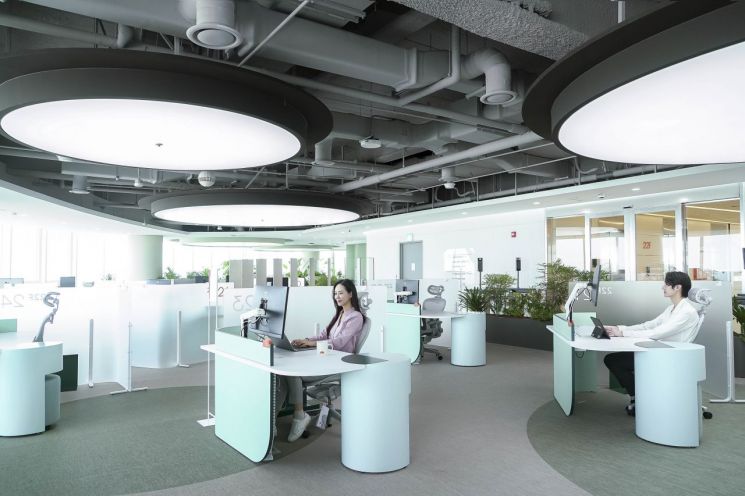
[Asia Economy Reporter Lim Hye-seon] The era of a four-day workweek, ‘Monday, Tuesday, Wednesday, Thursday, Sunday, Sunday, Sunday,’ is rapidly approaching.
SK Group affiliates SK Telecom and SK Square are introducing a biweekly four-day workweek system as part of their organizational culture innovation. Vice Chairman Park Jung-ho has drawn a ‘happiness map’ for employees in line with SK Group Chairman Chey Tae-won's ‘happiness management philosophy.’ This is interpreted as a strategy to gradually change working methods in the era of the COVID-19 endemic (periodic outbreaks of infectious diseases).
Four-day Workweek Twice a Month
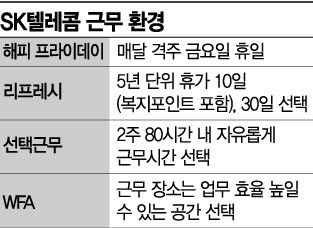
According to the telecommunications industry on the 20th, SKT and SK Square will expand the ‘Happy Friday’ system, which allowed employees to rest on one Friday per month after working more than 80 hours over two weeks, to twice a month starting in June. They introduced a biweekly four-day workweek while maintaining a 40-hour workweek and keeping salaries unchanged. The system was expanded because it did not harm productivity and increased employee satisfaction. SK Square takes days off on the first and third weeks of each month, while SKT rests on the second and fourth weeks. The Happy Friday system was first piloted in 2020 for members of the SK Supex Council and was first adopted by SKT. When there are bridge holidays, the days off are flexibly adjusted so that employees can have three or more consecutive days off. In April this year, SK Hynix, which marked its 10th anniversary of joining SK Group, also adopted this system. An SK Group official explained, “The results from the affiliates that implemented it first were good, so we are proceeding with a direction where each affiliate autonomously selects and operates the Happy Friday system according to their circumstances.”
SKT also expanded employee options for the ‘Refresh’ system, which grants long-term leave every five years of service. Employees can choose between 10 or 30 days of leave, and if they take 10 days off, they receive welfare points that can be used for language training, overseas travel, health care, self-development, or spending time with family.
The flexible work system is also being expanded depending on job categories. The system allows employees to freely set their commuting and days off based on a basic 80-hour two-week schedule. A new ‘WFA (Work From Anywhere)’ system for shared base offices was also introduced. This work method allows employees to perform their duties in spaces where they can maximize work efficiency without being restricted by location.
Work-Life Balance Brings Work Innovation
Since COVID-19, with the spread of remote work and growing awareness of ‘Work-Life Balance (WLB),’ more companies are adopting hybrid work models. Naver will introduce a new work system called ‘Connected Work’ from July, allowing employees to freely choose between working in the office or remotely. Employees can decide every six months whether to work at the office at least three days a week or work remotely five days a week. Musinsa, a domestic fashion platform company, has implemented a ‘three-day office attendance system’ for all employees starting this month, and Woowa Brothers, the operator of Baedal Minjok, is implementing a 32-hour workweek. Lotte Group and CJ Group are utilizing base office systems. A business insider said, “Many companies are struggling to find the appropriate work method,” adding, “I expect various organizational cultures tailored to the nature of their businesses to emerge.”
© The Asia Business Daily(www.asiae.co.kr). All rights reserved.
![Clutching a Stolen Dior Bag, Saying "I Hate Being Poor but Real"... The Grotesque Con of a "Human Knockoff" [Slate]](https://cwcontent.asiae.co.kr/asiaresize/183/2026021902243444107_1771435474.jpg)

















