On the 20th UN World Bee Day, 'Solar Beehive' Unveiled
"Maintaining Stable Growth Environment... Inducing Increase in Bee Population"
"Preserving Biodiversity... Contributing to UN Sustainable Development Goals"
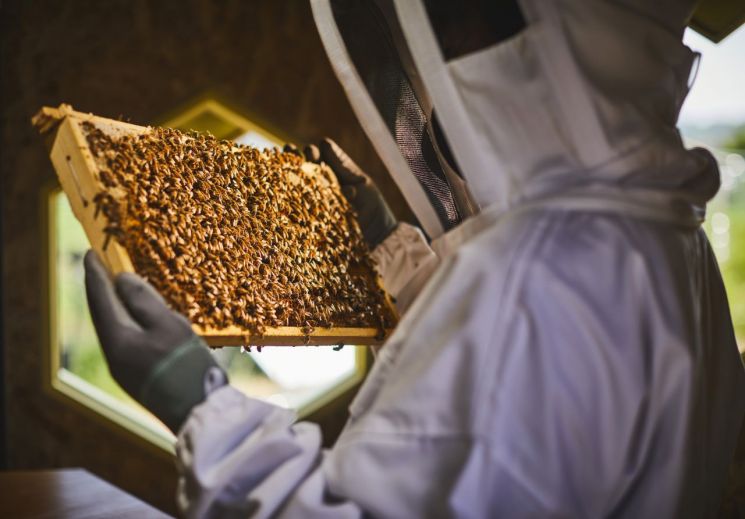 A look at the Solar Beehive made by Hanwha. It is a device equipped with a smart system that blocks the intrusion of wasps, natural enemies of honeybees, monitors the growth status of honeybees in real time, and controls power using solar energy. (Photo by Hanwha)
[Asia Economy Reporter Moon Chaeseok] Hanwha Group created and publicly unveiled Korea's first solar-powered carbon-reducing beehive, the 'Solar Beehive,' on the 19th, a day before the United Nations (UN) World Bee Day. By reducing carbon emissions through solar power and maintaining a stable environment for bee growth, the initiative aims to protect ecosystems and contribute to achieving the UN Sustainable Development Goals (SDGs). The SDGs are an international collective target proposed by the UN to address 17 main goals and 169 detailed targets by 2030, covering universal human issues such as poverty and disease, as well as global environmental challenges like climate change.
Hanwha installed a pilot Solar Beehive at the National Korea National College of Agriculture and Fisheries. Approximately 40,000 bees live there, helping to pollinate fruit trees used for practical training on campus and surrounding plants. The growth and activity data of these bees will be used for research related to bee population studies. On the 11th, Hanwha also signed a research-related Memorandum of Understanding (MOU) with the college.
The key feature of the Solar Beehive is the management of a 'smart beehive' that facilitates the control of the bees' growth environment using solar power. Solar modules are installed on top of the hive to generate electricity, enabling monitoring of the hive’s temperature, humidity, water, and food status. A smart system was applied to manage hive data in real time via an application. Additionally, it includes a function to analyze sounds to detect approaching bee predators such as hornets. When a hornet approaches, the entrance of the Solar Beehive changes to a small passage that only allows bees to pass, effectively blocking intrusions. Professor Kim Hyekyung of the Department of Industrial Entomology at the College of Agriculture and Fisheries said, "The Solar Beehive allows real-time monitoring of bee development and immediate detection of risks such as pests and diseases, which will be effective in increasing bee populations and preserving species."
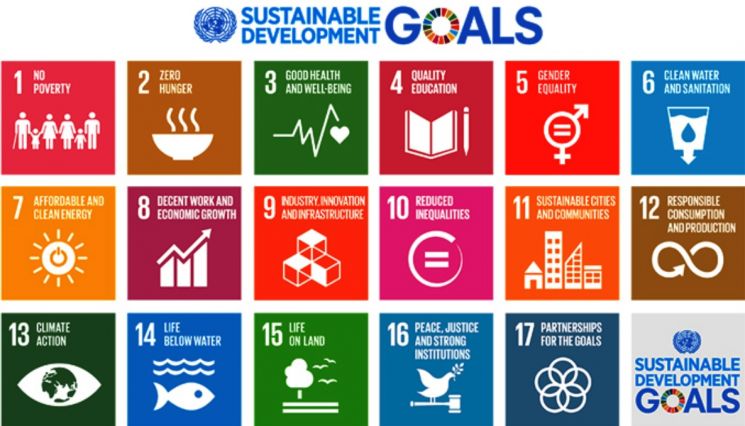 Photo of the 17 Sustainable Development Goals (SDGs) presented by the United Nations (UN) to the international community to achieve by 2030. (Image source=UN website)
Hanwha believes that 'bee management' can sufficiently contribute to securing food and protecting the environment. It is seen as an excellent ESG (Environmental, Social, and Governance) management tool. According to the United Nations Food and Agriculture Organization (FAO), over 70% of the top 100 crops that make up 90% of the world's food supply are pollinated by bees. Due to severe climate change, bee populations and species diversity are rapidly declining. A sharp decrease in bees could lead to ecosystem collapse from plants to animals and eventually a global food crisis. According to UN scenarios, the world population, which was about 7.8 billion in 2020, is expected to rise to approximately 11 billion by 2100, causing a surge in food demand. However, bee populations are stagnating or decreasing, leading to a projected shortage of bees relative to the population.
Research also shows that utilizing the environment around solar power plants can help protect bees. In December last year, the British-French Integrated Ecology Society revealed this finding. Researchers from the Department of Biology at Lancaster University in the UK analyzed the correlation between the location of solar power plants in the UK and the density of bee populations in surrounding areas. They found that within a 1 km radius of solar power plants, bee populations were up to four times higher than in other agricultural lands. This was attributed to the park-like landscaping around UK solar power plants, which are decorated with diverse plants. This case disproves the misconception that solar power generation negatively impacts bee ecosystems. In the US and Europe, there are cases of combining beekeeping with vegetation around solar power plants. Wildflowers are planted beneath solar panels to create suitable habitats for pollinating insects such as bees and butterflies.
Hanwha continues campaigns related to climate change response and carbon reduction using eco-friendly energy to contribute to achieving the UN Sustainable Development Goals. Since 2011, through the 'Hanwha Forest of the Sun' campaign, they have created nine eco-friendly forests across three countries using saplings grown with solar power. Approximately 520,000 trees were planted over an area of about 1.43 million square meters, equivalent to about 200 soccer fields. Last month, through the 'Making Clear Schools' campaign, which supports solar power facilities and various equipment that purify harmful substances in the air, the school environment was improved for 3,500 students in 140 elementary school classes.
© The Asia Business Daily(www.asiae.co.kr). All rights reserved.
![Clutching a Stolen Dior Bag, Saying "I Hate Being Poor but Real"... The Grotesque Con of a "Human Knockoff" [Slate]](https://cwcontent.asiae.co.kr/asiaresize/183/2026021902243444107_1771435474.jpg)
















