US at a Turning Point in Leadership Competition
Importance of Advanced Industry Technology Alliances Highlighted
Yoon and Biden Meet at Semiconductor Factory
Expectations to Elevate to a 'Comprehensive Strategic Alliance'
New Strategy Needed Amid US-China Hegemony Rivalry
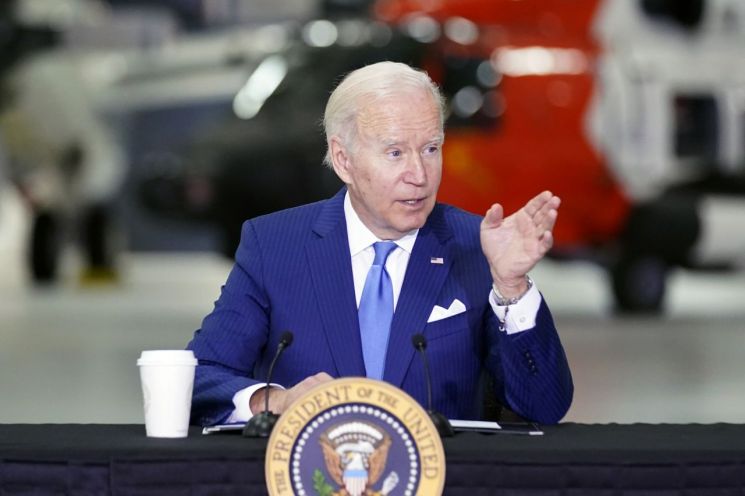
[Asia Economy Reporters Park Sun-mi and Choi Dae-yeol] On the 20th, U.S. President Joe Biden, visiting South Korea to meet with domestic business leaders and tour business sites, has a clear intention. It is aimed at strengthening the South Korea-U.S. alliance through investments and business activities between companies of the two countries. This is widely interpreted as a judgment that supply chain management has become more important than ever due to the deepening decoupling of the global economy caused by power struggles among major powers and the impact of COVID-19.
Alongside military and security alliances, the technology alliance centered on the U.S. and Western bloc is seen as a key factor determining the outcome of the global hegemony competition. For the U.S., regaining superpower status and restructuring the disrupted international trade order makes collaboration with South Korean companies such as Samsung, SK, Hyundai Motor, and LG increasingly important.
Yoon Launches ‘Semiconductor Superpower’... South Korea-U.S. Alliance Strengthens
President Yoon Suk-yeol will visit Samsung Electronics’ Pyeongtaek semiconductor plant together with U.S. President Biden. Samsung Electronics Vice Chairman Lee Jae-yong is expected to personally guide the visit.
This is the first time President Yoon has visited an industrial site since taking office, and it is also the first visit by a U.S. president to a semiconductor plant in South Korea. The joint visit by the two leaders to the Pyeongtaek semiconductor plant symbolizes the restoration of the global semiconductor supply chain and the strengthening of strategic cooperation.
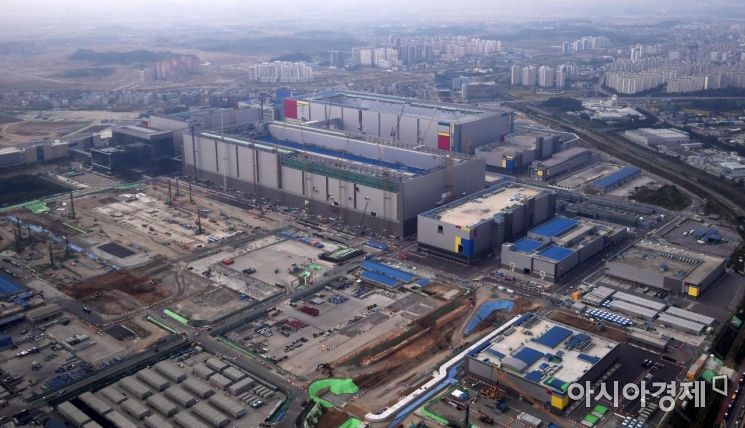 Panoramic view of Samsung Electronics' Pyeongtaek Line 2 factory, the world's largest semiconductor plant. Photo by Hyunmin Kim kimhyun81@
Notably, President Yoon’s choice of a semiconductor plant as his first diplomatic venue is significant. It signals the official launch of the ‘Semiconductor Superpower South Korea’ strategy, externally promotes the status of South Korea’s semiconductor industry, and demonstrates South Korea-U.S. cooperation on the global semiconductor supply chain issue, thereby reinforcing the comprehensive strategic alliance between the two countries.
The Yoon administration has designated the semiconductor industry, which leads South Korea’s exports and investments, as a ‘future strategic industry’ and set securing a technological gap as a national agenda. Last year, South Korea’s semiconductor exports amounted to $128 billion (based on MTI 3 units), accounting for 20% of total exports, and semiconductor facility investments reached 55.4 trillion won, representing 55.3% of manufacturing investment.
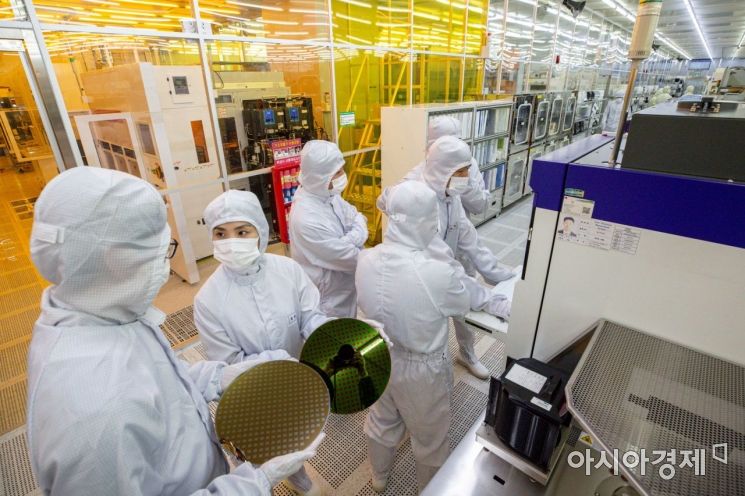 Researchers are conducting research for semiconductor material product development in the 12-inch semiconductor testbed cleanroom at Daejeon Nano Comprehensive Technology Institute. Photo by Jinhyung Kang, Daejeon aymsdream@
Samsung Electronics’ Pyeongtaek semiconductor plant is the world’s largest semiconductor production base, equipped with cutting-edge memory and system semiconductor (foundry) production facilities. It is regarded as a forward base for achieving South Korea’s technological gap in the era of the Fourth Industrial Revolution. In particular, the Pyeongtaek plant serves as a link in the global semiconductor supply chain connecting Samsung’s Giheung and Hwaseong plants in South Korea with its Austin and Taylor plants in the U.S.
The semiconductor industry expects that the joint visit by the South Korean and U.S. leaders to the Pyeongtaek plant will have a ‘twofold effect’: acting as a problem solver for global supply chain issues and elevating the South Korea-U.S. relationship to a comprehensive strategic alliance including economic and technological cooperation. An industry insider explained, “This ‘semiconductor meeting’ between the two leaders sends a message of the ‘South Korea-U.S. semiconductor alliance’ that supports the growth of South Korea’s semiconductor industry while actively responding to the U.S. industrial demand for semiconductors. Furthermore, it can be interpreted as solidifying the comprehensive strategic alliance between the two countries.”
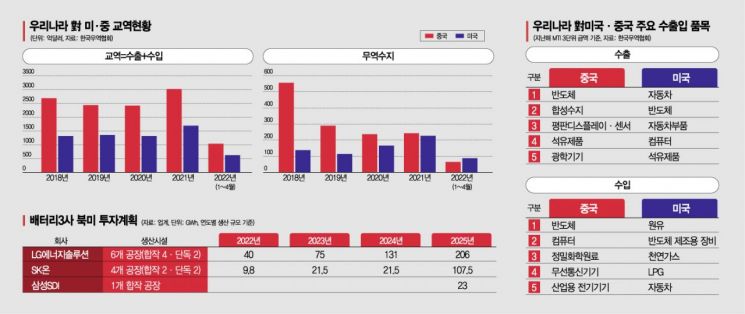
"U.S. Needs New Means to Check China... We Must Also Devise Response Strategies"
Batteries, which will be central to electric vehicles and future energy sources, are also a core element of the South Korea-U.S. technology alliance. Electric vehicles are expected to soon replace internal combustion engines and become the mainstream of the global automotive industry. Batteries will be widely used not only in transportation but also throughout daily life and various industries. Due to environmental regulations, the use of renewable energy is bound to increase, and batteries are needed to store electricity and supply it when necessary.
What makes the U.S. uneasy is China’s presence at key points of these next-generation foundational industries. The hegemony competition between the U.S. and China (G2) is ongoing, and China’s influence has grown at the upper levels of the value chains in major foundational industries such as semiconductors, electric vehicles, and batteries. Under the free trade regime established in the 20th century, with clear division of labor among countries, China has increased its influence on the international stage by leveraging resources like rare earth elements as strategic tools.
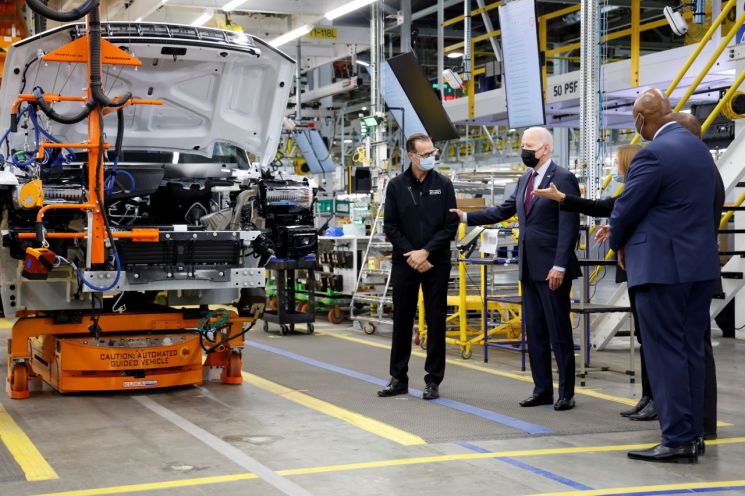 Last November, U.S. President Joe Biden visited General Motors' electric vehicle factory, 'Factory Zero'
 Experiencing firsthand how supply chains can be disrupted by unforeseen external shocks such as climate change or large-scale infectious diseases, which can collapse everyday social systems, has heightened the importance of economic security. Shortly after taking office, President Biden issued an executive order to investigate global supply chains focusing on semiconductors, batteries, rare earth elements, and medical supplies. After about 100 days of investigation, the conclusion was that dependence on certain countries, including China, is high, and efforts should be made to improve supply chains among allied countries. The Indo-Pacific Economic Framework (IPEF), a key topic of Biden’s Asia tour aimed at checking China, reflects this context.
Park Ga-hyun, senior researcher at the Korea Institute for International Trade and Commerce, assessed, “With the lifting of lockdowns on major production facilities and regions to curb COVID-19 spread and improving domestic and international conditions, severe supply chain problems are expected to ease somewhat, but many uncertainties such as resurgence, climate change, and resource nationalism remain.” She added, “Geopolitical issues such as the U.S.-China hegemony dispute are causing supply chains, which were previously built for efficiency, to be reorganized around stability, necessitating the formulation of response strategies for structural changes.”
Na Soo-yeop, senior researcher at the Korea Institute for International Economic Policy, said, “The Biden administration’s basic view is that past unilateral sanctions and World Trade Organization (WTO) rule enforcement have limitations in fundamentally changing trade relations with China, so a new strategy is needed. As U.S.-China trade conflicts expand into confrontations between the U.S., European Union (EU), and major countries against China, the tendency to use national and economic security as grounds for sanctions against each other will become more pronounced.”
© The Asia Business Daily(www.asiae.co.kr). All rights reserved.



















