Energy Technology Research Institute Develops Graphene Shell Coating Technology for Fuel Cell Catalysts and Secondary Battery Electrode Materials
Commercialization Begins After Technology Transfer Contract Signed with Private Company on the 6th
[Asia Economy Reporter Kim Bong-su] To achieve carbon neutrality, not only renewable energy technologies such as solar and wind power but also the development of next-generation energy devices that store and supply energy sources like hydrogen, fuel cells, and secondary batteries is actively underway. A domestic research team has developed a technology that can dramatically improve the durability of secondary batteries and fuel cells using graphene, known as the "dream material," and has entered commercialization.
The Korea Institute of Energy Research announced on the 18th that Dr. Kim Hee-yeon’s research team from the High-Temperature Energy Conversion Laboratory developed a technology to coat porous graphene shells on the surfaces of fuel cell catalysts and secondary battery electrode materials.
This technology fundamentally solves the durability degradation problem of fuel cell catalysts and secondary battery electrodes. By applying porous graphene shells to platinum (or platinum-transition metal alloy) catalysts for fuel cell electrodes and silicon oxide for secondary battery electrodes, durability can be improved by more than 200%.
Since the early 2010s, the research team has focused on electrode material research applying graphene, called the dream material. While most focused on creating flawless, smooth graphene, the team broke the stereotype and concentrated on porous graphene with many holes. When porous graphene is coated on the surface of metal catalysts, the elasticity and protective effect of the graphene shell with intermittent holes suppress performance degradation in fuel cells and secondary batteries. Graphene is a thin film with a thickness of 0.3 nm (10^-9 m), the thickness of a single carbon atom, making it thin and light yet highly physically and chemically stable and durable, allowing for a wide range of applications.
The research team applied the chemical vapor deposition process, mainly used in semiconductor manufacturing. By flowing a low concentration of gaseous hydrocarbons (compounds made of carbon and hydrogen) into the reaction chamber where the electrode materials are placed, porous graphene shells can be coated on the surfaces of platinum-based catalysts for fuel cells and silicon nanoparticles for secondary battery electrodes. The process is very simple, with treatment times ranging from a few seconds to a few minutes, and the shape and thickness of the graphene shell can be controlled by adjusting temperature and reactant concentration. Additionally, the raw material cost for coating 10 kg of catalyst is only a few hundred won, making it inexpensive and easy to commercialize in a short period with a small budget.
Basically, all types of batteries undergo expansion and contraction during charge-discharge cycles, causing damage and reducing charging efficiency. However, coating porous graphene shells on silicon nanoparticles, the next-generation anode material for secondary batteries, allows elastic response to expansion and contraction during charge-discharge cycles, fundamentally suppressing lifespan degradation (electrode deactivation). In the case of fuel cell electrode catalysts, severe deactivation of catalyst particles inevitably occurs during operation, but the protective effect of the porous graphene shell coated on the catalyst surface fundamentally suppresses catalyst particle aggregation, corrosion, and detachment. Furthermore, the holes in the graphene shell allow reactants to move easily, minimizing catalyst performance degradation.
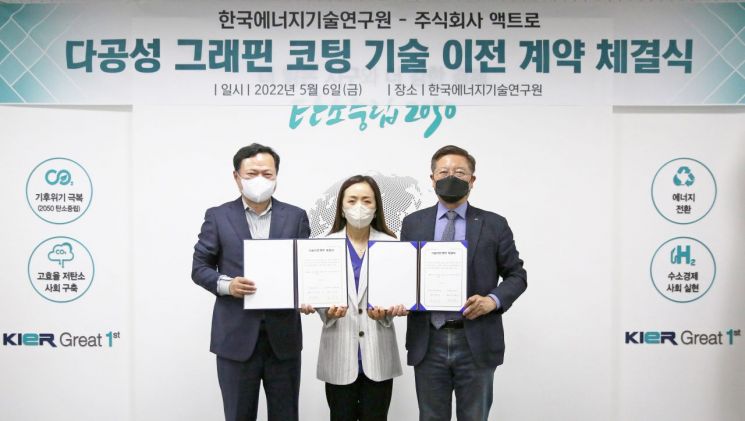
Meanwhile, the institute signed a technology transfer contract with a private company on the 6th and has entered commercialization.
© The Asia Business Daily(www.asiae.co.kr). All rights reserved.
![Clutching a Stolen Dior Bag, Saying "I Hate Being Poor but Real"... The Grotesque Con of a "Human Knockoff" [Slate]](https://cwcontent.asiae.co.kr/asiaresize/183/2026021902243444107_1771435474.jpg)















