Preventing Safety Accidents at Construction Sites, Subways, and Crosswalks
Full Effort in Developing LiDAR for Autonomous Vehicles
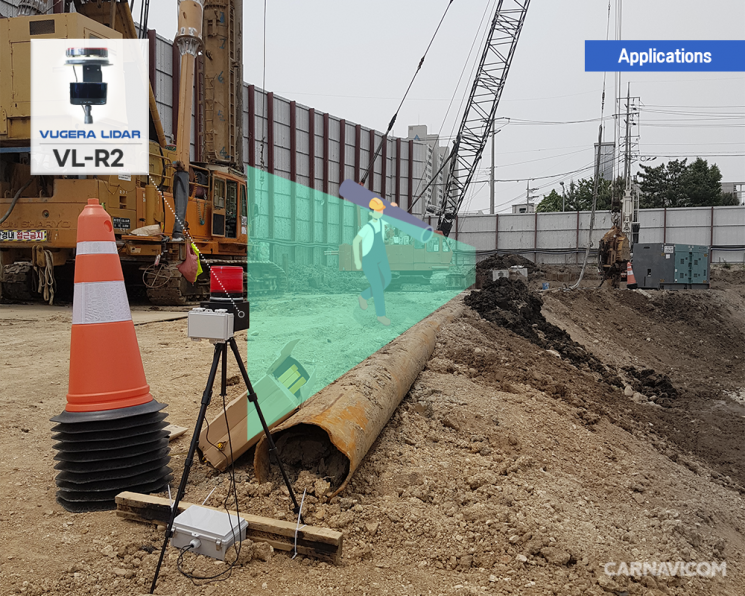 With the industrial LiDAR developed by Canebicom, vertical surfaces at construction sites can be monitored to prevent hazards.
[Asia Economy Reporter Donghyun Choi] There is a sensor called ‘LiDAR’ that is essential for autonomous vehicles and unmanned robots. This technology obtains information about objects, terrain, and distances by emitting laser beams and analyzing the reflected light. Currently, in the global LiDAR market, the United States, Germany, and Japan hold technological superiority, while China competes fiercely with price competitiveness. South Korea, which is significantly behind, relies mostly on imports for LiDAR.
There is a small and medium-sized enterprise quietly developing LiDAR technology independently despite the high technical barriers and costly research and development (R&D). The company is Kanevicom, an automotive electronic parts manufacturer that succeeded in mass-producing industrial LiDAR for the first time in Korea in 2018. Yoon Jaejun, Director of Kanevicom’s LiDAR Development Team, said, "During the development of vehicle LiDAR, we realized that applying it to other industries holds limitless business potential," adding, "We were able to secure proprietary technology by steadily investing without being bound by short-term results."
The first industrial LiDAR Kanevicom introduced to the market is the ‘VL-S3.’ It is installed on subway platform screen doors to prevent accidents caused by people getting caught between the train and the safety door. It continuously monitors a space 20 cm wide and 5 m long, and immediately opens the safety door if a person or obstacle is detected. In 2018, over 150 units were installed at Seoul Metro, and in 2020, 48 units were installed at two stations of the Busan Metro. Director Yoon stated, "LiDAR has high utilization value especially in safety-related industrial fields," and added, "Demand has increased in various industrial sites since the Serious Accident Punishment Act was enforced this year."
Kanevicom recently mass-produced the ‘VL-R2,’ a LiDAR warning device for preventing industrial accidents. When installed at construction sites, it emits warning sounds if a worker unconsciously approaches a cliff, preventing falls. It can also detect access to hazardous areas such as those with gas or flammable materials inside buildings, preventing accidents caused by carelessness in advance. When installed at crosswalks, it creates a kind of virtual wall in front of pedestrians waiting for signals, providing early warnings of potential car accidents.
When Kanevicom was established in 2001, its main products were black boxes and Hi-Pass devices. Since 2004, it has supplied dedicated black boxes (Viewgara) and Hi-Pass devices for Mercedes-Benz vehicles through Mercedes-Benz Korea. Sales grew from 18.8 billion KRW in 2012 to 49.5 billion KRW last year. During this process, Kanevicom expanded its business areas to include LiDAR, V2X (Vehicle to Everything), and DCU (Domain Control Unit). V2X is a communication terminal essential for autonomous vehicles, and DCU is an integrated control device that combines LiDAR, V2X, and others.
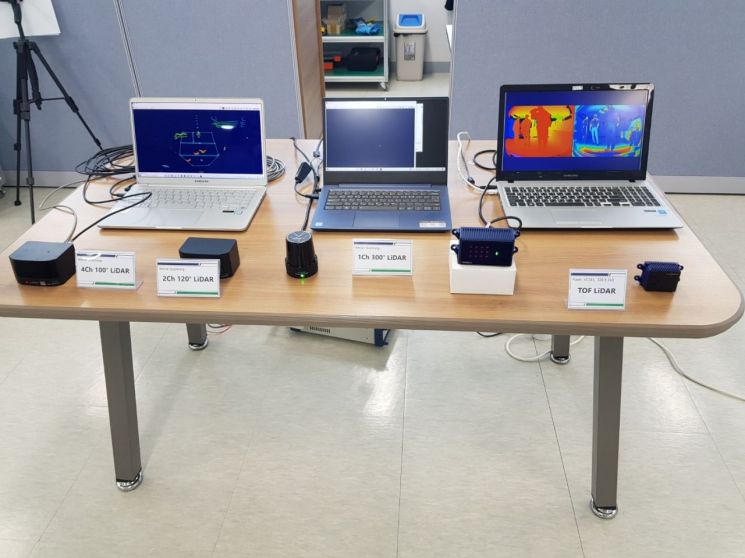
Kanevicom’s headquarters, located in Songdo International City, Yeonsu-gu, Incheon, houses the management headquarters, production line, research institute, and AS center all in one place. The research institute focuses its core capabilities on advancing LiDAR technology. Currently, technological superiority in the LiDAR market is achieved by increasing the number of LiDAR channels and reducing volume. The more channels LiDAR has, the higher its precision. LiDAR is typically motor-driven, but recently, ‘solid-state LiDAR,’ which replaces motors with semiconductors to reduce weight, has been gaining attention. Director Yoon said, "We are focusing on dual-track technology development for vehicle and industrial LiDAR," and added, "We plan to launch new products such as LiDAR for agricultural machinery and ships within the next one to two years."
© The Asia Business Daily(www.asiae.co.kr). All rights reserved.


















