Analysis of Beneficiary Stocks from Next Month's Regular MSCI KOSPI 200 Inclusion and Exclusion Changes
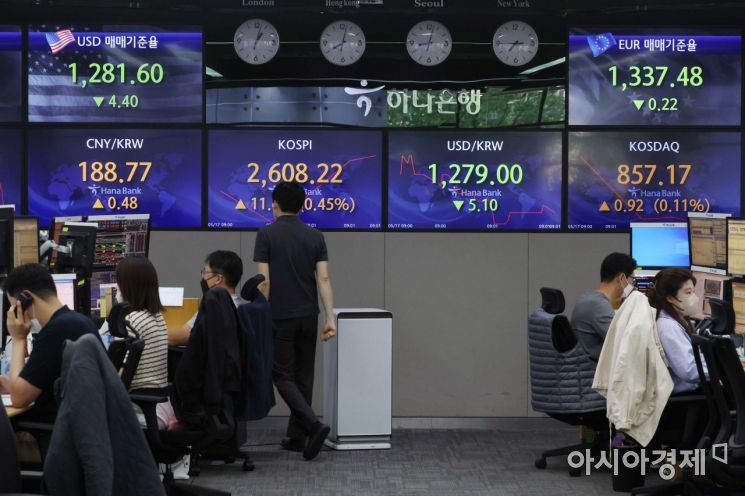 On the 17th, dealers were working in the dealing room of Hana Bank in Euljiro, Seoul. On that day, the KOSPI index opened at 2603.58, up 7.00 points (0.27%) from the previous trading day. The won-dollar exchange rate started at 1280 won, down 4.1 won. Photo by Moon Honam munonam@
[Asia Economy Reporter Junho Hwang] The regular inclusion and exclusion of stocks in the Morgan Stanley Capital International (MSCI Emerging Markets, Korea) index and the KOSPI 200 will take place next month. As the inflow and outflow of index funds change due to the stock adjustments, the price trends of individual stocks are also expected to vary. The securities industry advises paying close attention to these stocks starting one month before their inclusion.
According to the financial investment industry on the 18th, the recent May semi-annual review of the MSCI Korea index confirmed the new inclusion of Hyundai Heavy Industries, which was listed last year. As a result, the number of stocks included in the index will increase by one to a total of 112. According to Hana Financial Investment, Hyundai Heavy Industries received a 20% inclusion ratio, and an inflow of index funds worth approximately 423 billion KRW is expected. SK Telecom, which was a strong candidate for exclusion, will remain in the index this time.
Changes in supply and demand will also occur due to shifts in index inclusion ratios. Woori Financial Group's inclusion ratio increased due to an increase in floating shares following a change in its largest shareholder. Accordingly, a net inflow effect of approximately 248.6 billion KRW is expected. On the other hand, SK is expected to experience an outflow of about 216.1 billion KRW, which is 4.7 times the average weekly trading volume of 46.1 billion KRW. However, since the adjustment will be made on the 1st of next month based on the closing price on the 30th of this month, the exact effect of inclusion will be revealed later.
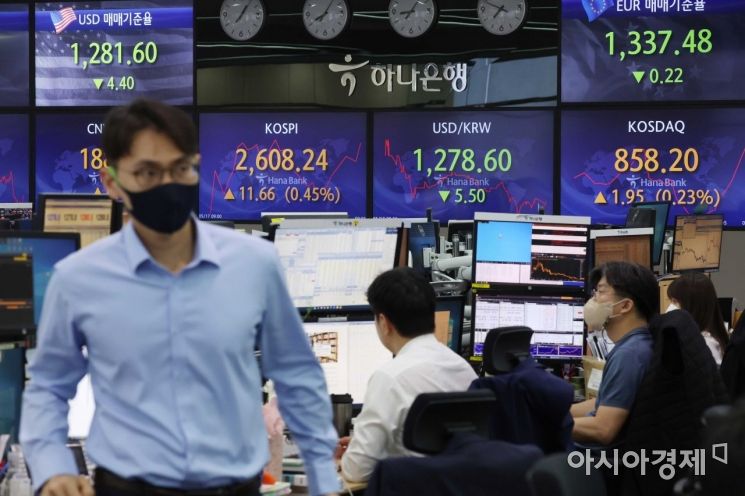 On the 17th, dealers are working in the dealing room of Hana Bank in Euljiro, Seoul. On this day, the KOSPI index opened at 2603.58, up 7.00 points (0.27%) from the previous trading day. The won-dollar exchange rate started at 1280 won, down 4.1 won. Photo by Moon Honam munonam@
On the 11th of next month, the inclusion and exclusion of stocks in the KOSPI 200 will also take place. Considering the KOSPI 200 tracking funds of 80 trillion KRW, the securities industry expects that the newly included stocks such as F&F (158.5 billion KRW), Meritz Fire & Marine Insurance (101.7 billion KRW), and Hanil Cement (28.1 billion KRW) will see increased demand. Conversely, stocks like Hyundai Home Shopping (-28.9 billion KRW), SK Discovery (-28.3 billion KRW), and Cuckoo Holdings (-10.9 billion KRW) are expected to experience adjustments in fund allocation due to exclusion.
Investors aiming to benefit from the index effect should consider investing from now. Lee Kyung-soo, a researcher at Hana Financial Investment, explained, "Looking at the stocks scheduled for inclusion over the past two years, their returns were significant from one month before inclusion until the inclusion date," adding, "It would be meaningful to check the list of stocks scheduled for inclusion in the KOSPI 200 and the fund inflow capacity of pension funds at this point."
However, a clear index effect may not appear. For example, in the case of Hyundai Heavy Industries, the MSCI inclusion factor is widely regarded as already priced into the stock. Additionally, its transition to a loss in the first quarter of this year and a price-to-earnings ratio (PER) of about 120 times are considered weaknesses. Kim Dong-young, a researcher at Samsung Securities, stated, "Hyundai Heavy Industries' stock price peaked in mid-last month and has since recorded an absolute return of -19% and a return of -6% relative to the KOSPI. Foreign net buying has already proceeded with about 65 billion KRW this month and approximately 100 billion KRW since mid-last month."
The reduction in Korea's weighting in the MSCI Emerging Markets index should also be taken into account. Kang Song-cheol, a researcher at Eugene Investment & Securities, analyzed, "Korea's weighting has decreased from 12.7% to 12.6%. On the day of rebalancing, Korean bonds are expected to show a slight selling bias (less than 300 billion KRW)."
© The Asia Business Daily(www.asiae.co.kr). All rights reserved.
![Clutching a Stolen Dior Bag, Saying "I Hate Being Poor but Real"... The Grotesque Con of a "Human Knockoff" [Slate]](https://cwcontent.asiae.co.kr/asiaresize/183/2026021902243444107_1771435474.jpg)
















