Aggressive Investment in Robots Established as Future Business
Robot Market Growing at Double-Digit Annual Rate
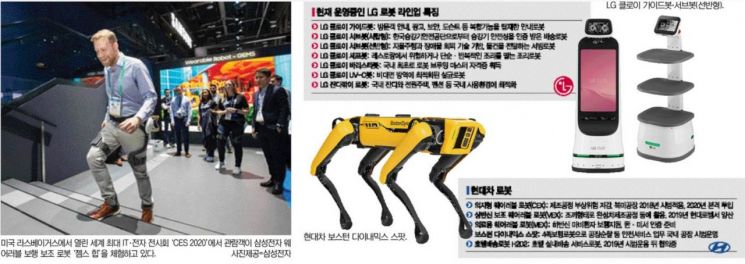
[Asia Economy Reporters Park Sun-mi, Choi Dae-yeol]Samsung, LG, Hyundai Motor Group, and other major domestic conglomerates are successively adopting robots as one of their future growth engines, making aggressive investments and advancing toward commercialization. In the hyper-connected era, integrating robots and artificial intelligence (AI) has become essential to expand customer touchpoints in the home appliance and automobile sectors, which have led the market so far. Samsung Electronics is preparing for the first commercialization of a robot product through the medical robot GEMS, while LG Electronics and Hyundai Motor Group, already in the commercialization and distribution stages of robots, have begun full-scale efforts to secure leadership by expanding robot application areas.
◆ Robot market grows double digits annually... Samsung takes on challenge with first commercialization =According to global market research firm Strategy Analytics (SA), the global service robot market has grown at an average annual rate of 13% since 2020 and is expected to surpass the industrial robot market size after 2025. The latest statistics released by the Ministry of Trade, Industry and Energy, Korea Institute for Robot Industry Advancement, and Korea Robot Industry Association show that the domestic service robot market size was about 857.7 billion KRW in 2020, a 34.9% increase from 2019.
The robot business is a field that Samsung Electronics Vice Chairman Lee Jae-yong has identified as one of the future growth engines. Last August, Lee announced plans to invest 240 trillion KRW over the next three years in future new business areas such as robots and AI. Since Lee expressed his strong intention to actively invest in new business areas, Samsung’s robot business has accelerated. The upgrade of the robot business task force (TF) to an official business team and the announcement of full-scale market entry also took place at the end of last year.
Samsung’s robot business currently focuses on health and daily life. This year, the goal is to commercialize the GEMS walking assist robot worn on the hip joint. After commercializing GEMS, Samsung Electronics plans to mass-produce ▲‘Samsung Bot Serving’ to assist with ordering and food serving in stores ▲‘Samsung Bot Guide’ for customer service ▲‘Samsung Bot Care’ for caregiving ▲and ‘Samsung Bot Handy,’ a household robot that helps with dishwashing and other tasks.
Samsung Electronics is also open to mergers and acquisitions (M&A) to expand its robot business.
◆ LG and Hyundai Motor early adopters of robots... expanding distribution stage =LG, which was the first domestic company to launch a robot vacuum cleaner in 2003 and early on made robots a pillar of its future business, already has seven robot lineups.
Starting with the pilot operation of the LG CLOi guide robot at Incheon International Airport in 2017, LG has strengthened its ‘CLOi Robot’ lineup to six types, including two types of CLOi ServeBots (drawer-type and shelf-type), CLOi BaristaBot, CLOi ChefBot, and CLOi UV-C Bot. Last month, LG released a Korean-style lawn mowing robot optimized for domestic lawns and garden environments. It plans to introduce additional commercial robot vacuum cleaners for use in offices and hotel lobbies this month and is preparing for the commercialization of integrated indoor and outdoor delivery robots.
LG Electronics’ robot investments have also reached the performance stage. Starting with the wearable robot startup SG Robotics in 2017, LG invested in AI startup ‘Acryl,’ domestic industrial robot manufacturer ‘Robotis,’ and U.S. robot developer ‘Boston Dynamics.’ In 2018, LG acquired domestic industrial robot manufacturer ‘Robostar,’ which has since turned profitable.
Hyundai Motor Group also identifies robotics as one of its five new businesses and has been conducting research and development, producing tangible results. Wearable robots have been developed since 2014 to assist those with walking difficulties. The independently developed chair-type wearable robot CEX and vest-type wearable robot VEX have undergone verification through pilot applications on-site and have been used on the automobile production line at the U.S. factory since October 2020. Hyundai is now considering expanding these for medical use, such as assisting walking for patients with lower body paralysis or for rehabilitation processes.
AI-based service robots include ‘Dali,’ which provides customer service, and ‘H2D2,’ which handles delivery services within hotels. Dali incorporates facial recognition, natural language conversation, and autonomous movement technologies. Since its debut early last year, it has been providing customer service at some locations. A Hyundai Motor official said, "Robotics technologies such as environmental recognition, situational judgment, and mechanisms are core technologies that can be applied to future mobility sectors such as autonomous vehicles, urban air mobility (UAM), and smart factories," adding, "Global automakers are also striving to seize leadership in the rapidly growing robot market."
© The Asia Business Daily(www.asiae.co.kr). All rights reserved.
![Clutching a Stolen Dior Bag, Saying "I Hate Being Poor but Real"... The Grotesque Con of a "Human Knockoff" [Slate]](https://cwcontent.asiae.co.kr/asiaresize/183/2026021902243444107_1771435474.jpg)















