Selected 6 General Universities and 7 Junior Colleges Among 43 Schools
General Universities Supported with 3 Billion KRW, Junior Colleges with 2 Billion KRW Each
Unprecedented Additional Selection Draws Criticism as a 'Bad Precedent'
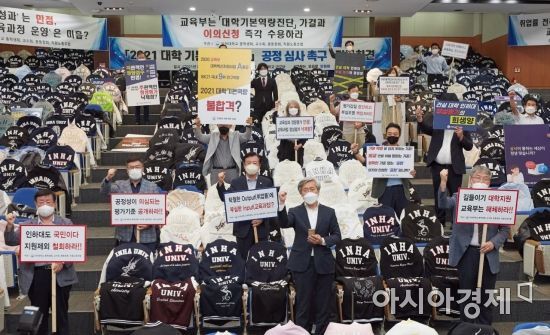
[Asia Economy Reporter Han Jinju] Sungshin Women's University, Inha University, Chugye University for the Arts, Kunsan National University, Dongyang University, Jungwon University, and seven other universities have been additionally selected as general financial support universities by the Ministry of Education.
On the 17th, the Ministry of Education announced the results of an additional selection evaluation conducted for 43 universities that wished to participate among 52 universities that were not selected as general financial support universities in the 2021 University Basic Competency Diagnosis. The applicant universities included 23 general universities and 20 vocational colleges.
The selected universities include six general universities (Sungshin Women's University, Inha University, Chugye University for the Arts, Kunsan National University, Dongyang University, Jungwon University) and seven vocational colleges (Kaywon University of Art and Design, Dong-Ah Institute of Media and Arts, Christian College of Nursing, Seongwoon University, Sekyung University, Songgok College, Hosan University). The selected general universities will receive an average of 3 billion KRW per school, and vocational colleges will receive an average of 2 billion KRW per school.
There has never been a precedent for additionally selecting universities that failed the basic competency diagnosis evaluation. The National Assembly's Education Committee secured additional budget for the Ministry of Education this year to support universities that failed the 3rd cycle basic competency diagnosis at the end of last year, increasing the number of supported universities from the originally planned 147 to 160. This has been criticized as creating a "bad precedent" that if one disputes the government's financial support project evaluation results, they can be rescued.
Among the 52 universities, nine did not participate, which is interpreted as their own judgment that it would be difficult to achieve good results in the additional selection. A Ministry of Education official stated, "The qualitative indicators assess the future three-year plan, which may have been somewhat burdensome for universities to prepare," and added, "Since department and structural reorganization are likely to accompany selection, universities that judged their chances of selection to be low probably did not participate considering the effort and difficulties involved."

The additional selection evaluation consisted of quantitative indicators (60%) and qualitative indicators (40%). Quantitative indicators were evaluated based on data submitted by universities, such as enrollment rates of new and current students, faculty securing rates, education expenditure return rates, and graduate employment rates.
Qualitative indicators comprised educational innovation directions and strategies for the next three years, liberal arts curriculum, major curriculum, and teaching and learning methods. Unlike last year's evaluation, both written and face-to-face evaluations were conducted. Sixty experts who participated in the previous evaluation took part in the selection evaluation. The Ministry of Education explained that the number of evaluators per qualitative indicator was increased from 15 to 30.
According to the basic competency diagnosis sanction criteria, differential point deductions were applied to five universities. Points were deducted after checking whether they complied with enrollment reduction and any university fraud or corruption over the past four years.
A Ministry of Education official explained, "If existing indicators were used as they were, it could create a structure that only rescues certain universities, so we divided the evaluation into 60 points for quantitative indicators and 40 points for qualitative evaluation, adjusting the score intervals so that universities must meet a certain level to be selected." He added, "We are aware of concerns about fairness in the qualitative evaluation, and since universities were given time to brief directly and respond to questions, there should be no difficulty in acceptance by the universities."
The additional selection considered regional balance, selecting 90% of the total scale by region, the same as last year's selection process. The remaining 10% were selected nationwide based on the highest total scores. Additionally, the Ministry of Education provides all universities participating in the additional selection with scores by indicator and comprehensive evaluation feedback.
The final results will be confirmed by the end of this month. Universities with objections to the additional selection results can submit appeals by the 20th.
Meanwhile, the additionally selected universities must establish and implement autonomous innovation plans, including appropriate scaling, considering school conditions, capabilities, and development strategies by July. A Ministry of Education official explained, "Considering the enrollment rate results by the end of May, it was judged reasonable for universities to submit appropriate scaling plans, so we gave a little more time, and some universities have already submitted them."
Deputy Minister of Education Jang Sang-yoon said, "We will reform the uniform government-led evaluations in the future and prepare improvement plans for the diagnosis system by the end of the year by collecting various opinions from the field to support autonomous development of universities." He added, "In line with the new government's policy direction of autonomy and innovation, we will do our best to support universities to lead innovation through continuous deregulation and expansion of financial support."
© The Asia Business Daily(www.asiae.co.kr). All rights reserved.
![Clutching a Stolen Dior Bag, Saying "I Hate Being Poor but Real"... The Grotesque Con of a "Human Knockoff" [Slate]](https://cwcontent.asiae.co.kr/asiaresize/183/2026021902243444107_1771435474.jpg)
















