Korea Research Institute for Human Settlements Report
About half of the population considers those owning three or more houses as "multi-homeowners."
According to the quarterly "Real Estate Market Survey and Analysis" report published by the Korea Research Institute for Human Settlements on the 17th, a survey conducted in January this year targeting 6,680 general households asked, "From how many houses owned should a person be considered a multi-homeowner and face higher tax burdens?" The results showed that 48.3% of respondents answered "three houses."
Those who answered "two houses" accounted for 44.2%. Responses of "four houses" and "five houses" were 3.0% each, and "six houses" accounted for 1.5%.
When the same survey was conducted among 2,338 real estate agencies, 65.3% responded with "three houses" and 20.4% with "two houses," showing a significantly higher proportion of "three houses" responses compared to general households.
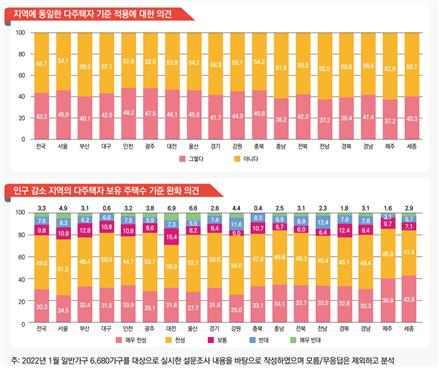
Regarding the question of whether the criteria for multi-homeowners to increase tax burdens should be applied uniformly regardless of region, 56.7% of general households answered "No," while 43.3% answered "Yes." Among real estate agencies, 66.0% answered "No," and 34.0% answered "Yes."
Among those who answered "No," when asked about easing the criteria for multi-homeowners only in rural fishing and farming areas with populations under 100,000 or declining populations, 79.3% of general households expressed support (strongly support + support). In the case of real estate agencies, support was even higher at 90.6%.
Gwon Geon-woo, a senior researcher at the Korea Research Institute for Human Settlements, said, "We planned this survey due to high interest in how to set the criteria for multi-homeowners, which serve as the basis for real estate-related tax burdens early this year." He added, "In Seoul and other metropolitan cities with many high-priced properties, responses favoring three houses were relatively higher, while in regions with many low-priced properties, responses favoring two houses were more common."
Meanwhile, the comprehensive real estate market index (K-REMAP) for the first quarter of 2021 shifted from a stable phase in the previous quarter to an upward phase.
The K-REMAP index, which combines the real estate market consumer sentiment index and pressure index, recorded 116.1 nationwide and 115.9 in the metropolitan area. The index had been declining continuously since June last year, turning stable nationwide and in the metropolitan area in November, but rose again this year, returning to an upward phase.
© The Asia Business Daily(www.asiae.co.kr). All rights reserved.
![Clutching a Stolen Dior Bag, Saying "I Hate Being Poor but Real"... The Grotesque Con of a "Human Knockoff" [Slate]](https://cwcontent.asiae.co.kr/asiaresize/183/2026021902243444107_1771435474.jpg)















