Korea Industrial Federation Forum Announces Survey on Serious Accident Punishment Act
"Companies Are Considering Reducing New Hires Instead"
[Asia Economy Reporter Yoo Hyun-seok] A survey has revealed that the Serious Accident Punishment Act yields minimal effects compared to the costs invested. Companies responded that with the increased burden of on-site safety training, urgent revision or abolition of the law is necessary.
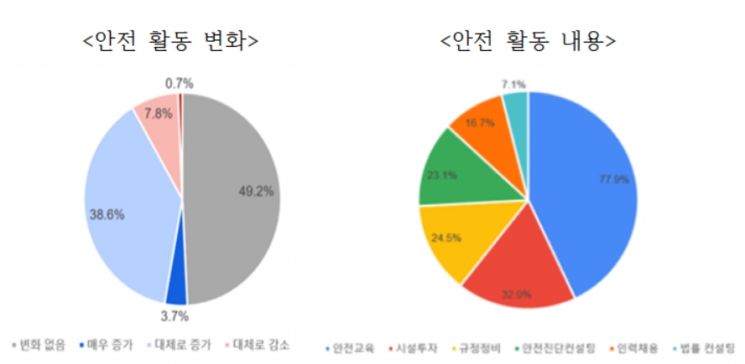
On the 17th, the Korea Industrial Alliance Forum (KIAF) conducted a survey on the impact of the Serious Accident Punishment Act on accident occurrence and corporate management. More than half of the participating companies answered that there was either no change (49.2%) or even a decrease (8.5%) in their industrial safety activities. This accounts for 57.7% (170 out of 295 companies) of the total respondents.
Companies reported strengthening safety education (77.9%) as part of their industrial safety activities. Additionally, 32% invested in safety facilities (94 companies), and 24.5% revised or established internal safety regulations (72 companies). They also received safety diagnosis consulting (23.1%, 68 companies) and legal consulting (7.1%, 21 companies).
Regarding causes of industrial accidents, 47.8% (141 companies) cited workers’ lack of safety awareness. This was followed by tight work schedules (29.8%, 88 companies), insufficient safety facilities (18%), and shortage of safety personnel (13.6%).
Notably, companies are considering reducing new hires after the enforcement of the Serious Accident Punishment Act. 35.3% (104 companies) responded that they are contemplating reducing new recruitment or mechanizing labor. Companies considering business downsizing or withdrawal accounted for 25.4% (75 companies). In manufacturing, 43.3% (55 companies)?8 percentage points higher than the overall respondents?are considering reducing new hires or mechanization.
Especially, 7 out of 10 companies (71.5%, 211 companies) believe that revision or abolition of the Serious Accident Punishment Act is necessary. The remaining 25.1% (74 companies) responded that revision or abolition should be considered after reviewing the law’s enforcement results next year.
Companies argued that the law should clearly define causality. The most common opinion (44.1%, 130 companies) was that the law should clarify the causal relationship between punishment and incident occurrence. This was followed by the need to establish exemption provisions based on intentionality or negligence (30.8%, 91 companies), and to differentiate and subdivide detailed legal regulations according to industry type and company size (24.1%, 71 companies).
Regarding measures the government should prioritize, the most frequent opinion (34.0%, 100 companies) was to concretize and clarify authority and responsibility through legal revision. This was followed by budget support for industrial safety activities (33.3%, 98 companies), safety education for workers (19.0%), and support for safety consulting (6.5%).
Experts diagnosed that the Serious Accident Punishment Act imposes a significant burden on corporate management. At the Industrial Development Forum held under the theme “Evaluation and Tasks of the Serious Accident Punishment Act 100 Days after Enforcement,” Lee Geun-woo, professor of law at Gachon University, pointed out, “The Serious Accident Punishment Act appears to have been legislated too roughly and hastily. The strong punishment provisions for management officials are difficult to defend against constitutional challenges.”
Yang Ok-seok, head of the Human Resources Policy Office at the Korea Federation of SMEs, explained, “Although the punishment level of this law is high, its obligations are broad and unclear, causing a significant management burden for small and medium enterprises. Legislative supplementation is needed to clarify employer obligations and shift focus from punishment to prevention of industrial accidents, along with active government support for safety facility investment costs.”
Jung Man-gi, chairman of KIAF, emphasized, “The Serious Accident Punishment Act has not significantly helped secure safety at corporate sites but has only caused side effects such as employment and business downsizing. The government and the National Assembly should actively consider major revisions or abolition of the law.”
© The Asia Business Daily(www.asiae.co.kr). All rights reserved.
![Clutching a Stolen Dior Bag, Saying "I Hate Being Poor but Real"... The Grotesque Con of a "Human Knockoff" [Slate]](https://cwcontent.asiae.co.kr/asiaresize/183/2026021902243444107_1771435474.jpg)















