Yejeongcheo, 'Analysis of the 2nd Supplementary Budget for 2022'
Many projects with the same total budget but delayed execution timing included in expenditure restructuring targets
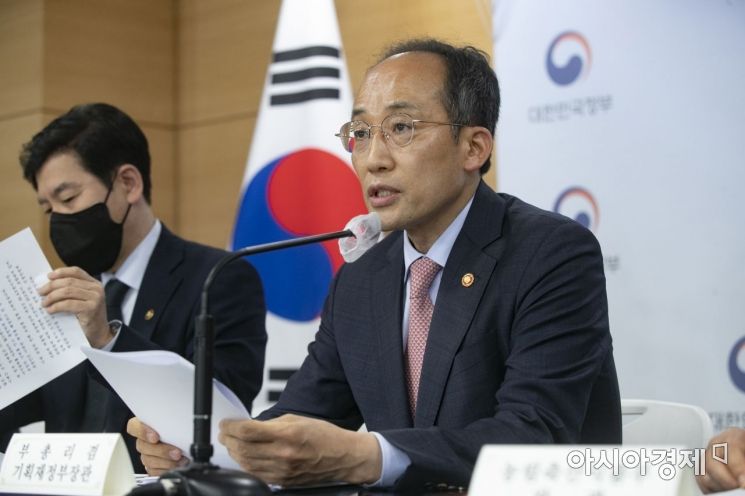 Deputy Prime Minister and Minister of Economy and Finance Choo Kyung-ho is holding a joint briefing with related ministers on the 2nd supplementary budget for 2022 at the government Seoul office briefing room on the 12th. Photo by Hyunmin Kim kimhyun81@
[Asia Economy Sejong=Reporter Kwon Haeyoung] As the government has decided to carry out a 7 trillion won expenditure restructuring to secure funds for the 59.4 trillion won supplementary budget (supplementary budget) plan, it is expected that many of the targeted projects have only postponed the execution period to next year, and the total project cost remains the same, so it will not achieve as much substantial expenditure reduction effect as expected. It is pointed out that many projects with leftover funds due to excessive budget allocation by the government are included, making it difficult to see this as a genuine expenditure restructuring.
According to the 'Analysis of the 2nd Supplementary Budget Plan for 2022' report released by the National Assembly Budget Office on the 17th, some of the Ministry of Trade, Industry and Energy's research and development (R&D) projects, such as building an industrial innovation foundation, were included in the expenditure restructuring target by reducing several months' worth of R&D contributions this year.
There are a total of 10 projects, with a reduction scale of 166.1 billion won, but the project and research periods were only delayed due to project and agreement delays, and the total project cost or research funds were not cut. The government did not reduce the budget itself through active expenditure restructuring but only postponed the budget execution timing. Accordingly, even if included in the expenditure restructuring target in this supplementary budget, it is highly likely that additional budget allocation will be required after next year, making it difficult to expect a substantial expenditure reduction effect, according to the Budget Office.
Looking at cases where this method was used to reduce project costs this year, the Ministry of Oceans and Fisheries reduced 159.6 billion won, the Ministry of Science and ICT 47.4 billion won, and the Korea Forest Service 37.5 billion won.
Projects that were likely to have leftover funds due to overestimation of financial needs during the 2022 main budget formulation process last year were also included in the expenditure restructuring target. For example, in the Ministry of National Defense's clothing project, the actual number of personnel supplied is expected to be less than the previously predicted clothing demand, resulting in leftover execution funds. Since this project was allocated more budget than necessary initially, it is difficult to consider it a genuine expenditure restructuring.
The Ministry of National Defense's cost-sharing military facility improvement project and logistics support project also underwent expenditure restructuring amounting to 119.7 billion won during the formulation of this supplementary budget due to delays in new project implementation during the gap period of the Korea-US defense cost-sharing special agreement. The Budget Office pointed out that this could have been sufficiently predicted during the 2022 main budget formulation process last year.
The Budget Office stated, "The government conducted expenditure restructuring under the principle of reducing project costs expected to have leftover execution funds or carryover amounts due to project delays and decreased financial needs," adding, "The fact that the expected scale of leftover execution funds or carryover amounts is in the trillions of won at this point, one-third into the fiscal year, indicates that the prediction of financial needs and review of execution feasibility during the main budget formulation process were insufficient."
The Budget Office also analyzed that the Ministry of Economy and Finance's forecast of 53.3 trillion won in excess tax revenue this year is excessive. According to the Budget Office's forecast, the 2022 national tax revenue will be 391.2 trillion won, and the excess tax revenue will be 47.8 trillion won, which is 5.5 trillion won less than the estimate announced by the Ministry of Economy and Finance when presenting the supplementary budget plan.
The Budget Office analyzed, "The downward risks and uncertainties in the economy are increasing due to worsening external conditions such as the Russia-Ukraine war, the resurgence of COVID-19 in China and lockdowns in major cities, and rising international interest rates," adding, "It cannot be ruled out that the increase in revenue may slow down more than expected."
© The Asia Business Daily(www.asiae.co.kr). All rights reserved.
![Clutching a Stolen Dior Bag, Saying "I Hate Being Poor but Real"... The Grotesque Con of a "Human Knockoff" [Slate]](https://cwcontent.asiae.co.kr/asiaresize/183/2026021902243444107_1771435474.jpg)















