People Power Party Policy Committee Holds Forum at Korea Federation of SMEs
Seeking SME Votes Ahead of Local Elections
Differences Expected Over Method of Introducing Linkage System
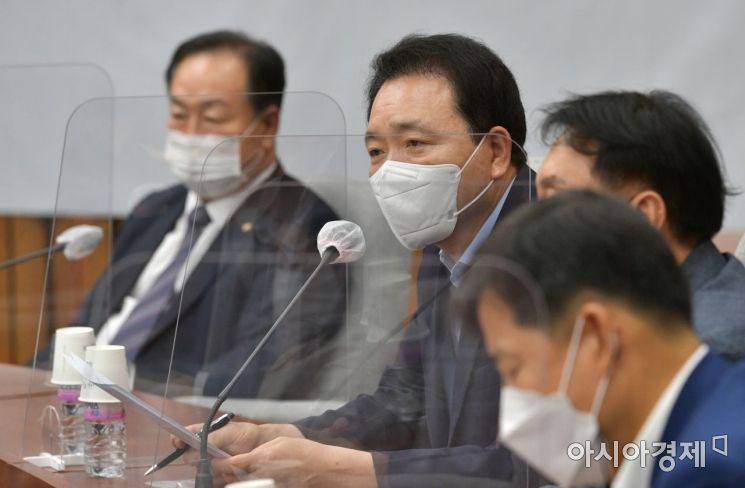 Seong Il-jong, Chairman of the Policy Committee of the People Power Party / Photo by Yoon Dong-ju doso7@
With local elections approaching, both ruling and opposition parties are united in calling for the introduction of a delivery price linkage system, aiming to win the support of small and medium-sized enterprises (SMEs). This move seeks to address the issue of rising manufacturing costs caused by the recent surge in international raw material prices being passed on to SMEs. However, since contracts between companies are private agreements, legally enforcing such a system could conflict with the new government's philosophy of upholding market economy principles, making the method of implementing the linkage system a point of keen interest.
◆Ruling and opposition parties hold successive discussions with SME industry on delivery price linkage system= On the morning of the 17th, the People Power Party's Policy Committee held a policy forum at the Korea Federation of SMEs in Yeouido, Seoul, to discuss the introduction of the delivery price linkage system. Attendees included Seong Il-jong, chairman of the Policy Committee, lawmakers Kim Jeong-jae and Han Mu-gyeong from the People Power Party, officials from the Fair Trade Commission and the Ministry of SMEs and Startups, as well as Kim Ki-moon, president of the Korea Federation of SMEs.
At the forum, Yoo Byung-jo, chairman of the Changho Curtain Wall Association, reported, "Prices of aluminum raw materials and steel pipes, which are auxiliary materials, have risen due to global supply chain instability, and have surged about twofold as of May due to the Ukraine crisis." President Kim emphasized, "The only solution to this problem is the delivery price linkage system," adding, "SMEs must receive fair prices to secure their innovation capabilities and to reduce the gap between large and small-to-medium enterprises."
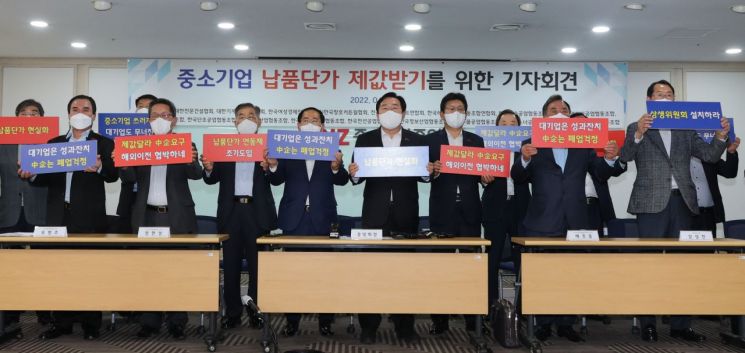
Earlier, on the 4th, the Democratic Party also held a meeting with the SME industry to discuss plans for introducing the delivery price linkage system. About ten members of the Democratic Party's floor leadership, including floor leader Park Hong-geun, attended. The delivery price linkage system was also a campaign promise made by candidates from both major parties in the presidential election. At that time, when the Presidential Transition Committee proposed providing incentives to companies that reflected raw material prices in their delivery prices, the Democratic Party criticized it as a 'breach of promise.'
With local elections scheduled for the 1st of next month, both ruling and opposition parties are reigniting the issue of introducing the delivery price linkage system to win SME votes. Lawmakers Kim Gyeong-man from the Democratic Party and Kim Jeong-jae and Han Mu-gyeong from the People Power Party have already jointly proposed legislation to introduce the delivery price linkage system.
◆Two approaches to the linkage system: corporate incentives vs. legal mandate= Minister Lee Young of the Ministry of SMEs and Startups also expressed his commitment to introducing the delivery price linkage system. During his confirmation hearing on the 11th, Minister Lee mentioned a method that would include a clause in contracts between primary and subcontracting companies requiring the linkage of delivery prices. This means that the contracting parties would agree in advance to adjust delivery payments according to fluctuations in raw material prices, and this agreement would be included in the contract.
In this regard, Kim Eun-ha, a research fellow at the KBIZ Small and Medium Business Research Institute, proposed two approaches to introducing the delivery price linkage system through revisions to the standard contract form. One is an incentive-based approach that provides administrative and financial support to companies adopting the linkage system, and the other is a legislative approach that mandates the inclusion of the linkage system in contracts.
Researcher Kim stated, "South Korea's market structure is unfair, with large corporations and conglomerates exercising excessive market dominance," adding, "Addressing unfair economic order and the gap between large and small-to-medium enterprises is a crucial task for sustainable economic growth." She also explained that in the U.S. and Europe, adjusting delivery prices through contracts between parties is common practice, often including clauses to renegotiate when raw material price fluctuations exceed ±10%.
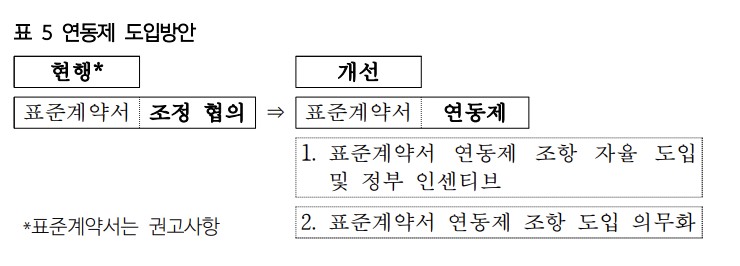 Proposal for the introduction of a delivery price linkage system suggested by Eunha Kim, Research Fellow at KBIZ Small and Medium Business Research Institute.
Until now, the delivery price linkage system has repeatedly failed to be introduced due to concerns over infringement on contractual freedom between companies, excessive government intervention in the market, and fears of consumer price increases. If introduced, challenges remain in designing the system, such as determining which industries it will apply to, setting linkage conditions, and deciding how to distribute the burden of raw material price increases among large corporations, SMEs, and consumers.
The SME sector insists that the government must take the lead, but given the new government's principle of emphasizing market autonomy, attention is focused on how discussions about the introduction of the linkage system will proceed. Professor Song Chang-seok of Soongsil University said, "A combined approach of delivery price adjustment consultation and the linkage system is necessary," adding, "The key is to enable companies to have equal bargaining power so that swift resolutions are possible."
© The Asia Business Daily(www.asiae.co.kr). All rights reserved.
![Clutching a Stolen Dior Bag, Saying "I Hate Being Poor but Real"... The Grotesque Con of a "Human Knockoff" [Slate]](https://cwcontent.asiae.co.kr/asiaresize/183/2026021902243444107_1771435474.jpg)

















