Yoon Emphasizes 'Livelihood Stability,' 'Communication with the Public,' and 'Strengthening Cooperation with North Korea' in First Week
Different Approach from Moon's First Week Highlighting 'Job Creation' and 'National Unity'
Attention on Whether 'Cooperation' Will Lead to Prime Minister Approval and Supplementary Budget Passage
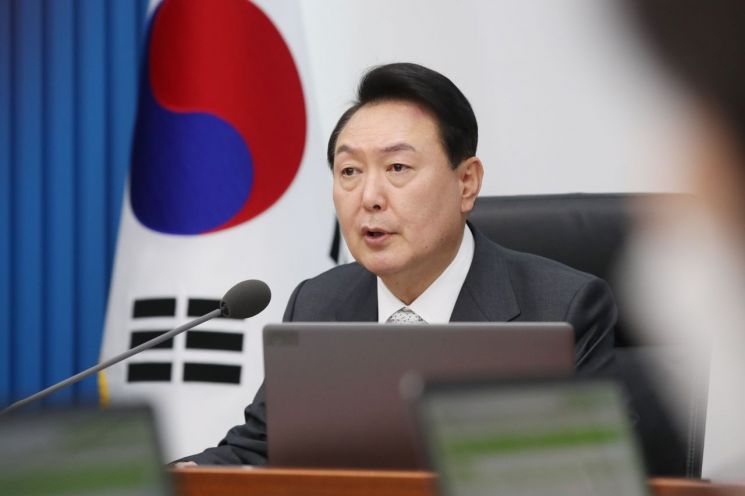 President Yoon Suk-yeol is presiding over the first extraordinary Cabinet meeting for the supplementary budget formulation at the Yongsan Presidential Office building in Seoul on the 12th./Presidential Office Communication Photo Journalists Group [Image source=Yonhap News]
[Asia Economy Intern Reporter Yoonjin Kim] In his first week in office, President Yoon Suk-yeol focused on the economy, communication, and security. Unlike former President Moon Jae-in, who emphasized job creation and cooperation, the government's response centered on overcoming the economic crisis and communicating with the public. This has been evaluated as reflecting the new administration's policy direction, which emphasizes "responding to global economic and security crises."
On the 10th, President Yoon chaired his first Cabinet meeting since taking office and met with diplomatic envoys, focusing on ▲ responding to the economic crisis ▲ free communication ▲ strengthening cooperation on North Korea. While addressing the global economic crisis, he also reviewed ways to fulfill his pledge of "full compensation for losses."
On the second day of his inauguration, the 12th, an extraordinary Cabinet meeting approved a supplementary budget of 59 trillion won for loss compensation for small business owners, and on the 13th, he personally chaired the first on-site meeting, the Macroeconomic and Financial Situation Review Meeting. At this meeting, President Yoon emphasized the importance of "stably managing inflation expectations" to stabilize prices and called for proactive policy responses.
In contrast, former President Moon focused on his core pledge of "creating 810,000 public sector jobs" immediately after his inauguration in 2017. On his first day in office, he issued the first work directive to establish the Presidential Committee on Jobs, a presidential advisory body. On the third day, his first external schedule was a visit to Incheon International Airport, where he reaffirmed his pledge to "open an era of zero irregular workers in the public sector" during his term.
Both presidents emphasized "communication" in their first week. President Yoon, since his time as president-elect, strongly promoted the "relocation of the presidential office to Yongsan" and "opening the Blue House to the public," highlighting enhanced communication. A press room was set up on the first floor of the Yongsan-gu government building in Seoul, where the presidential office is located, and he occasionally engaged in brief Q&A sessions with reporters during his commute. Former President Moon also emphasized anti-authoritarianism and communication, pledging during his candidacy to relocate the presidential office and inaugurate the "Gwanghwamun era." However, this was not realized due to security and other issues.
Meanwhile, some argue that since the Yoon administration was launched in a situation where the ruling party holds fewer seats than the opposition, it should focus more on cooperation with opposition parties. On his first day in office, former President Moon visited the leadership of the four ruling and opposition parties, including the main opposition Liberty Korea Party, to show his commitment to national unity. In contrast, the current ruling People Power Party and the main opposition Democratic Party continue a confrontational stance ahead of the confirmation of first-term cabinet nominees and the June 1 local elections. Although President Yoon emphasized "bipartisan cooperation" in his policy speech to the National Assembly on the 16th, it is expected that the gap between the ruling and opposition parties will not easily narrow.
Both President Yoon and former President Moon faced North Korea's missile provocations during their first week in office. Four days after his inauguration, former President Moon convened the National Security Council (NSC) after North Korea launched a ballistic missile, strongly condemning it as "a serious challenge to international peace and security."
Similarly, on the 12th, after confirming North Korea's ballistic missile launch, the Yoon administration held a security situation review meeting chaired by National Security Office Director Kim Sung-han, announcing plans to strengthen international cooperation on North Korea, including the South Korea-U.S. alliance. Although opposition parties criticized President Yoon for not attending the meeting, the presidential office stated that "it is inefficient to convene the NSC every time North Korea provokes."
Entering the second week of his term, major issues that will determine the new government's policy direction, such as the confirmation of Prime Minister nominee Han Duck-soo and the passage of the supplementary budget, have yet to be resolved. In his policy speech to the National Assembly on the 16th, President Yoon urged, "True liberal democracy is parliamentary democracy," and requested "the National Assembly's deep interest and cooperation on the supplementary budget and other pending issues."
© The Asia Business Daily(www.asiae.co.kr). All rights reserved.
![Clutching a Stolen Dior Bag, Saying "I Hate Being Poor but Real"... The Grotesque Con of a "Human Knockoff" [Slate]](https://cwcontent.asiae.co.kr/asiaresize/183/2026021902243444107_1771435474.jpg)
















