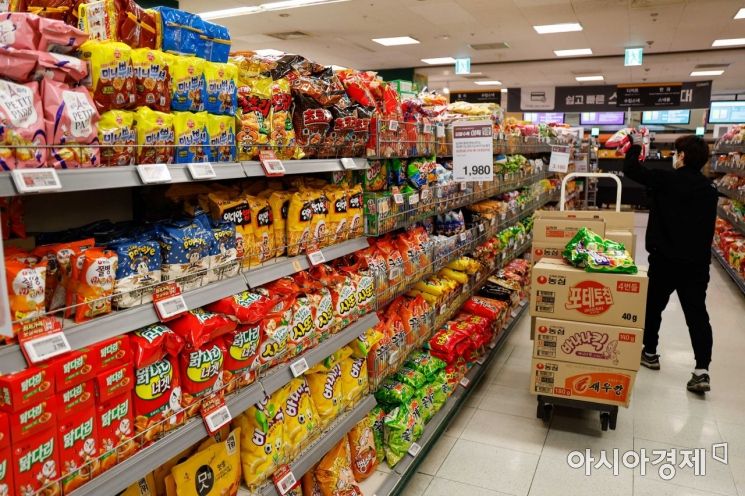
 On the 16th, as the Indian government immediately banned wheat exports to secure its food security, leading to a visible increase in domestic snack and bread prices, snacks are displayed at a large supermarket in Seoul. Photo by Jinhyung Kang aymsdream@
[Asia Economy Reporter Kwon Jae-hee] As India has imposed a wheat export ban, concerns are rising that 'agflation'?the phenomenon of rising prices due to soaring agricultural product costs?will intensify further, drawing attention to whether feed and food stocks using wheat as a raw material will rise again. This is especially due to the prolonged Russia-Ukraine conflict, which has already caused wheat prices to surge significantly, along with forecasts that global wheat production will decrease this year.
According to the Korea Exchange as of 9:34 a.m. on the 16th, Hanil Feed, considered a representative wheat-related stock, is trading at 8,290 KRW, up 8.51% from the previous trading day. At the same time, Sajo Dong-A One is up 16.71% at 2,025 KRW, and Farm Story is up 8.88% at 3,925 KRW. Shinsong Holdings and Hyundai Feed are trading at 10,250 KRW and 134,500 KRW, up 8.70% and 3.94%, respectively.
The simultaneous rise in wheat-related stocks is due to India, the world's second-largest wheat producer, abruptly halting wheat exports citing food security concerns. Previously, the prolonged Russia-Ukraine conflict, responsible for 25% of global wheat exports, had already restricted wheat exports, causing a ripple effect. Additionally, major wheat exporters such as the United States and France are expected to see a sharp decline in wheat harvests due to drought.
The rise in wheat prices is likely to expand beyond feed stocks to food stocks as well. This is because raw materials account for about 30% on average of processed foods such as ramen and snacks. Food companies are likely to pass these costs on to consumer prices. As a result, companies like SPC Samlip, Nongshim, CJ CheilJedang, Hite Jinro, and Samyang Foods are also attracting attention. SPC Samlip is trading at 83,500 KRW, up 2.58% from the previous trading day, and CJ CheilJedang is trading at 408,000 KRW, up 0.99%.
Kim So-hyun, a researcher at Daishin Securities, analyzed, "It is difficult to expect a stabilization of food prices, especially grain prices, in the near term. This is at a higher level than during the 2008 food crisis and the early stages of the 2020 COVID-19 pandemic."
© The Asia Business Daily(www.asiae.co.kr). All rights reserved.
![Clutching a Stolen Dior Bag, Saying "I Hate Being Poor but Real"... The Grotesque Con of a "Human Knockoff" [Slate]](https://cwcontent.asiae.co.kr/asiaresize/183/2026021902243444107_1771435474.jpg)
















