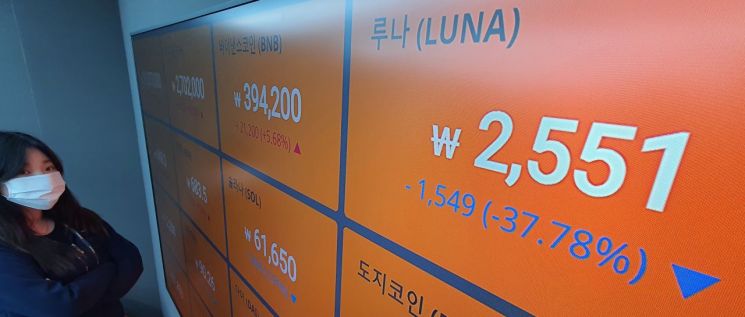
[Asia Economy Reporter Lee Jung-yoon] The price of Luna, which experienced a crash, has fallen by 99.99% compared to early this month, dropping to 0.29 KRW.
According to the global cryptocurrency market tracking site CoinMarketCap as of 7:05 AM on the 16th, Luna's price was trading at $0.0002291 (approximately 0.29 KRW), down 53.46% from the previous day. Compared to the $78.73 (about 101,089 KRW) recorded earlier this month, this represents a 99.99% decrease. The 24-hour trading volume also dropped by 48.13% to $420,355,434 (approximately 539.799 billion KRW).
Recently, as the value of TerraUSD (UST) declined, the price of its sister coin Luna began to plummet. UST is a stablecoin designed to peg its value at $1 per coin. Most of the assets backing UST's value are Luna, but as UST's price fell below $1, Luna's price also plunged, creating a vicious cycle of declines for both UST and Luna. Currently, UST is trading at $0.177 (approximately 227.27 KRW). Despite the price crash, short-term trading aimed at profiting from Luna is reportedly continuing until just before delisting.
Domestic cryptocurrency exchanges have decided to delist Luna following the crash. Bithumb will end trading support for Luna from 3 PM on the 27th. Additionally, Bithumb announced that it will terminate staking services for Luna starting from the 20th. Staking refers to the process of delegating held cryptocurrencies to a blockchain network to participate in its operation and verification, receiving cryptocurrency rewards in return.
The first to decide on delisting Luna was Gopax, which announced that trading and deposits for Luna and TerraKRT will end at 3 PM on the 16th. TerraKRT is a stablecoin pegged to the Korean won.
Upbit also announced its delisting policy for Luna through a notice. Luna was listed on Upbit’s BTC market, where cryptocurrency trading is possible with Bitcoin, but trading support will end from 12 PM on the 20th.
Upbit stated, "Since Luna was designated as a watchlist item, there has been a continuous rapid increase in circulating supply and price volatility. The UST peg is not functioning properly, and there has been no meaningful progress in the project’s business operations, including efforts to restore the UST peg."
© The Asia Business Daily(www.asiae.co.kr). All rights reserved.











![The Special Connection Between the Statue of Martyr Lee Jun in Jangchungdan Park and Mayor Oh Sehoon ③ [Current Affairs Show]](https://cwcontent.asiae.co.kr/asiaresize/319/2026012110001599450_1768957215.jpg)
