[Asia Economy Reporter Seongpil Cho] The government has decided to provide higher fuel subsidies to business operators who make a living with diesel vehicles such as trucks and taxis.
According to the Ministry of Economy and Finance and the Ministry of Land, Infrastructure and Transport on the 15th, the government is considering announcing measures to ease the burden of diesel fuel costs for transport operators such as truck drivers as part of its response to the livelihood economy as early as later this week. The government plans to reform the temporary diesel fuel price fluctuation subsidy system, which operates until July, ultimately increasing the amount of subsidies paid. Simply put, this means giving more subsidies to transport operators like truck drivers when they purchase diesel to reduce their burden.
Currently, transport operators such as trucks, buses, taxis, and coastal cargo ships receive fuel tax-linked subsidies that cover part or all of the increase in fuel tax following the 2001 energy tax reform. However, as the government lowered fuel taxes amid soaring oil prices, the subsidies also decreased. Since the fuel tax-linked subsidies are designed to offset the fuel tax increase from 2001, when the fuel tax is reduced, the subsidies also decrease accordingly.
If the fuel tax is cut by 20%, the subsidy decreases by 106 KRW per liter, and if the reduction is expanded to 30%, the subsidy decreases by 159 KRW per liter. Although subsidies are immediately cut following the fuel tax reduction, the actual fuel prices consumers face at gas stations do not fully reflect the extent of the tax cut, and it takes time for consumers to feel the impact. Additionally, with diesel prices rising more steeply than gasoline prices, those receiving fuel tax-linked subsidies complain that their fuel cost burden has increased after the fuel tax cut.
To address this issue, the government is temporarily operating a diesel fuel price-linked subsidy for truck drivers, who are the existing recipients of fuel subsidies, from May to July when the 30% fuel tax cut is applied. This subsidy compensates for part of the reduction in fuel tax-linked subsidies caused by the fuel tax cut.
Currently, the diesel fuel price-linked subsidy covers 50% of the amount exceeding the reference price when diesel prices rise above 1,850 KRW per liter, but many argue that this is insufficient. Truck operators demand that the fuel tax-linked subsidies be paid at the level before the fuel tax cut or at the 20% reduction level.
The government has decided to respond to these demands by providing additional diesel fuel price-linked subsidies. Deputy Prime Minister and Minister of Economy and Finance Choo Kyung-ho stated at an economic ministers' meeting held at the Government Seoul Office that day, "To ease the burden on the transportation and logistics industry, we have decided to lower the subsidy reference price (1,850 KRW per liter) for the diesel fuel price-linked subsidy." Lowering the reference price increases the amount of subsidy paid. For example, if the diesel price is 1,950 KRW per liter and the reference price is 1,850 KRW, 50% of the excess, or 50 KRW per liter, is paid; if the reference price is lowered to 1,750 KRW, then 100 KRW per liter is paid.
However, Deputy Prime Minister Choo added, "We will promptly conclude inter-agency consultations on the specific details of the reduction plan, including the exact reference price."
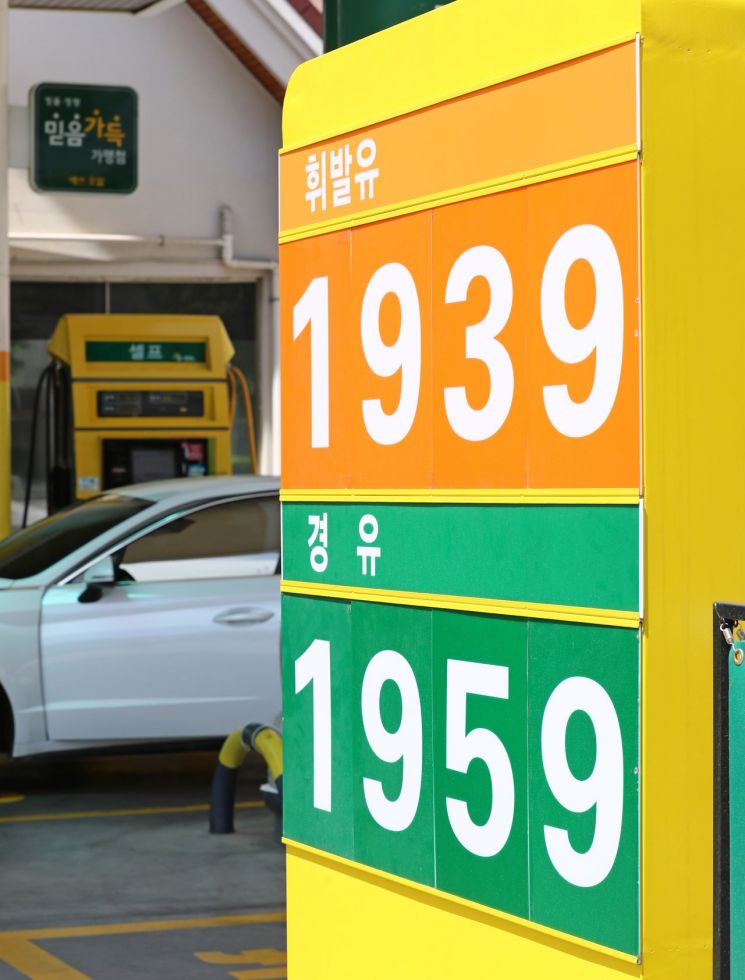
As of the morning of the 12th, the average diesel retail price nationwide recorded 1,950.8 KRW per liter. This is the highest price ever recorded, surpassing the previous record of 1,947.75 KRW per liter on July 16, 2008. The global shortage of diesel inventories, centered in Europe, combined with supply difficulties triggered by the Russia-Ukraine conflict, is influencing the market, and the prevailing forecast is that diesel prices will continue to rise for the time being.
© The Asia Business Daily(www.asiae.co.kr). All rights reserved.
![Clutching a Stolen Dior Bag, Saying "I Hate Being Poor but Real"... The Grotesque Con of a "Human Knockoff" [Slate]](https://cwcontent.asiae.co.kr/asiaresize/183/2026021902243444107_1771435474.jpg)















