UN World Meteorological Organization "48% Probability of Global Temperature Rising Over 1.5°C Above Pre-Industrial Levels Within 5 Years"
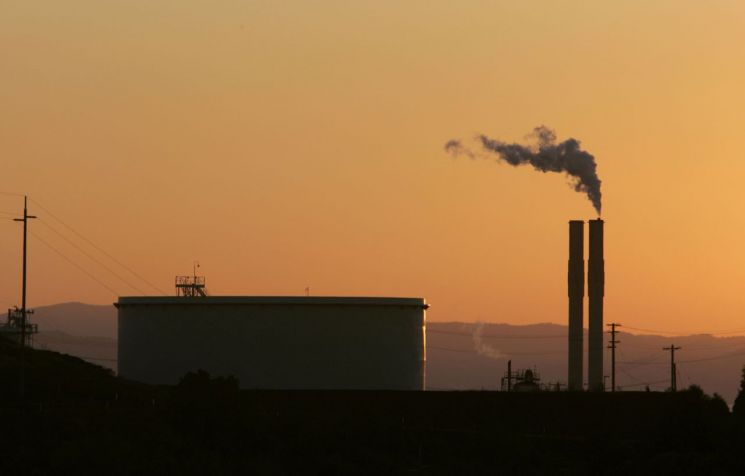
[Asia Economy Reporter Park Byung-hee] Recently, concerns have arisen that the goals of the Paris Climate Agreement, agreed upon by 197 countries worldwide in 2015, may soon be broken as carbon dioxide emissions have surpassed an all-time high.
According to the Scripps Institution of Oceanography (SIO) in San Diego, California, USA, the carbon dioxide emissions measured recently at the Mauna Loa volcano in Hawaii were recorded at 421.37 ppm, exceeding the previous all-time high of 418.95 ppm recorded in May last year.
Mauna Loa is the site where the longest record of carbon dioxide emissions has been collected. American chemist Charles Keeling began investigating carbon dioxide emissions there in 1958.
The scientific community explains that to maintain a healthy state of the Earth, carbon dioxide emissions must be kept below 350 ppm.
Analysis by the National Oceanic and Atmospheric Administration (NOAA) also shows that recent carbon dioxide emissions are at record highs. Peter Tans, a senior researcher at NOAA, said, "Carbon dioxide emissions reached an all-time high in April and are expected to be even higher in May," adding, "This is very concerning." He also stated, "Not only are carbon dioxide emissions very high, but the rate of increase in emissions is accelerating."
Last year, as the global economy began to recover from the COVID-19 pandemic, carbon dioxide emissions reached an all-time high. Recently, there are projections that greenhouse gas emissions, including carbon dioxide, may temporarily increase due to the impact of the Ukraine war. This is because the United States and Europe have decided to reduce their dependence on Russian oil and gas, potentially increasing fossil fuel investments in other regions.
In fact, the U.S. government resumed bidding for oil and gas development on public lands last month. Since President Joe Biden, who has set environmental friendliness as a policy goal, took office, public land bidding had been suspended. Qatar, the world's largest liquefied natural gas (LNG) exporter, is considering expanding six LNG plant construction projects, which began last year with an investment of $30 billion (approximately 37 trillion won).
As carbon dioxide emissions increase, there is analysis that the Paris Climate Agreement is also facing a crisis. The United Nations World Meteorological Organization (WMO) and the UK Met Office reported on the 10th that there is a 48% probability that the Earth's temperature will rise more than 1.5 degrees Celsius above pre-industrial levels within the next five years. According to the WMO and the UK Met Office, seven years ago, the probability of exceeding 1.5 degrees within five years was close to 0%, but it has steadily increased.
At the time of the Paris Climate Agreement, the world agreed to strive to keep the Earth's temperature from rising more than 2 degrees Celsius above pre-industrial levels, while aiming to limit it to within 1.5 degrees if possible.
Currently, the Earth's temperature is 1.1 degrees Celsius higher than pre-industrial levels.
© The Asia Business Daily(www.asiae.co.kr). All rights reserved.
![Clutching a Stolen Dior Bag, Saying "I Hate Being Poor but Real"... The Grotesque Con of a "Human Knockoff" [Slate]](https://cwcontent.asiae.co.kr/asiaresize/183/2026021902243444107_1771435474.jpg)
















