[Asia Economy Reporter Yoo In-ho] As North Korea shifts to a national emergency system in response to the spread of the COVID-19 crisis, changes in inter-Korean relations are anticipated.
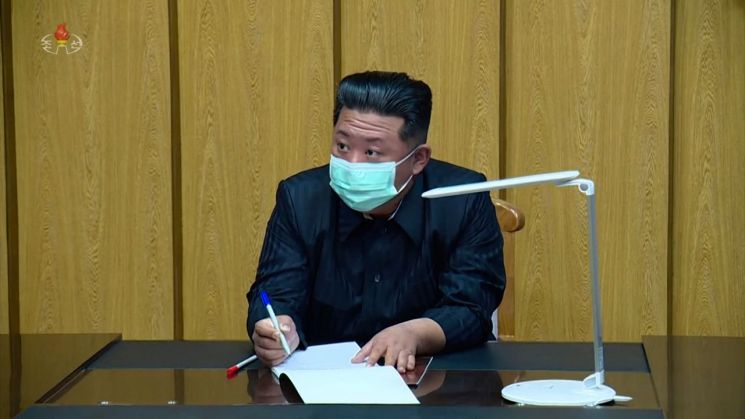
North Korea experts have mixed predictions, with some expecting Kim Jong-un, General Secretary of the Workers' Party, to halt military provocations to focus on COVID-19 prevention, while others anticipate continued military provocations as demonstrations.
According to a report by the Korean Central News Agency (KCNA) on the 14th, as the nationwide spread of COVID-19 accelerates in North Korea, nearly 300,000 new fever cases were reported on the 14th. The death toll also rose by 15, reaching 42 so far.
The North Korean National Emergency Anti-epidemic Command announced through KCNA on the 15th that from the evening of the 13th until 6 p.m. on the 14th, approximately 296,180 new fever patients appeared nationwide, with 15 deaths reported.
Considering that North Korea previously reported about 18,000 new fever patients on the 12th and approximately 174,400 new fever patients on the 13th, the spread is steeply increasing.
KCNA stated, “Since the onset of the current epidemic crisis, many deaths have resulted from careless use of medication due to a lack of public awareness and understanding of the stealth Omicron variant infection and insufficient knowledge of treatment methods.”
At a Politburo meeting related to COVID-19, General Secretary Kim emphasized, “The spread of this malignant infectious disease can be called the greatest upheaval since the founding of the nation,” and stated, “The current situation is not an uncontrollable spread between regions but a transmission within locked-down areas and respective units,” urging confidence that the malignant infectious disease can be overcome in the shortest possible time.
This is interpreted as a stance that North Korea can respond to COVID-19 independently rather than receiving external assistance. Accordingly, it seems unlikely that North Korea will immediately accept the COVID-19 prevention cooperation proposed by President Yoon Suk-yeol.
Since upgrading the national epidemic prevention system to the “maximum emergency epidemic prevention system” at the Party Politburo meeting on the 12th, General Secretary Kim has been continuously engaged in epidemic prevention-related schedules. This is seen as an effort by the supreme leader to directly oversee epidemic control and prevent public unrest.
Domestically, experts both in South Korea and abroad have divergent views on whether North Korea will proceed with the 7th nuclear test despite the worsening COVID-19 situation. Some believe the nuclear test will be postponed due to the epidemic crisis, while others argue it will proceed regardless.
Hong Min, head of the North Korea Research Division at the Korea Institute for National Unification, analyzed in a COVID-19 spread situation report on the 14th that “If North Korea carries out a nuclear test while defining the current phase as an epidemic crisis, it would be difficult to persuade its people.”
He added, “Nuclear tests have distinctly different domestic and international impacts and are events that require public display to showcase nuclear capabilities,” suggesting the possibility of schedule adjustments.
Professor Yang Moo-jin of the University of North Korean Studies also noted, “North Korea has announced a Party plenary meeting in early June to decide on important national policies,” and judged that a nuclear test would likely not occur before then.
On the other hand, Olli Heinonen, former Deputy Director General of the International Atomic Energy Agency (IAEA) and a senior fellow at the U.S. Stimson Center, told Voice of America (VOA), “I do not think North Korea’s political system links nuclear tests to the COVID-19 situation,” and stated, “If necessary, North Korea could conduct nuclear tests regardless of COVID-19, using all means available.”
Meanwhile, the South Korean government plans to officially propose COVID-19 prevention and patient treatment support to North Korea early this week, drawing attention to whether the North will respond positively.
A senior government official stated on the 15th, “We are actively considering officially proposing support to North Korea as early as this week.”
After consultations among related ministries, the Ministry of Unification is expected to send a traditional message to North Korea via the inter-Korean liaison office communication line, expressing willingness to provide epidemic prevention support and suggesting working-level talks.
The government assesses the COVID-19 situation in North Korea to be more severe than the official statistics indicate and is believed to be taking an active humanitarian stance toward providing support.
Additionally, Foreign Minister Park Jin and U.S. Secretary of State Antony Blinken expressed concern over the COVID-19 outbreak in North Korea during a phone call on the 13th and agreed to discuss humanitarian aid measures with the international community.
However, if North Korea responds positively to South Korea’s offer, working-level or high-level inter-Korean contacts are expected. Still, given the current internal atmosphere in North Korea, it is widely believed that a positive response is unlikely.
Since General Secretary Kim expressed confidence that “the current situation is not an uncontrollable spread between regions,” it appears difficult to expect an immediate affirmative reply.
© The Asia Business Daily(www.asiae.co.kr). All rights reserved.
![Clutching a Stolen Dior Bag, Saying "I Hate Being Poor but Real"... The Grotesque Con of a "Human Knockoff" [Slate]](https://cwcontent.asiae.co.kr/asiaresize/183/2026021902243444107_1771435474.jpg)















