Tax Revenue Forecast Changes by Tens of Trillions Amid Intentional Incompetence Controversy
Expected to Collect 53 Trillion Won More Than Last Year's Budget Proposal
Measures Discussed Including State Audit and Budget Review System Improvement
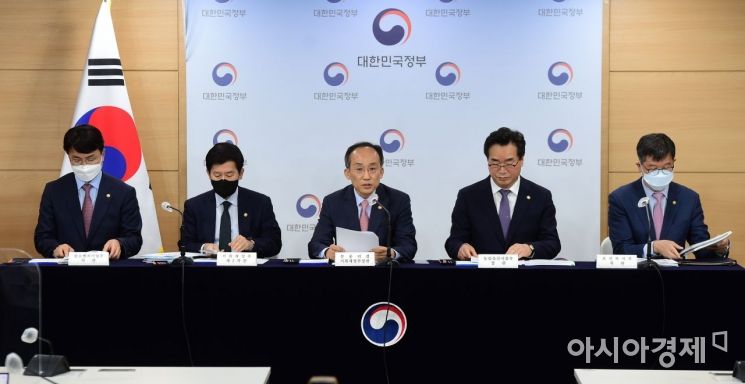 Deputy Prime Minister and Minister of Economy and Finance Choo Kyung-ho is holding a joint briefing with related ministers on the '2022 2nd Supplementary Budget' at the Government Seoul Office in Jongno-gu, Seoul on the 12th. From the left, Cho Joo-hyun, Vice Minister of the Ministry of SMEs and Startups; Choi Sang-dae, 2nd Vice Minister of the Ministry of Economy and Finance; Deputy Prime Minister Choo Kyung-ho; Jeong Hwang-geun, Minister of Agriculture, Food and Rural Affairs; and Cho Kyu-hong, 1st Vice Minister of the Ministry of Health and Welfare. Photo by Kim Hyun-min kimhyun81@
[Asia Economy Reporter Naju-seok] After the launch of the Yoon Suk-yeol administration, it surprised many by announcing that it might not incur a single penny of ‘debt’ while pushing for a large-scale supplementary budget. It even stated that it would not issue deficit bonds but rather use 9 trillion won to repay national bonds. The secret lies in ‘excess tax revenue.’
‘Excess tax revenue’ means that more taxes are collected than initially expected when the budget was formulated this year. The Ministry of Economy and Finance announced that this year’s excess tax revenue would reach 53.3 trillion won, of which 44.3 trillion won would be used as supplementary budget funds. For President Yoon Suk-yeol, who had pointed out government debt management issues while proposing various pledges during the last presidential election, this news is like a ‘timely rain.’ Since more taxes will be collected, it allows the government to keep its pledges while managing debt effectively.
Immediately, the Democratic Party of Korea showed a flushed reaction to the news of excess tax revenue. Park Hong-geun, the floor leader of the Democratic Party, said, "The Ministry of Economy and Finance’s estimation errors have gone too far," and argued, "We need to investigate whether the Ministry intentionally underestimated or if the financial authorities are incompetent." The Democratic Party is even mentioning a parliamentary audit to address this issue. Yong Hye-in, a member of the Basic Income Party, criticized the Ministry of Economy and Finance’s “financial coup” regarding former Deputy Prime Minister for Economy Hong Nam-ki’s opposition to the supplementary budget of 50 trillion won earlier this year, saying, "Deputy Prime Minister Hong should have said that a supplementary budget of 50 trillion won was fully possible and feasible."
During the COVID-19 crisis, the previous government faced the task of increasing government spending to defend the economy and support victims of the pandemic. What repeatedly hindered this was the financial authorities, including the Ministry of Economy and Finance, who were concerned about excessive government spending expansion. Despite the close cooperation between the ruling party and the government, there were numerous conflicts and clashes. What left the Democratic Party disheartened was the excess tax revenue. They had claimed there was no money, only to later reveal that more taxes were collected and that there was money after all.
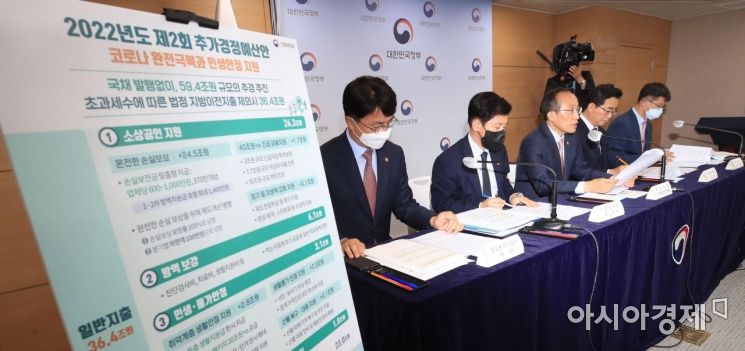 Deputy Prime Minister and Minister of Economy and Finance Choo Kyung-ho is giving a joint briefing with related ministers on the 2nd supplementary budget for 2022 at the government Seoul office briefing room on the 12th. From the left, Cho Joo-hyun, Vice Minister of the Ministry of SMEs and Startups; Choi Sang-dae, 2nd Vice Minister of the Ministry of Economy and Finance; Deputy Prime Minister Choo Kyung-ho; Jeong Hwang-geun, Minister of the Ministry of Agriculture, Food and Rural Affairs; and Cho Kyu-hong, 1st Vice Minister of the Ministry of Health and Welfare. Photo by Kim Hyun-min kimhyun81@
Regarding this issue, fiscal experts are raising questions about the Ministry of Economy and Finance. While last year’s economic situation could be explained by uncertainty, this year’s excess tax revenue was predictable.
The National Fiscal Research Institute recently pointed out in a report, "This year’s excess tax revenue could have been sufficiently reflected in the original budget, considering last year’s high nominal growth rate and this year’s forecasted high nominal growth rate." What is particularly noteworthy is that the Ministry of Economy and Finance’s original budget for national tax revenue this year was set at 343.4 trillion won, while last year’s final settlement showed national tax revenue of 344.1 trillion won. The National Fiscal Research Institute stated, "Given that the nominal growth rate exceeded 6% last year and this year, the original budget’s forecast that this year’s national tax revenue would be less than last year’s final settlement was bound to be wrong."
The large-scale excess tax revenue issue is a serious problem, whether it stems from incompetence based on inability or deliberate incompetence. This is because the government, feeling the need for expansionary fiscal policy, was presented with an underestimated tax revenue forecast, forcing it to choose whether to bear the political burden of issuing ‘deficit bonds.’ The government becomes cautious in managing finances due to concerns about issuing deficit bonds and ends up not using the collected taxes properly.
The Ministry of Economy and Finance’s tax revenue estimation problem has already surfaced last year, leading to an audit by the Board of Audit and Inspection, yet the same situation is repeating, which is also problematic.
Due to these issues, experts argue that national tax collection data and forecasting simulation methods should be disclosed. Earlier, the National Fiscal Research Institute announced the scale of excess tax revenue ahead of the government based on the limited national tax revenue collection data disclosed by the government. In response, the Ministry of Economy and Finance switched the previously disclosed national tax revenue collection data to non-disclosure, further shrouding the excess tax revenue in secrecy.
Within the Democratic Party, voices are emerging that improvements are needed in budget review and examination processes. There are also calls for parliamentary audits targeting the financial authorities.
© The Asia Business Daily(www.asiae.co.kr). All rights reserved.
![Clutching a Stolen Dior Bag, Saying "I Hate Being Poor but Real"... The Grotesque Con of a "Human Knockoff" [Slate]](https://cwcontent.asiae.co.kr/asiaresize/183/2026021902243444107_1771435474.jpg)
















