Dollar Index Hits Highest in 19 Years 5 Months
If US Fed Continues Big Step Moves
Possibility High for Breaking 1300 Won Level
Authorities' Intervention Intensity and Speed Are Variables
Market Focuses on Stabilization Measures
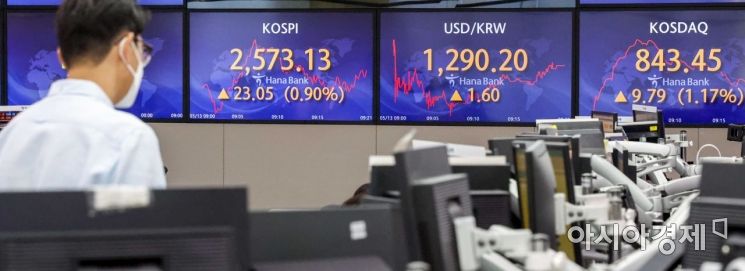 On the 13th, KOSPI opened at 2,570.01, up 19.93 points (0.78%) from the previous trading day, as dealers were working in the dealing room at the Hana Bank headquarters in Jung-gu, Seoul. On the same day, the won-dollar exchange rate started trading at 1,290.8 won, up 2.2 won from the previous trading day. Photo by Kang Jin-hyung aymsdream@
[Asia Economy Reporter Seo So-jeong] As the won-dollar exchange rate approaches the 1,300-won level, a sense of crisis is intensifying in the South Korean economy. The strong dollar phenomenon continues due to the U.S. Federal Reserve's (Fed) aggressive tightening and the prolonged Ukraine crisis, causing the won's value to plummet sharply and casting a shadow over South Korea's highly external-dependent economy. Experts suggest that the exchange rate could break through 1,300 won as early as May, focusing attention on the intensity of intervention by foreign exchange authorities.
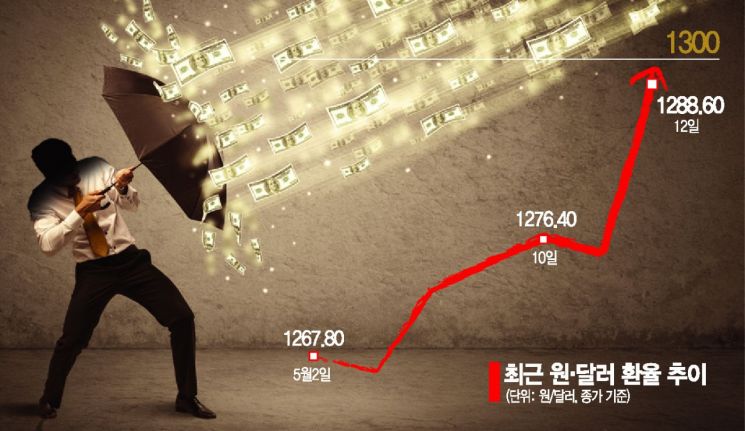
According to the Seoul foreign exchange market on the 13th, the won-dollar exchange rate surged to 1,291 won immediately after opening, then reversed to a downward trend and closed at 1,284.2 won. The exchange rate, which closed at 1,288.6 won the previous day and recorded the highest level in about 13 years since July 14, 2009 (1,293.0 won) amid the aftermath of the global financial crisis, gradually stabilized as concerns about intervention by foreign exchange authorities emerged.
However, experts foresee a high possibility of breaking through 1,300 won in the short term, as the Fed has indicated it will continue its ‘big step’ approach by raising interest rates by 0.5 percentage points at once. The last time the won-dollar exchange rate closed above 1,300 won was on July 13, 2009 (1,315 won), and there is speculation it could surpass that level again after 13 years.
Oh Chang-seop, a researcher at Hyundai Motor Securities, said, "The won-dollar exchange rate hitting 1,300 won was during emergency situations such as the global financial crisis, but looking at the recent exchange rate trend, it is highly likely to break through in the first half of the year. However, the government is expected to launch an all-out effort to block the 1,300 won level, which is a factor that weakens additional betting." He explained that the U.S. Producer Price Index (PPI) for April, announced overnight, rose 11% compared to a year ago, remaining at a high level, which is strengthening risk-averse sentiment and sustaining the strong dollar.
In particular, recent sharp rises in the exchange rate are analyzed to be intensifying due to concerns over economic slowdown in addition to U.S. inflation. Moon Hong-chul, a researcher at DB Financial Investment, pointed out, "Inflation and interest rate hikes are factors for a strong dollar, and economic recession also causes a strong dollar. While the strong dollar until last week was due to concerns over U.S. tightening, from this week, recession factors seem to have a significant impact on the strong dollar. From the perspective of foreigners, investment preference for emerging markets weakens, leading to capital outflows, which ultimately results in exchange rate increases." He predicted, "The 1,300 won level could be broken as early as May."
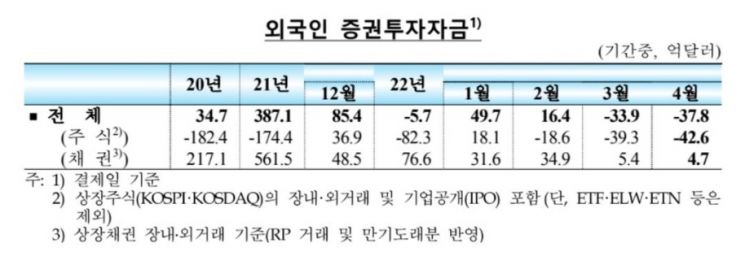
In fact, foreign investor capital outflows are intensifying in the South Korean stock market. According to the Bank of Korea’s ‘International Finance and Foreign Exchange Market Trends,’ foreign stock investment funds recorded a net outflow of $4.26 billion in April. Based on the won-dollar exchange rate at the end of April (1,255.9 won), about 5.35 trillion won was withdrawn, marking the third consecutive month of net outflows. The scale of net outflows also intensified from $1.86 billion in February to $3.93 billion in March. Foreign bond investment funds recorded a net inflow of $470 million this month, mainly from private funds, but the growth rate is slowing. The net inflow shrank from $3.49 billion in February to $540 million in March. Combined foreign stock and bond investment funds recorded a net outflow of $3.78 billion in April.
Experts warn that the rapid depreciation of the won could shock South Korea’s highly external-dependent economy. While past won depreciation was a positive factor for exporters, continuous depreciation signals economic sluggishness. The sharp rise in energy prices is causing trade deficits to accumulate, which lowers the won’s value and acts as an external risk factor. The trade deficit from the beginning of this year to the 10th of this month is $9.86 billion (about 12.72 trillion won). Kim Jeong-sik, an emeritus professor at Yonsei University, emphasized, "Rising import prices due to soaring raw material prices increase the burden on companies. If the won-dollar exchange rate breaks through 1,300 won amid ongoing trade deficits, there is a possibility of exposure to a foreign exchange crisis, so stabilizing the foreign exchange market is an urgent task."

Market attention is focused on the foreign exchange authorities’ measures. Although it will not be easy to stop the rising exchange rate trend amid the global strong dollar phenomenon, the intensity and speed of intervention by authorities could act as variables. Jeon Gyu-yeon, a researcher at Hana Financial Investment, said, "Breaking through 1,300 won occurred during emergencies such as the global financial crisis, COVID-19, and the Southern European crisis. The current exchange rate level is very burdensome." He added, "Since there are many global factors for a strong dollar, the possibility of breaking through 1,300 won in the short term is high, and the situation requires reliance on government intervention."
Kwon Ah-min, a researcher at NH Investment & Securities, also said, "The average won-dollar exchange rate rose to 1,464 won in March 2009, when South Korea’s total external debt ratio to GDP was 37.4%. Considering that last year’s total external debt ratio rose to 35%, if won weakness continues in the second half of the year, the upper limit of the exchange rate could rise to 1,350 won."
On the day, the won-dollar exchange rate surged to 1,291 won in the morning before reversing downward, leading the market to estimate that there was actual intervention by authorities.
President Yoon Suk-yeol expressed concern at the macro-financial situation review meeting he presided over that day, saying, "Volatility in the financial and foreign exchange markets has recently increased." Bang Ki-seon, First Vice Minister of Strategy and Finance, also instructed at the Emergency Economic Response Task Force (TF) meeting to re-examine timely implementation measures in preparation for any contingencies, noting, "Volatility in foreign exchange and financial markets has greatly expanded due to concerns over prolonged inflation in major countries."
© The Asia Business Daily(www.asiae.co.kr). All rights reserved.
![Clutching a Stolen Dior Bag, Saying "I Hate Being Poor but Real"... The Grotesque Con of a "Human Knockoff" [Slate]](https://cwcontent.asiae.co.kr/asiaresize/183/2026021902243444107_1771435474.jpg)

















