Increased Outdoor Activities Reduce Personal Time... Some Workers Complain of 'Endemic Blue'
Discomfort with Commuting as Remote Work Ends
6 out of 10 MZ Generation Workers Prefer Simplified Company Dinners
"Endemic Blue Similar to Adjustment Stress After Holidays and School Breaks"
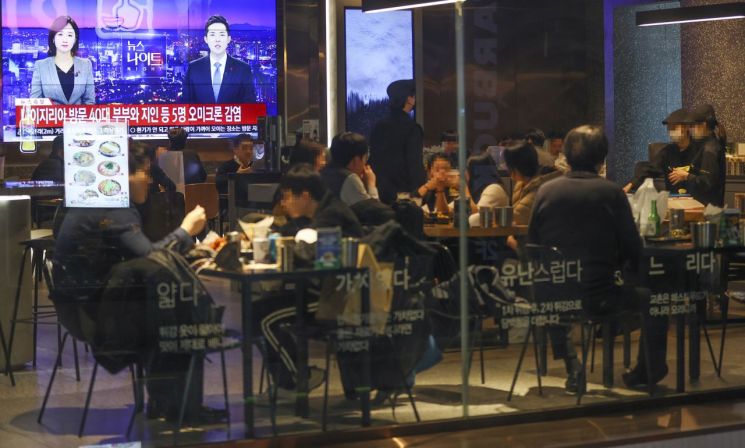 As social distancing measures are fully lifted, workplace gatherings are increasing. Some office workers are experiencing 'endemic blues' as their personal time decreases.
 [Image source=Yonhap News]
[Asia Economy Reporter Park Hyun-joo] As social distancing measures have been fully lifted, the culture of company dinners, which had been suspended for over two years, is rapidly increasing again. Some refer to this phenomenon as so-called 'revenge drinking,' which describes the surge in company dinners and private gatherings where people drink all at once after the lifting of distancing measures, making up for the alcohol they couldn't consume during COVID-19. However, some office workers are experiencing feelings of depression as their personal time decreases due to increased outdoor activities following the lifting of social distancing.
Following the lifting of distancing measures, with company dinners and various face-to-face business activities resuming, corporate card usage in the pub industry has increased. According to sales analysis data from BC Card on the 11th, corporate card sales in the pub sector during the 'full lifting period (April 18?30)' rose by 70% compared to the 'pre-lifting period (March 1?20).' Additionally, during the 'full lifting period,' offline-focused restaurant sales increased by 27% compared to the 'pre-lifting period,' while delivery-focused restaurant sales decreased by 12%.
As company dinners increase, some office workers are complaining of 'endemic blue.' This refers to feelings of depression caused by reduced personal time due to the rise in company dinners and private gatherings following the lifting of distancing measures. This is the opposite phenomenon of 'COVID blue,' where depression was experienced due to reduced outdoor activities during strengthened distancing.
Endemic blue is particularly increasing among those who joined their companies around the time of the COVID-19 outbreak. Those who enjoyed an 'evening life' with exercise and self-development after work have become accustomed to the reduced company dinners and changed work life post-COVID-19, so they find it difficult to adapt to having their time taken up by work-related gatherings. Some also complain about the inconvenience of commuting, which they had not experienced during remote and telecommuting periods.
Foreign media have also introduced Korea's endemic blue phenomenon. One foreign news outlet reported on the 28th of last month (local time) that many young Korean office workers view company dinners as an 'outdated workplace culture that invades personal time' and are expressing concerns about the lifting of social distancing.
Millennial and Gen Z office workers are voicing concerns about the return of pre-COVID-19 company dinner culture. On the 8th of last month, HR tech company Incruit conducted a survey of 1,013 male and female office workers nationwide on the 'status of company dinners and satisfaction with new company dinner culture.' When asked whether the in-house company dinner culture had changed since COVID-19, more than 9 out of 10 respondents (94.5%) gave positive answers ('very satisfied' + 'generally satisfied') regarding the changed company dinner culture.
Millennial and Gen Z office workers also expressed satisfaction with the simplification of company dinners after COVID-19. Respondents cited 'shortened time and finishing at the first round' (61.7%) as the top improvement in the changed company dinner culture, followed by 'small group dinners' (36.7%).
Experts view endemic blue not as an unfamiliar concept but as similar to adaptation stress experienced when changes occur in daily life. Professor Lim Myung-ho of Dankook University's Department of Psychology explained, "It is similar to the difficulty of readjusting to daily life such as school or work after holidays, vacations, or breaks end. Because non-face-to-face and telecommuting became normalized for over two years due to COVID-19 and now we are returning to the previous ways, it takes a long time to adapt. Especially, office workers in their 20s and 30s, who have less experience with similar adaptation stress, may find it more difficult than older generations who have more experience," he said.
© The Asia Business Daily(www.asiae.co.kr). All rights reserved.
![Clutching a Stolen Dior Bag, Saying "I Hate Being Poor but Real"... The Grotesque Con of a "Human Knockoff" [Slate]](https://cwcontent.asiae.co.kr/asiaresize/183/2026021902243444107_1771435474.jpg)















