Allowing 8 Text Messages Under Public Official Election Act
No Restrictions on Information Collection Methods
Possible Penalties Under Personal Information Protection Act
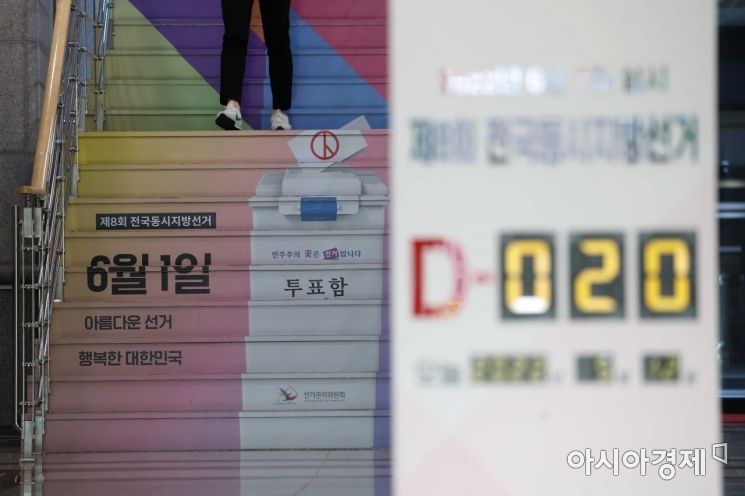 The status board installed in front of the Comprehensive Election Situation Room of the Central Election Commission in Gwacheon-si, Gyeonggi-do, shows D-20, with the 8th nationwide local elections 20 days away on the 12th. Photo by Moon Honam munonam@
[Asia Economy Reporters Jang Sehee and Oh Gyumin]#Kim Seul-ah (30, pseudonym), who lives in Seongbuk-gu, Seoul, received election campaign text messages on her mobile phone from a candidate running in the local elections from April 28 to May 13. She did not know the candidate at all and never consented to provide her information, yet she was contacted on her personal phone. Despite making dozens of calls to the sender's number, she could not get through and ultimately decided to file a complaint with the police for violation of the Personal Information Protection Act. Another office worker in her 30s, Mr. Noh, also said, "I live in Seoul, but a candidate from Bucheon sends election promotional text messages," adding, "It's absurd how they got my number."
With the local elections scheduled for the 1st of next month, candidates' promotional text messages are flooding in. Most recipients express discomfort, saying they do not know how their phone numbers were obtained. Some are even afraid to click on links in the messages, fearing they might contain malware.
Although these messages relate to the 'local elections,' it is difficult to apply election law violation charges. Article 59 of the Public Official Election Act only regulates the number of text messages sent (8 times) and the use of one registered phone number. A representative from the National Election Commission said on the 13th, "To maintain the stability of citizens' daily lives, the number of bulk text messages sent via text message systems is limited to 8 times," adding, "There are no restrictions on how the information is collected, so it is difficult to impose penalties under election law."

Violation of Personal Information Protection Act Charges: "Evidence of Illegal Collection Required"
According to the police, whether election candidates' promotional text messages lead to punishment depends on how the information was collected. If the purpose of processing personal information is not clearly stated and personal information is not collected lawfully and legitimately within the necessary scope, it can be punished under the 'Personal Information Protection Act.' A head of investigation at a frontline police station in Seoul said, "It is important whether the collection of personal information was legal or illegal," adding, "If the information was provided by a third party without the consent of the data subject, both the recipient and the provider can face criminal charges."
Attorney Park Sang-oh of Barun Law Firm stated, "If consent was not obtained from the data subject at the information collection stage, it constitutes illegal collection," and added, "Even if the information is received from basic local governments, consent for the purpose of information use must be obtained again." Violations of the Personal Information Protection Act can result in imprisonment of up to 5 years or a fine of up to 50 million KRW. According to the Personal Information Protection Commission, if personal information is not destroyed after the election or upon the voter's request for deletion, a fine of up to 30 million KRW may also be imposed.
Those wishing to report to the police can submit a petition or a complaint. Filing a complaint immediately makes the other party a suspect upon acceptance by the investigative agency but carries a high risk of counter-suit for false accusation. On the other hand, a petition is a request for investigation and is free from liability for false accusation. However, proving illegal acquisition of personal information is not easy. A police official said, "When information is obtained from third or fourth parties, it is difficult to find the connection without statements," adding, "There are various methods such as picking up business cards left on cars and entering the information before passing it on, making it challenging to uncover the entire acquisition process."
© The Asia Business Daily(www.asiae.co.kr). All rights reserved.
![Clutching a Stolen Dior Bag, Saying "I Hate Being Poor but Real"... The Grotesque Con of a "Human Knockoff" [Slate]](https://cwcontent.asiae.co.kr/asiaresize/183/2026021902243444107_1771435474.jpg)
















