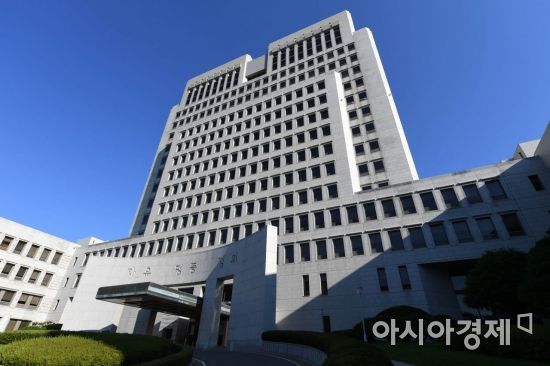
[Asia Economy Reporter Choi Seok-jin, Legal Affairs Specialist] The Supreme Court overturned a defamation conviction against a supervisor who lied in front of other employees, saying "there was no report," despite having been informed by a subordinate about an incident of sexual harassment in the workplace.
The court reasoned that since the supervisor expressed a subjective feeling of being "unfairly treated" while passively responding to a superior who was questioning the failure to report the incident to the police, it is difficult to recognize the necessary elements of "statement of fact" or "intent" required for defamation.
The Supreme Court's Second Division (Presiding Justice Cheon Dae-yeop) announced on the 13th that it overturned the lower court's ruling that sentenced Mr. A, who was indicted for defamation, to a fine of 6 million KRW, and remanded the case to the Chuncheon District Court Gangneung Branch.
The court stated, "The lower court erred in its understanding of the legal principles regarding intent and statement of fact in defamation, which affected the judgment in recognizing the charges as guilty."
Mr. A, who worked as a facility manager at a workplace in Donghae City, Gangwon Province, was informed around October 2018 by his subordinate Mr. B, a senior vocational training instructor (team leader), that a disabled employee Mr. C had sexually harassed Mr. D five times, including hugging Mr. D from behind and touching his chest.
On or around November 26 of the same year, Mr. A called Mr. C's mother to the company and met with her along with Mr. B, obtaining a confirmation letter acknowledging that Mr. C had sexually harassed Mr. D and had received warnings and cautions from the company regarding the matter.
However, six months later, a problem arose when the company was fined for failing to report the workplace sexual crime to investigative authorities. When Mr. A was asked by his superior to provide a progress report and was held responsible for the fine, he lied, saying, "Mr. B never reported the sexual harassment incident to me." Five other employees were present in the meeting room at the time.
The prosecution filed a summary indictment against Mr. A, accusing him of defaming Mr. B by falsely stating that he had not received a report about the sexual harassment incident despite having been informed by Mr. B, and sought a fine of 5 million KRW. Mr. A appealed and requested a formal trial.
In court, Mr. A claimed that he had not received any report from Mr. B, so his statement during the meeting was true. He also admitted meeting Mr. C's mother with Mr. B but argued that he attended the meeting without knowing the specific problematic behavior of Mr. C and did not even read the contents of the "guardian confirmation letter."
However, both the first and second trials rejected Mr. A's claims. They reasoned that typically, reports are made to superiors before such meetings, and approvals are obtained afterward, so Mr. A's claim that he was unaware of the sexual harassment was not credible.
In particular, the courts concluded that Mr. A's lie that Mr. B did not report the incident to avoid responsibility led other employees to misunderstand that the company suffered damage due to Mr. B's poor handling or that Mr. B tried to conceal the sexual harassment incident, thereby damaging Mr. B's social value and reputation.
Ultimately, the first trial court stated, "Although the defendant's crime is clear, the defendant denies the crime, shows no remorse, and rather appears to cause secondary harm to the victim," and imposed a heavier fine of 6 million KRW than the prosecution's requested 5 million KRW summary order. The second trial also upheld this judgment.
However, the Supreme Court's judgment differed. Considering the circumstances before and after Mr. A's statement, the court found it difficult to conclude that Mr. A intended to defame Mr. B or that he stated specific facts to defame Mr. B.
The court explained, "It can be seen that the defendant made the statement while responding to a superior's request for a progress report and being held responsible for the fine. Considering the content, circumstances, motive, and situation of the statement, it is reasonable to view that the defendant expressed a subjective feeling or emotion of being 'unfairly treated' in the process of passively answering a simple confirmation while defending himself regarding his responsibility, rather than making the statement with the intent to defame Mr. B. Therefore, such an answer cannot be definitively regarded as a statement of fact under defamation law."
© The Asia Business Daily(www.asiae.co.kr). All rights reserved.
![Clutching a Stolen Dior Bag, Saying "I Hate Being Poor but Real"... The Grotesque Con of a "Human Knockoff" [Slate]](https://cwcontent.asiae.co.kr/asiaresize/183/2026021902243444107_1771435474.jpg)















