April Employment Trends
[Asia Economy Sejong=Reporter Son Seon-hee] In April, the number of employed people increased by more than 800,000 compared to the same month last year, marking the largest increase for the month in 22 years. However, more than 70% of the increase in employment was concentrated among middle-aged and older adults aged 50 and above, while the increase for those in their 40s was only 15,000, highlighting a stark contrast in employment conditions by age group.
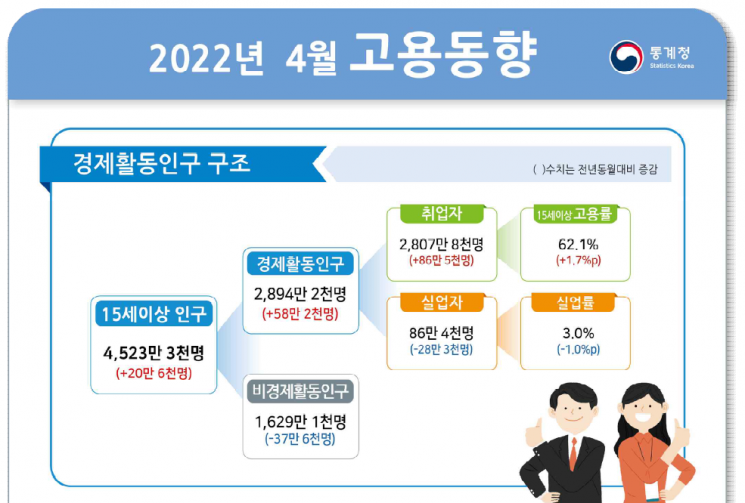
According to the 'April Employment Trends' released by Statistics Korea on the 11th, the number of employed people last month was 28,078,000, an increase of 865,000 compared to the same month last year. The employment rate for those aged 15 and over rose by 1.7 percentage points from a year earlier to 62.1%, the highest ever recorded for the month since monthly statistics began in July 1982.
However, looking at the increase in employment by age group, those aged 60 and over saw the largest increase of 424,000. This was followed by those aged 50 to 59, with an increase of 208,000. Combined, these two age groups accounted for a total increase of 632,000, representing 73% of the total increase in employment.
On the other hand, the number of employed people in their 30s, considered the "middle" of the labor market, increased by only 33,000, and those in their 40s increased by just 15,000. However, this should be viewed in light of the declining population in the 30s and 40s age groups. Compared to the same month last year, the population in their 30s decreased by 132,000, and those in their 40s decreased by 72,000.
By industry, the healthcare and social welfare services sector saw the largest increase with 230,000 more employed, followed by manufacturing with 132,000, and business facility management, business support, and rental services with 104,000 more employed. Conversely, the finance and insurance sector, which is rapidly undergoing non-face-to-face digitalization, saw a decrease of 54,000 employed, and the accommodation and food service sector also decreased by 27,000 due to the lingering effects of social distancing measures that have not yet been fully lifted.
Gong Mi-sook, Director of the Social Statistics Bureau at Statistics Korea, said, "The increase in employment is due to strong exports and the non-face-to-face digitalization of industries," adding, "It is confirmed that the trend of employment recovery is continuing."
© The Asia Business Daily(www.asiae.co.kr). All rights reserved.
![Clutching a Stolen Dior Bag, Saying "I Hate Being Poor but Real"... The Grotesque Con of a "Human Knockoff" [Slate]](https://cwcontent.asiae.co.kr/asiaresize/183/2026021902243444107_1771435474.jpg)















