[Seoul District News] Nowon-gu Signs Agreement with 33 Auto Repair Shops to Open 72 Parking Spaces Free to Nearby Residents Outside Business Hours · 'Parking Sharing Practice Shop' Signs Posted at Participating Shops, Information Posted on District Office Website... Gangbuk-gu Signs MOU with Chilgapsan Chestnut Farming Association for Coffee Grounds Composting... Seodaemun-gu Installs Safety Emergency Bells and Pedestrian Protection Systems in Public Parking Lots... Eunpyeong-gu Installs IoT-Enabled Smart Security Lights in Yeokchon-dong Area... Dongjak-gu Conducts Virtual Training for Summer Flood and Wind Disaster Preparedness... Mapo-gu
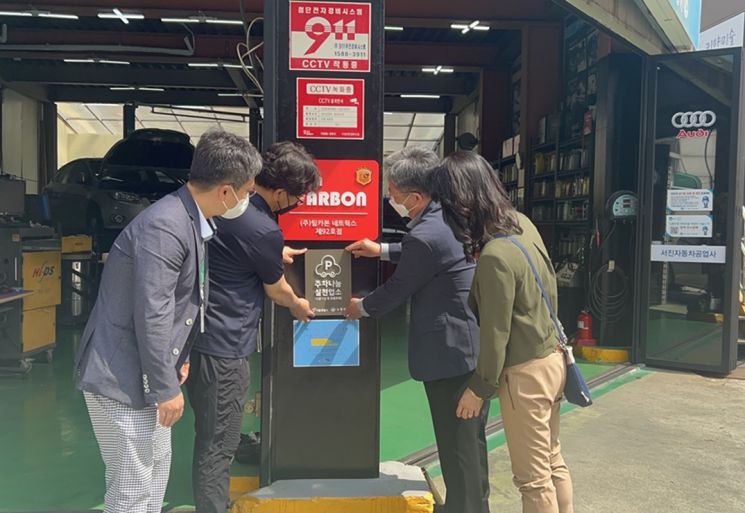
[Asia Economy Reporter Park Jong-il] Nowon-gu announced that it will promote the nation’s first ‘Parking Sharing Project’ in collaboration with local automobile repair shops to alleviate parking difficulties.
About 80% of residences in Nowon-gu are apartments, but most were built long ago and lack underground parking lots or have insufficient parking space, causing severe parking problems. The situation is even worse in general residential areas, with an average of about 2,800 parking-related complaints per month (as of May 2022).
The district is focusing on spreading a culture of sharing parking spaces, especially around schools, religious facilities, and distribution centers, to improve the poor parking environment.
Some shops belonging to the Nowon-gu branch of the Seoul Metropolitan Automobile Repair Business Association (hereinafter ‘Carpos’) had been opening their parking spaces to local residents to ease parking difficulties, but utilization was low because residents were unaware of the availability.
Accordingly, the district signed a formal agreement with the Nowon-gu branch to expand participating shops, strengthen publicity to residents, and promote a culture of sharing parking spaces through the ‘Parking Sharing Project.’
Through this agreement, 33 automobile repair shops affiliated with Carpos Nowon-gu branch will open a total of 72 parking spaces to residents. The repair shops’ parking spaces can be used free of charge outside business hours.
To help residents easily identify participating shops, ‘Parking Sharing Practice Shop’ signs will be installed at these locations. Additionally, the names, addresses, phone numbers, and opening hours of participating shops will be posted on the district office website for easy access to information.
The district expects that since most participating shops are located in residential areas with better accessibility than existing open facilities such as schools, this will greatly help residents suffering from parking difficulties.
Also, by attaching the signs, residents will associate participating shops with businesses that cooperate with the local community, which is expected to improve the shops’ image.
Meanwhile, as a result of continuously promoting the parking lot opening project, as of May 2022, a total of 96 privately managed parking lots with 1,732 spaces are open in Nowon-gu. These include ▲17 religious facilities with 427 spaces ▲13 school facilities with 320 spaces ▲5 distribution facilities with 314 spaces ▲38 public institutions with 470 spaces ▲23 general buildings with 201 spaces.
Information on open facilities and usage methods can be found on the district office website (Category Information/Transportation/Parking Environment Improvement and Expansion/Private Parking Lot Night Opening).
A district official said, “Despite many difficulties in business due to COVID-19, we are grateful to the repair shops for opening their parking spaces to nearby residents for the local community. We will continue to strive to improve the parking environment through various policy developments to alleviate parking difficulties.”
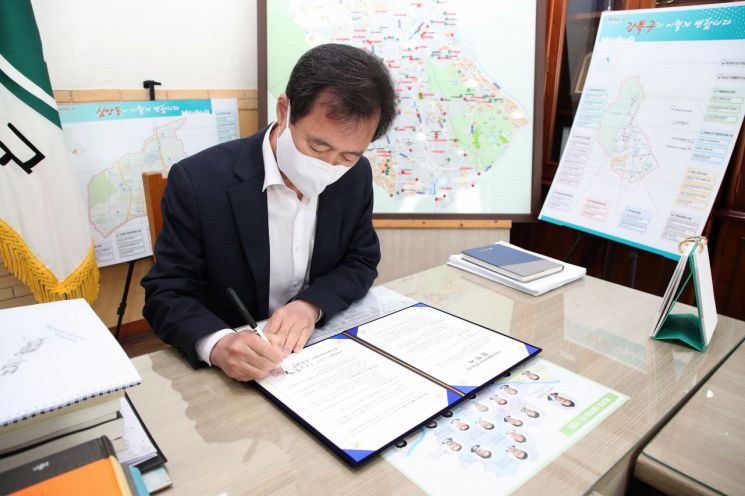
Gangbuk-gu (Mayor Park Gyeom-su) signed a public-private cooperation agreement on May 28 with Chilgapsan Chestnut Agricultural Cooperative in Cheongyang-gun, Chungnam Province, for coffee grounds composting.
The coffee grounds composting project designates three local gas stations as collection points and manages collection, transport, and processing to recycle coffee grounds into eco-friendly compost.
Under the current Waste Management Act, coffee grounds are classified as household waste and are landfilled or incinerated, causing various environmental pollution problems. The project aims to reduce household waste generation and processing costs by composting coffee grounds.
Gangbuk-gu plans to initially promote the project with about 70 coffee shops and expand participation through continuous publicity.
According to a district official, there are about 290 coffee shops in the area, generating an average of 3 kg of coffee grounds per shop per day, totaling 310 tons annually. Recycling this amount is expected to save about 210 million KRW in annual budget.
Coffee shops wishing to participate in the coffee grounds recycling project can apply to the Gangbuk-gu Cleaning Administration Division.
Mayor Park Gyeom-su said, “Resource recycling to respond to the climate crisis is now an unavoidable trend. I hope residents will join forces so that recycling and reuse become daily habits and establish a routine culture.”
Seodaemun-gu (Mayor Moon Seok-jin) announced on the 10th that it has installed ‘Safety Emergency Bells’ and ‘Pedestrian Protection Systems’ to ensure residents can safely use public parking lots.
The ‘Safety Emergency Bells’ were recently installed at four building-type public parking lots: ▲Chunghyeon-dong 1st Public Parking Lot ▲Chunghyeon-dong 2nd Public Parking Lot ▲Sinchon-dong 1st Public Parking Lot ▲Namgajwa 2-dong 1st Public Parking Lot.
The district selected these parking lots after conducting crime prevention assessments with the Seodaemun Police Station.
Anyone in an emergency can press the bell, which sends location information to the 112 comprehensive control center, prompting police dispatch from the nearest precinct.
The ‘Pedestrian Protection System’ was also recently installed at three locations: ▲Hong Eun 1-dong 4th Public Parking Lot ▲Hong Eun 2-dong 1st Public Parking Lot ▲Namgajwa 2-dong 1st Public Parking Lot.
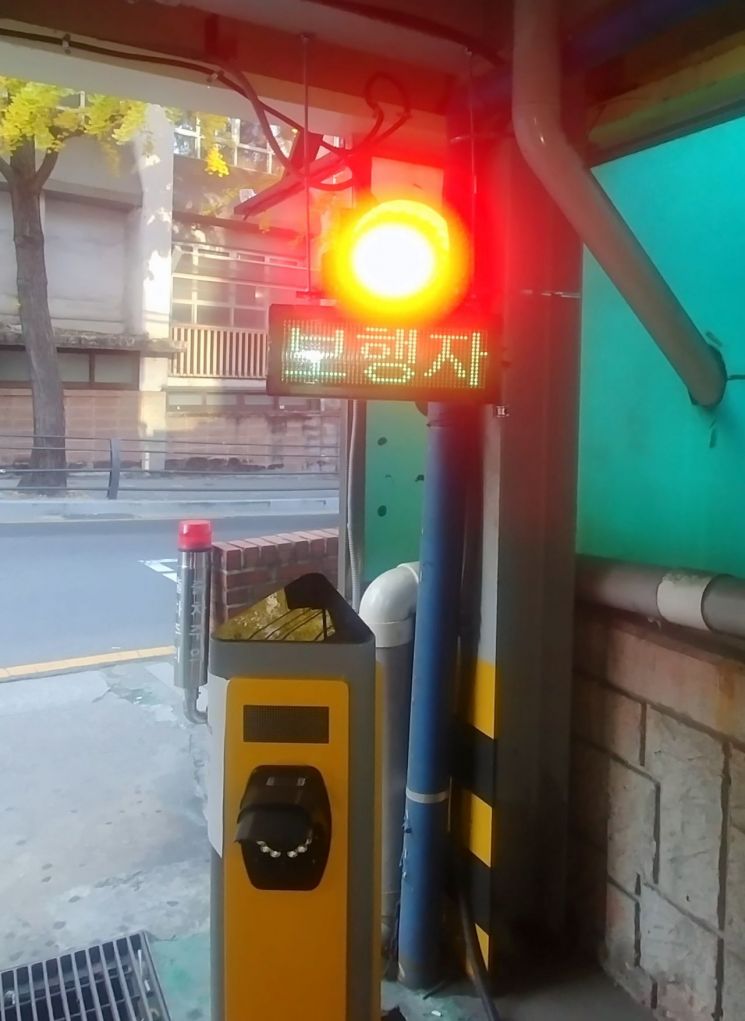
This system protects pedestrians in blind spots from vehicles using the parking lots and prevents accidents.
When the system’s sensors detect pedestrians near the parking lot entrances and exits, warning lights installed in visible locations automatically turn on, and the electronic display shows the message ‘Pedestrian Approaching, Driver Warning.’
The district installed this system in residential areas to enhance drivers’ alertness through visual effects without causing noise.
Mayor Moon Seok-jin said, “The 24-hour operating Safety Emergency Bells and Pedestrian Protection Systems are expected to help alleviate drivers’ anxiety and enhance residents’ safety.”
The district plans to expand this project annually to protect residents from crime and traffic accidents.
Eunpyeong-gu announced that it will install smart security lights equipped with Internet of Things (IoT) technology mainly in the Yeokchon-dong area.
The district will invest 280 million KRW by June to replace and install 955 security lights in Yeokchon-dong with smart security lights.
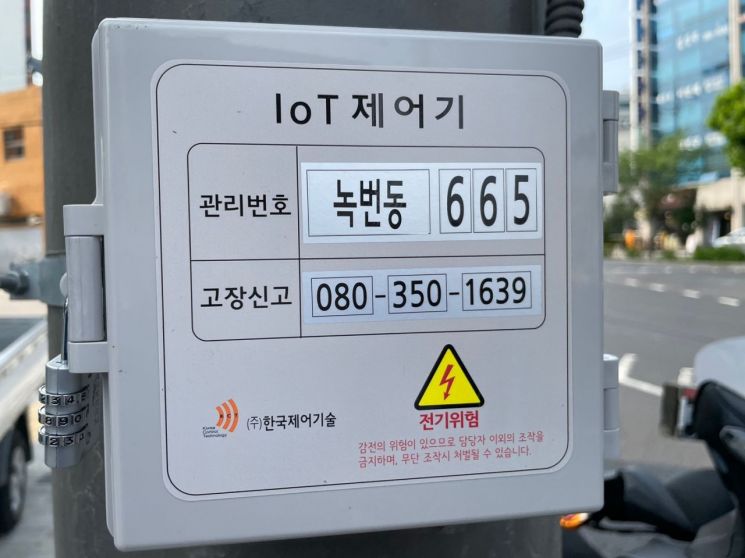
Smart security lights are security lights equipped with bidirectional flashers based on a short-range wireless communication network IoT signal device. The communication modem built into the bidirectional flasher connects to a central control system, allowing real-time monitoring of the security lights’ status, such as power outages, leakage, or partial lighting failures.
Previously, malfunctions were identified through complaint reports or self-inspections, but with smart security lights, real-time monitoring and management minimize partial lighting downtime, creating a safe and pleasant nighttime walking environment.
Additionally, by efficiently managing lighting operation times according to weather conditions, the district minimizes residents’ inconvenience and prevents unnecessary power consumption, contributing to reduced carbon emissions.
Last year, the district began the smart security light installation project by replacing and installing 709 security lights in the Nokbeon-dong area. This year, the project targets Yeokchon-dong, with plans to gradually expand the smart security light remote monitoring and control system throughout the district.
A district official said, “We will take the lead in creating a safe and pleasant nighttime walking environment through the installation of smart security lights.”
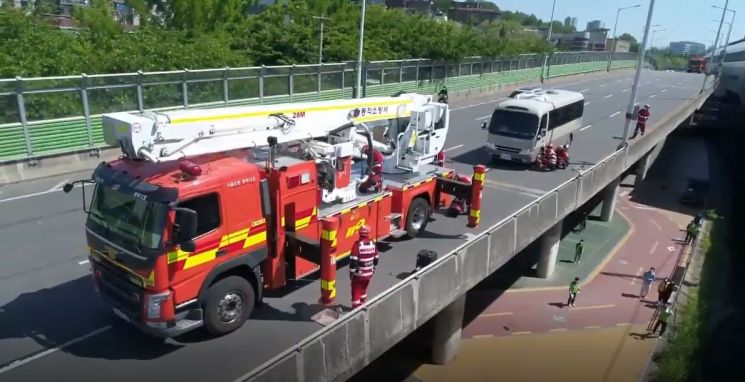
Dongjak-gu (Mayor Lee Chang-woo) announced on the 9th that it conducted a ‘Summer Flood and Wind Disaster Preparedness Virtual Drill’ involving citizens and fire stations to prepare for natural disasters such as typhoons and heavy rains in the upcoming summer.
The drill was prepared in response to the recent frequent guerrilla-style heavy rains, anticipating a rapid rise in the water level of Dorimcheon, which is under the district’s jurisdiction. It included resident evacuation drills at the Dorimcheon underpass near Sindebang Station, operation of Dorimcheon flood barriers, and rescue training for isolated persons.
The Dorimcheon Patrol Team, Autonomous Disaster Prevention Group, and Public Guardians participated together, conducting evacuation and blocking access to Dorimcheon. Assuming isolated persons due to sudden heavy rain and rapid water level rise, the district collaborated with Dongjak Fire Station to conduct rescue drills.
Alongside on-site drills, the district used SNS (KakaoTalk) to share real-time disaster site information among all staff, emphasizing clear task assignments and swift response during disasters.
On the 11th, the district will conduct on-site training at Dongjak-gu Office for employees, related agencies such as Korea Electric Power Corporation, and representatives of large construction sites in the area. The training covers facility safety management, action guidelines for various situations, roles of care public officials, and pump operation through practical videos.
Additionally, the district plans to strengthen proactive disaster preparedness and capabilities by implementing services such as ▲care services for flood-vulnerable households ▲education and publicity on flood and wind disaster preparedness ▲Dorimcheon patrol team ▲rainwater drain management responsibility system.
The district also established the ‘2022 Flood and Wind Disaster Safety Management Plan’ and will operate the ‘Flood and Wind Disaster Safety Countermeasures Headquarters’ 24 hours a day for five months from May 15 to ensure thorough accident prevention.
Kim Sang-hoon, Director of the Water Management Division, said, “This drill was a virtual exercise for potential summer disaster situations to strengthen the ability to respond quickly and accurately. This summer, we will do our best to prepare for flood and wind disasters in cooperation with residents, related departments, and agencies to prevent any harm to citizens.”
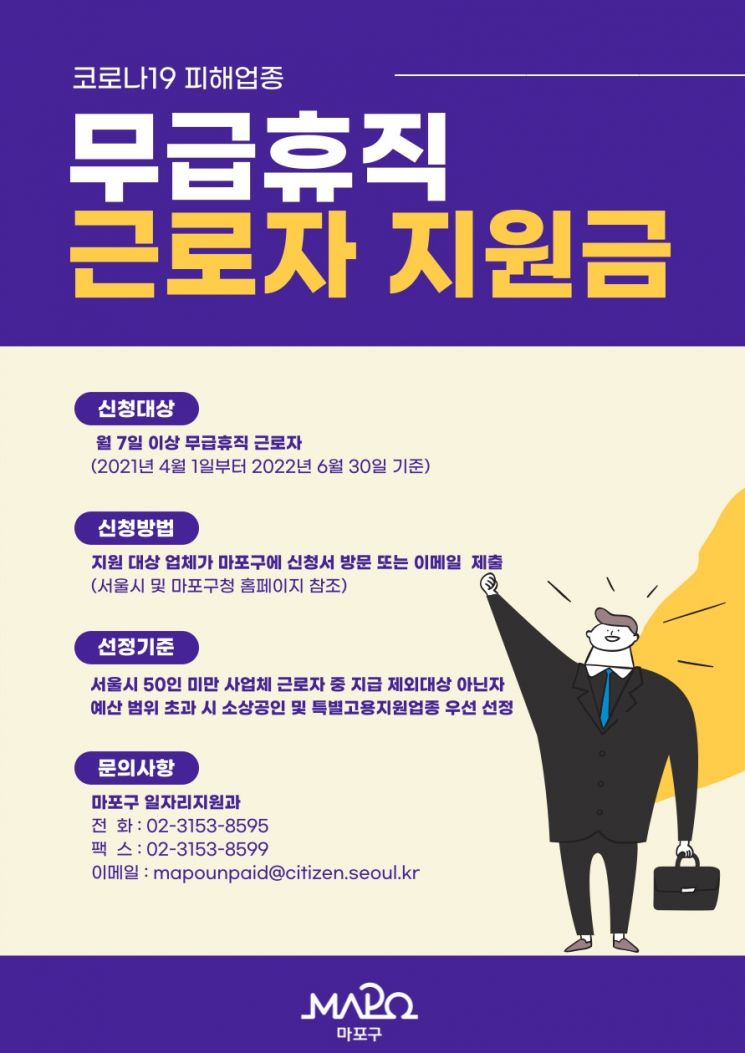
Mapo-gu announced on the 10th that it will provide unpaid leave support payments of up to 1.5 million KRW to small business workers struggling due to COVID-19.
The ‘Unpaid Leave Worker Support Fund’ is a public support policy that pays workers at small businesses with fewer than 50 employees 500,000 KRW per month for up to three months, totaling 1.5 million KRW.
Eligible recipients are workers who have been on unpaid leave for at least seven days per month at companies with fewer than 50 employees located in Mapo-gu from April last year to June this year and must maintain employment insurance until July 31 this year.
The district prioritizes support for workers in ‘Special Employment Support Sectors for Small Business Owners’ such as shipbuilding, travel, tourism accommodation, and performance industries.
The application period is from the 10th to June 30.
Applicants can download the application form and necessary documents from the Mapo-gu Office website, fill them out, and submit them in person at the unpaid leave worker support fund reception desk on the 6th floor of Mapo-gu Office or via email. Postal mail and fax submissions are also accepted.
The support payments are scheduled to be directly deposited into workers’ bank accounts in July.
For more details, contact the Mapo-gu Office unpaid leave worker support fund reception desk.
© The Asia Business Daily(www.asiae.co.kr). All rights reserved.
![Clutching a Stolen Dior Bag, Saying "I Hate Being Poor but Real"... The Grotesque Con of a "Human Knockoff" [Slate]](https://cwcontent.asiae.co.kr/asiaresize/183/2026021902243444107_1771435474.jpg)


















