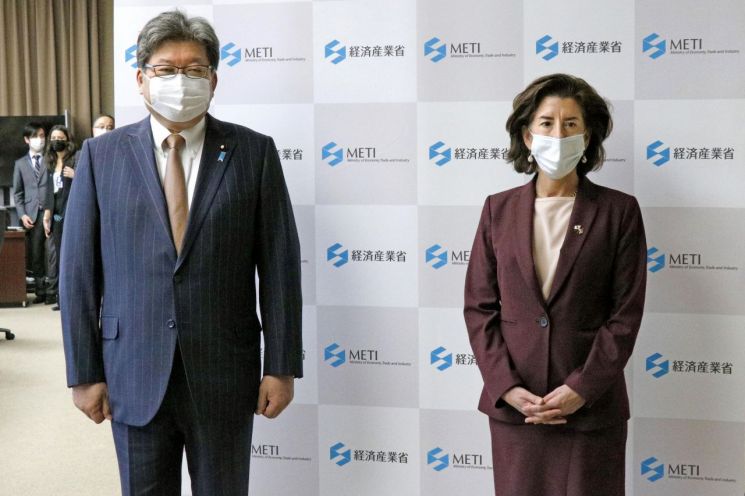
 Koichi Hagiuda, Japanese Minister of Economy, Trade and Industry (left), and Gina Raimondo, U.S. Secretary of Commerce
 [Image source=AP Yonhap News]
[Asia Economy Reporter Jeong Hyunjin] "I feel a strange fate in joining hands with the United States in semiconductors."
On the 4th (local time), when the United States and Japan announced semiconductor cooperation, Koichi Hagiuda, Japan's Minister of Economy, Trade and Industry, said this at a press conference. The announcement, which was less than a single A4 page, stated the basic principles of US-Japan semiconductor cooperation as "mutually recognizing and complementing each other," "valuing open markets, transparency, and free trade," and "sharing the goal of strengthening supply chains."
On the 9th, Japan's Nihon Keizai Shimbun focused on Minister Hagiuda's use of the word "strange," mentioning that "it is because of the past conflicts between Japan and the United States surrounding semiconductors." Considering that Japan's semiconductor industry, which flourished in the late 1980s, bowed to pressure from the United States and reached its current period of decline, it is interpreted that Japan perceives this cooperation as a peculiar situation.
According to Nihon Keizai, Japanese semiconductor companies dominated the global semiconductor market in the late 1980s, recording a market share of over 50%. Until the early 1980s, the semiconductor market was led by American companies, but Japanese companies rapidly grew and surpassed them. Feeling threatened, the US Semiconductor Industry Association (SIA) filed a complaint with the US Trade Representative (USTR) in 1985, accusing the Japanese government of unfairly supporting private companies through semiconductor industry policies, and began pressuring Japan.
As a result, the United States and Japan signed a semiconductor agreement in 1986. However, in 1987, the US imposed 100% retaliatory tariffs on Japanese-made computers and TVs, among other additional retaliatory measures. During this process, the Japanese government and semiconductor companies bowed to the US, increasing the market share of foreign semiconductor companies within Japan from the existing 11% to 20%, and accepting restrictions such as halting low-priced exports of DRAM. This agreement ended only in 1996. Meanwhile, American semiconductor companies like Intel and Microsoft (MS) grew, and Samsung Electronics rapidly expanded its market share in the DRAM market, gradually displacing Japan and showing signs of retreat.
At the press conference, Minister Hagiuda reflected on Japan's semiconductor industry, saying, "There was pressure from the United States, and missteps afterward led to Japan's decline. The challenge and ambition to dominate the world with 'Made in Japan' 'Hinomaru (Japanese flag) semiconductors' ended in failure."
Nihon Keizai stated, "The reason Japan and the US are joining hands despite this past is because semiconductors carry weight in economic and security matters," noting that their importance is growing not only in private sectors such as artificial intelligence (AI) but also in military technology. It further analyzed, "The US can cooperate with Japan because Japan's industry currently does not pose a threat to the US."
© The Asia Business Daily(www.asiae.co.kr). All rights reserved.
![Clutching a Stolen Dior Bag, Saying "I Hate Being Poor but Real"... The Grotesque Con of a "Human Knockoff" [Slate]](https://cwcontent.asiae.co.kr/asiaresize/183/2026021902243444107_1771435474.jpg)















