Full Opening from Tomorrow Noon
6 Sessions Daily · Up to 39,000 Visitors
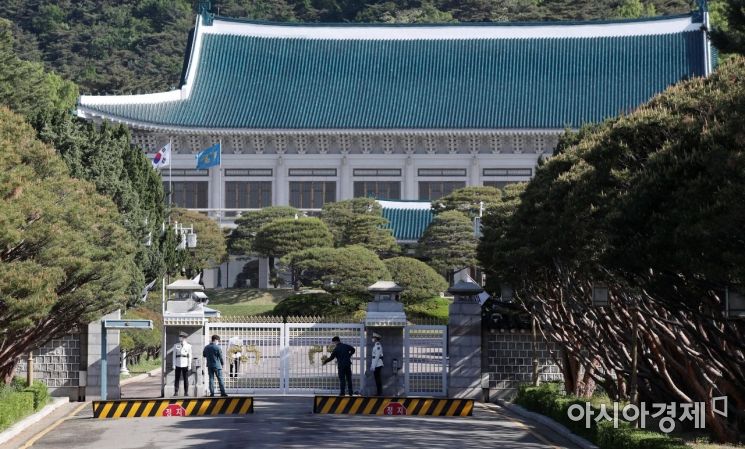 On the 9th, one day before the Blue House opens to the public, security personnel are on guard duty at the main gate of the Blue House. Photo by Hyunmin Kim kimhyun81@
With the inauguration of President-elect Yoon Suk-yeol, the full opening of the Blue House has begun, allowing the public to see the previously hidden cultural assets and the interior of the Blue House.
According to the Blue House Relocation Task Force (TF) on the 9th, tours of the Blue House will start at noon on the 10th for citizens who have applied in advance. Tours will be conducted six times a day in two-hour intervals, with 6,500 visitors admitted per session and a maximum of 39,000 visitors per day. Yoon Han-hong, head of the Blue House Relocation TF, explained, "The Blue House, including the Main Building, the State Guest House, the Green Garden, and Sangchunjae, will be reborn as an open space that anyone can enjoy." Visitors will also have the opportunity to explore hidden cultural heritage throughout the grounds while touring the Blue House.
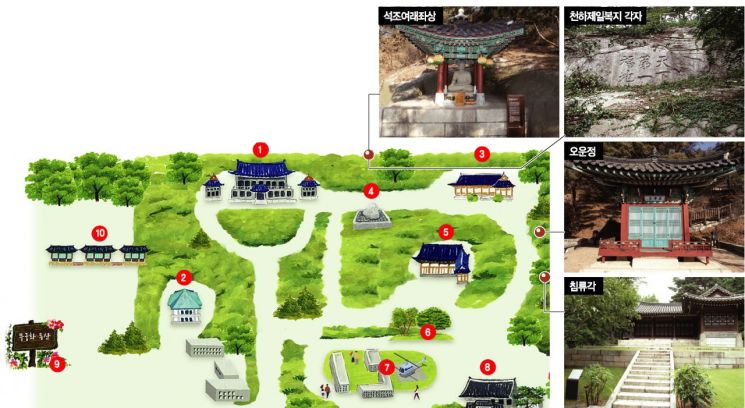 ①Cheongwadae Main Building ②Yeongbingwan ③Presidential Residence ④Sugung Site ⑤Sangchunjae ⑥Nokjiwon ⑦Presidential Secretariat ⑧Chunchugwan ⑨Mugunghwa Hill ⑩Chilgung. Views of major cultural heritage sites within the Cheongwadae grounds. From the top, clockwise: National Treasure No. 1977 Stone Seated Buddha Statue, Cheonhajeilbokji Inscription, Seoul City Tangible Cultural Property No. 102 Ounjeong, No. 103 Chimryugak. Photo by Presidential Security Service
First, the Main Building, the central structure of the Blue House, allows visitors to appreciate the architectural style of the old royal palaces. The entrance hall of the Blue House Main Building features a roof decorated with ‘Morodan-cheong’. Morodan-cheong is a type of traditional Korean decorative coloring where patterns are applied only at the ends and the middle is finished with simple lines, commonly used in palace or government office architecture. At the entrance of the Main Building, visitors can also see the ‘Deumeu’ (a wide, flat jar). There is a legend that the god of fire came to light a fire but fled after seeing his reflection in the Deumeu.
Moving to the right rear of the Main Building leads to the Presidential Residence. Between the Main Building and the residence is the Sugung site. Sugung was a building for soldiers guarding Gyeongbokgung Palace during the Joseon Dynasty. Heading toward the residence, several significant cultural assets are gathered nearby. First, visitors can see the ‘Cheonhajeilbokji’ inscription, estimated to have been carved about 300 to 400 years ago. This inscription indicates that the area around the Blue House has long been regarded as the best auspicious site. The characters were copied from the calligraphy of ‘Ogeo’, who lived during the Southern Song Dynasty in China. Behind the residence is the ‘Seokjo Yeorae Jwasang’ (Stone Seated Buddha Statue), designated as National Treasure No. 1977. Near the Buddha statue are the ‘Ounjeong’ pavilion within the Blue House and the ‘Chimryugak’, a building presumed to have been used for enjoying traditional music and poetry.
Additionally, visitors can tour the State Guest House, where official events for foreign dignitaries were held, Sangchunjae, used for visitor receptions and unofficial meetings, and the Green Garden. Sangchunjae was built to introduce traditional Korean houses to foreign guests or for ceremonial purposes, using wood from 200-year-old Chunyang trees. The Green Garden is considered the most beautiful spot on the grounds, housing over 120 species of trees and commemorative trees planted by past presidents. At the center front of the Green Garden stands the ‘Bansong’, a pine tree over 170 years old, famous for its beauty. On the west side of the Blue House is Chilgung, where the memorial tablets of Joseon Dynasty royal concubines are enshrined.
The hiking trail on Bukaksan Mountain, which had been blocked due to the Blue House, will also be fully opened from 7 a.m. on the 10th. The Baegakjeong Daetongmun gate behind the Blue House, which had been closed for security reasons, will be opened on this day. A new hiking trail section called the ‘Blue House Area’ has been established. This trail, accessible from the east and west sides of the Blue House, can be used without prior application or visitor limits. The new courses include a route from the back of Chunghugwan to Baegakjeong, Daetongmun, and Bukaksan, and another starting from the back of Chilgung opposite Gyeongbok High School, passing Baegakjeong and Daetongmun. In line with the Blue House opening event, the Seoul Metropolitan Government has established a new bus route circulating downtown Seoul and increased subway services on lines 3 and 5. Stairs and wooden railings have been installed on the section connecting Baegakjeong and Bukaksan.
© The Asia Business Daily(www.asiae.co.kr). All rights reserved.
![Clutching a Stolen Dior Bag, Saying "I Hate Being Poor but Real"... The Grotesque Con of a "Human Knockoff" [Slate]](https://cwcontent.asiae.co.kr/asiaresize/183/2026021902243444107_1771435474.jpg)
















