Poet Kim Ji-ha Passes Away at 81 After Illness
Debuted in 1969 with Poems like 'Hwangtotgil' in 'Siin' Magazine
Notable Works Include 'Ojeok', 'Taneun Mokmareum-euro', and the Essay Collection 'Saengmyeong'
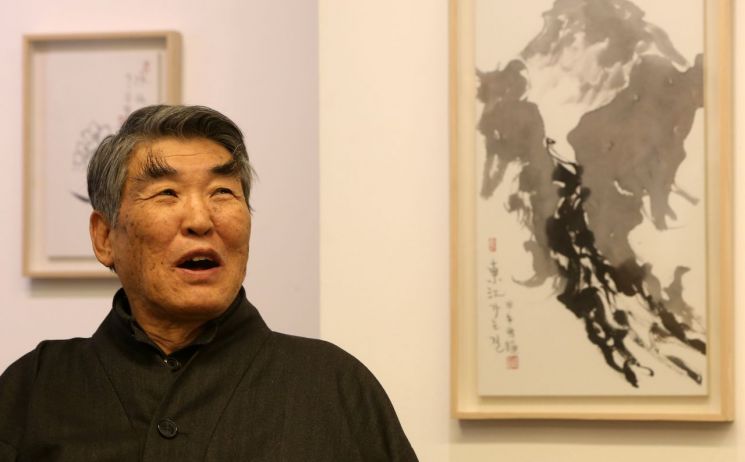 Poet Kim Ji-ha, known for works such as "Burning Thirst" and "Five Enemies," passed away on the 8th at the age of 81. According to a representative from the Land Culture Foundation, the poet died that afternoon at his home in Wonju, Gangwon Province, after battling illness for over a year. The photo shows him at a press conference for the ink landscape exhibition "Empty Mountain" held at Auction Dan in Gyeonun-dong, Jongno-gu, Seoul, on October 31, 2014. [Image source=Yonhap News]
[Asia Economy Reporter Han Seung-gon] "Life and the world now open to me a door that was previously closed, lonely and solitary, yet radiant with light. Through this door, I will be able to freely explore ideas and logic of peace, coexistence, reconciliation, and great creation beyond conflict and struggle."
Kim Ji-ha (81, honorifics omitted hereafter), a representative resistance poet during the dictatorship era known for works such as 'With Burning Thirst' and 'Ojeok (Five Thieves)', passed away on the 8th. Born in Mokpo, Jeollanam-do, he graduated from Seoul National University’s Department of Aesthetics and officially debuted in 1969 by publishing poems like 'Hwangtotgil' and 'Rain' in the magazine Poet, after first publishing 'Evening Story' in Mokpo Literature in 1963. His birth name was Yeong-il (永一), and his pen name Ji-ha (芝河) is known to be derived from the word ji-ha (地下), meaning underground.
As glimpsed in his memoir, Kim Ji-ha consistently delivered messages of reconciliation to a Korean society deeply divided by progressive and conservative ideologies. Consequently, he often became embroiled in ideological debates.
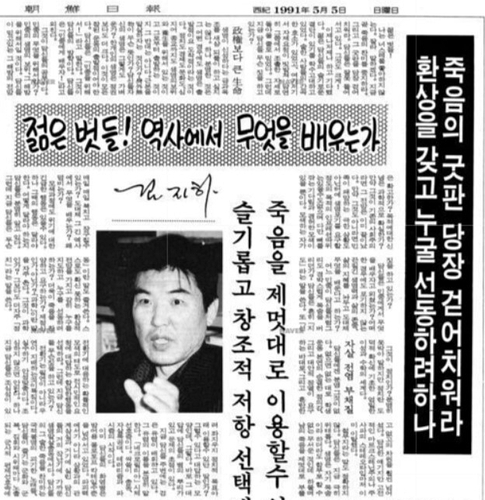
In particular, a column he wrote for the Chosun Ilbo in May 1991 caused a major stir in progressive circles. In the article, he said, "Stop the death ritual," and "Cease the glorification of death. Immediately stop the chilling medical shamanistic ritual."
At that time, following the death of Myongji University student Kang Kyung-dae due to police violence, university students’ self-immolations in protest were occurring one after another. Kim Ji-ha, emphasizing the value of life, likened the act of sacrificing one’s life in democratization protests to a 'cursed shamanistic ritual.' However, the public largely ignored this. Especially among progressives, criticism arose that the poet who had resisted the dictatorship with his pen in the 1960s had betrayed his cause. This column ultimately cemented Kim Ji-ha as a controversial figure criticized by both conservative and progressive camps.
◆ Harsh Words for Both Progressives and Conservatives... Was He Born a Rebel?
The term 'rebel' (반골) literally means 'a bone turned upside down,' symbolizing a disposition to resist authority or orders. However, Kim Ji-ha himself firmly denied having a rebellious nature. Let’s look at part of a column he contributed to Jeonbuk Ilbo on May 29, 2009.
He said, "I was not a rebel from childhood. My innate temperament was rather very gentle and kind. How else could my childhood nicknames have been 'crybaby,' 'whiner,' 'clingy,' and 'gentle soul'?"
He began raising his voice in society during his university years. In the same article, he recalled, "I transformed from a fool into the famous rebel Kim Ji-ha during my university days. There was a humiliating anti-Japan treaty protest, and I heard bloody news while hiding in a refuge."
Indeed, he entered Seoul National University’s Department of Aesthetics in 1959 and participated in the April 19 Revolution the following year. He then took a leading role in democratization movements, engaging with groups such as the National Federation of Korean Students for National Unification and the 'Seoul National University 6.3 Anti-Japan Humiliation Treaty Student General Union.'
Although he denied having a rebellious nature, Kim Ji-ha spoke harshly at critical social turning points and suffered hardships related to literary censorship. During the 1960s, when media and literary controls tightened, several literary censorship incidents occurred, including the 'Lee Young-hee Incident' and the 'Bunji Incident.'
Kim Ji-ha, who participated in the anti-Japan treaty movement, published the satirical poem 'Ojeok (Five Thieves)' in May 1970 through the magazine Sasanggye, sharply criticizing conglomerates, lawmakers, high-ranking officials, generals, and vice ministers whom he labeled as the 'Five Thieves.' This marked the beginning of the 'Ojeok Literary Censorship Incident,' one of the most representative literary censorship cases of the 1970s that would follow Kim Ji-ha throughout his life.
According to sources such as the Democracy Movement Commemoration Association Research Institute and the Encyclopedia of Korean National Culture, the Park Chung-hee government halted the distribution of Sasanggye to prevent the spread of 'Ojeok.'
On June 2, around 1:50 a.m., agents from the Central Intelligence Agency and Jongno Police Station confiscated about 100,000 copies of the 'Democratic Front.' On June 20, Kim Ji-ha, along with Sasanggye representative Bu Wan-hyuk, editor Kim Seung-gyun, and Democratic Front publishing director Kim Yong-sung, were arrested and indicted for violating the Anti-Communist Law. The prosecution argued that the poem 'Ojeok' "incited class consciousness and was used as North Korean propaganda," seeking a guilty verdict. Everything proceeded swiftly, and poet Kim Ji-ha was brought to trial as a defendant.
In court, Kim Ji-ha testified, "The satirical poem 'Ojeok' was a pansori-style satire on some ignorant corrupt officials and the police misconduct in cracking down on them, and it was not intended to incite class consciousness." However, with presidential and parliamentary elections a year away, the Park Chung-hee government could not tolerate a poet who openly criticized political and social elites and the opposition party that used the poem.
In this tense atmosphere, Kim Ji-ha defended himself in court with just a few words directed at the judges and prosecutors. According to a column by the late 'first-generation human rights lawyer' Han Seung-heon, who defended Kim Ji-ha and wrote in Hankyoreh on January 29, 2009, Kim Ji-ha later recalled the trial, saying, "When the trial began and the defense cross-examination proceeded, the lawyer’s concise and sophisticated famous questioning started."
Kim Ji-ha defended himself in a kind of immediate question-and-answer style. When the lawyer asked, "Are you a communist?" he answered, "No." When asked again, "Then why are you on trial?" he replied, "I don’t know either." One lawyer recalled, "It was a strong blow. The essence of the case was summarized and revealed simply with just a couple of questions."
However, the harsh times ultimately shook the monthly Sasanggye, which published the poem 'Ojeok.' Sasanggye’s registration was canceled on September 29, 1970, for violating regulations requiring publishing houses without their own printing presses to register the printing press manager as the printer of the magazine. Sasanggye filed a lawsuit to cancel the government’s registration cancellation, and on October 26, 1971, the Seoul High Court’s special division ruled in favor of Sasanggye.
What is noteworthy here is Kim Ji-ha’s claim?his thoughts and philosophy. He did not describe his poem as a grand discourse inciting social revolution but rather as a form of humor and satire. This philosophy remained unchanged even after nearly 40 years. Although some labeled him a traitor, his philosophy and his value of life remained steadfast.
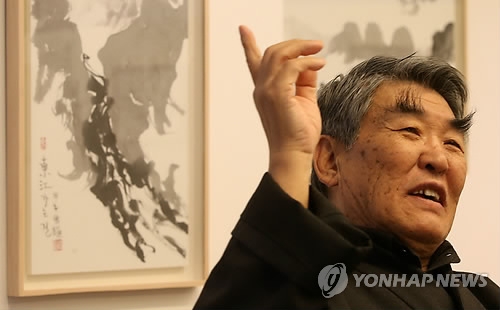 Poet Kim Ji-ha, known for works such as "Burning Thirst" and "Five Enemies," passed away on the 8th at the age of 81.
 [Image source=Yonhap News]
◆ "The Taxes That Poor People Barely Paid. You Embezzle That?"
More than a decade later, as the democratization government took power and Kim Ji-ha’s 'Ojeok' faded from memory, Kim Ji-ha, who had been imprisoned and even sentenced to death for involvement in the past National Democratic Youth and Students Federation (Mincheonghakryeon) incident, was acquitted on January 4, 2013, and once again brought up 'Ojeok.'
In his testimony at the trial, Kim Ji-ha emphasized that his poem was purely satire. He said, "I protected the essence of the poem by exposing the corrupt," and "The largest domain of poetry in our country is 'satire.'" Regarding using poetry to expose society, he said, "I am a poet, so I speak about the world through poetry. Psy’s 'Gentleman' and 'Gangnam Style' are all satire, so if the law restricts that, how can we realize the Renaissance and create a creative economy?"
Kim’s lawyer also argued, "The poem 'Ojeok' satirizes state corruption. It is absurd to prosecute it under the Anti-Communist Law," asserting Kim’s innocence. When asked if he was tortured after arrest, Kim answered, "Yes," and claimed there were grounds for retrial.
However, the court stated in its ruling, "When a verdict sentences a single punishment for multiple crimes, and only some of those crimes are grounds for retrial, the retrial must cover the entire verdict. However, the 'Ojeok Literary Censorship Incident' cannot be retried simply because crimes without retrial grounds were sentenced together with those with retrial grounds." Ultimately, Kim Ji-ha’s 'Ojeok' did not fully escape the charge of violating the Anti-Communist Law.
Immediately after the trial, in an interview with Dong-A Ilbo, he criticized the government again regarding 'Ojeok,' saying, "When I wrote 'Ojeok,' I did not criticize businessmen giving bribes. But I said those who embezzle national treasury funds should be torn apart. That is my belief, no, the people’s belief. It’s okay for merchants to give bribes. But the national treasury is the tax that poor people barely paid. You embezzle that? You should be killed. And at the end of the Roh Moo-hyun administration, those in power embezzled money? The geniuses of resentment from Mokpo and Gwangju who pride themselves as revolutionaries? Did they receive more than the blood money from Mangwol-dong?"
His criticism targeted neither conservatives nor progressives but solely political and high-ranking official corruption. Many citizens at the time sympathized with his stern warning that the 'Five Thieves' he criticized during the dictatorship still existed under the democratization government.
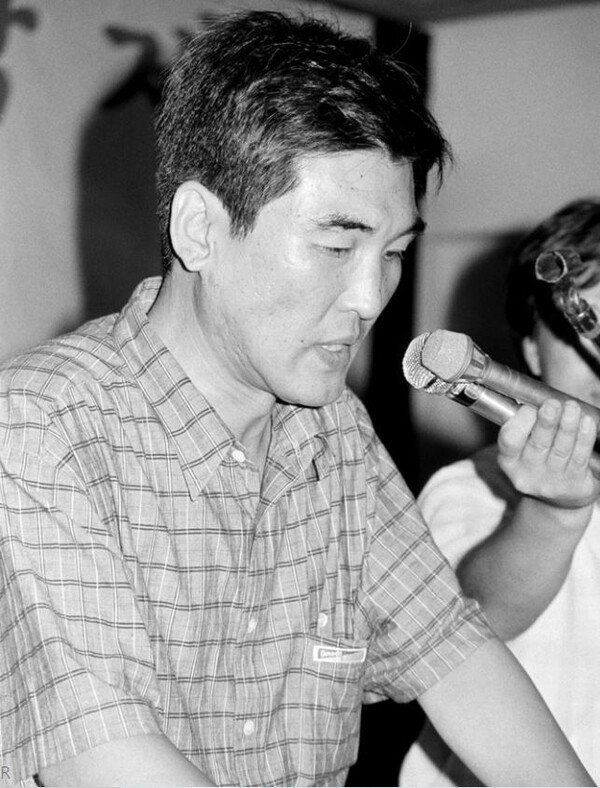 On September 1, 1988, at the Baekinhwekwan in Yeouido, Seoul, poet Kim Jiha is reading a message to world writers at the 88 Seoul National Literature Festival. Photo by Yonhap News
◆ Kim Ji-ha, Who Pursued a Centrist Path... Apologized for Supporting Park, Later Positively Evaluated Candlelight Protests
Politically, Kim Ji-ha pursued a centrist path, focusing on social issues such as reconciliation, unification, environment, and education. On November 9, 2006, he participated as a founding member of the 'Reconciliation and Coexistence Forum.' After refraining from political statements following his 1990s column on the 'cursed shamanistic ritual,' Kim Ji-ha began speaking about the environment and life.
However, he was reserved about politics. In an interview with Kyunghyang Shinmun, he said, "I don’t want to talk about politics. But this can also be seen from a centrist perspective. The Park Chung-hee era developed the economy but forced many sacrifices through dictatorship, and the democratization forces achieved democracy through self-sacrifice but sometimes claimed only they were right, calling others cherry blossoms, traitors, or betrayers."
During the May 2008 candlelight protests, he brought out his poetry collection
Later, in the 2012 presidential election, he declared support for candidate Park Geun-hye, sparking another controversy over 'betrayal.' He later expressed regret for supporting the former president.
In 'Fool 1,' written in 2016, he stated, "Supporting Park Geun-hye / I didn’t know Choi Soon-sil / Nor her father / Choi Tae-min / That’s right / Only fools could do that." He also drew attention for his positive views on the candlelight protests and the Me Too movement. However, he was sometimes critical of the Moon Jae-in administration. In a 2018 interview with Chosun Ilbo, Kim Ji-ha said, "I am neither right-wing nor left-wing, nor centrist. I am someone whose mission is to find a new path."
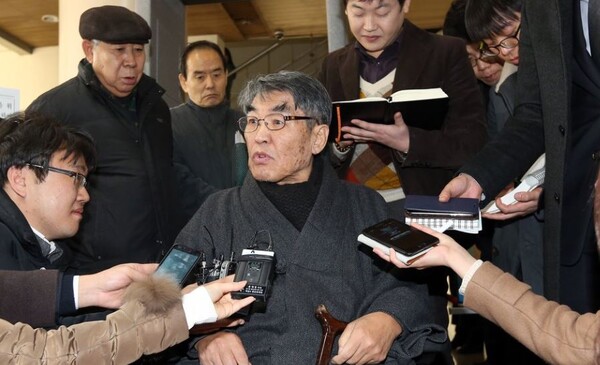 Poet Kim Ji-ha, who was imprisoned in 1974 due to the Mincheonghakryeon incident, answered questions from reporters after finishing a trial at the Seocho-dong Central District Court, clearing his name after 39 years through a retrial. January 4, 2013. Photo by Yonhap News
According to his family, Kim Ji-ha had been battling illness for about a year before passing away at his home in Wonju, Gangwon Province, on the 8th. He married Kim Young-joo, daughter of novelist Park Kyung-ni, in 1973. His survivors include sons Kim Won-bo (writer) and Kim Se-hee (chairman of the Land Culture Foundation and director of the Land Culture Center). The funeral will be held at the Wonju Severance Christian Hospital funeral hall.
His poetry collections include 'Nam (South)' (1984), 'Sallim' (1987), 'Aerin 1' (1987), 'Black Mountain White Room' (1987), 'Rain Clouds on This Family Day' (1988), 'My Mother' (1988), 'Looking Up at the Star Field' (1989), 'Pain of the Center' (1994), 'Hwage' (2002), 'Nomadism and Seclusion' (2004), 'Silk Road' (2006), 'Dawn River' (2006), 'Clumsy Poems' (2009), 'Sikimsae' (2012), and 'White Shade' (2018).
He received numerous awards including the 1975 Lotus Special Prize from the Afro-Asian Writers' Conference, the 1981 Great Poet Award from the International Poets' Association, the Bruno Kreisky Prize, the 14th Jeong Ji-yong Literary Award in 2002, the 10th Daesan Literary Award, the 17th Manhae Literary Award, the 11th Gongcho Literary Award in 2003, the 10th Poetry and Poetics Award for Best Work in 2005, the 10th Manhae Grand Prize in 2006, and the 2nd Minse Award in 2011.
He received an honorary doctorate in literature from Sogang University in 1993 and an honorary doctorate from Jeju National University in 2006. He served as a distinguished professor at Myongji University, Korea National University of Arts, Dongguk University, Wonkwang University, and as a distinguished professor at Konkuk University Graduate School.
© The Asia Business Daily(www.asiae.co.kr). All rights reserved.
![Clutching a Stolen Dior Bag, Saying "I Hate Being Poor but Real"... The Grotesque Con of a "Human Knockoff" [Slate]](https://cwcontent.asiae.co.kr/asiaresize/183/2026021902243444107_1771435474.jpg)

















