Research Results from the University of Georgia Team in the USA
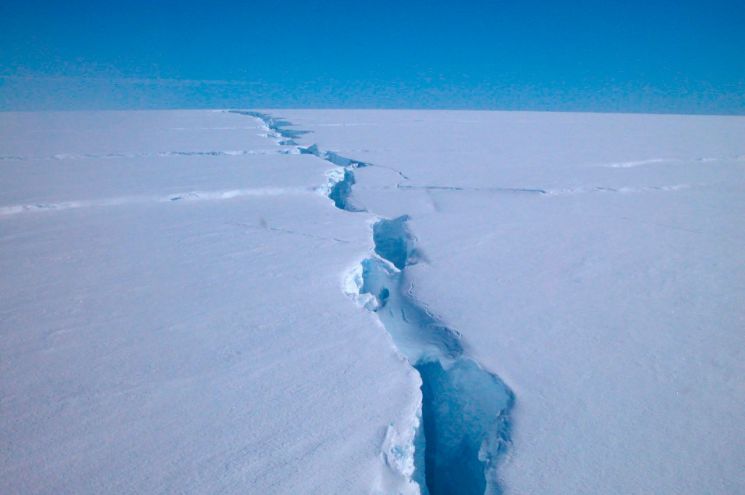 This is the "Wobbly Tooth" point of the Amery Ice Shelf, the third largest on the Antarctic continent, where a massive iceberg "D28" weighing an astonishing 315 billion tons has broken off. The area of this iceberg reaches 1,636 km². [Image source=Yonhap News]
[Asia Economy Reporter Kang Woo-seok] American researchers have expressed concerns that the continued melting of Antarctic glaciers could disrupt the balance of the ecosystem.
On the 8th (local time), according to CNN, a team led by Professor Patricia Jaeger from the Department of Marine Sciences at the University of Georgia confirmed that the melting of the massive Swaits Glacier in Antarctica this January not only caused sea levels to rise but also affected the surrounding ecosystem. The Swaits Glacier is roughly the size of Florida, USA, and is sometimes called the "Doomsday Glacier" because its melting could have catastrophic effects on Earth.
The researchers visually confirmed that the entire ecosystem, from phytoplankton to elephant seals and penguins, has been affected by years of warming.
In fact, elephant seals were observed for the first time in the open water areas called polynyas between the sea ice. The researchers explained that this was due to the abundant iron in the seawater acting as fertilizer for the local ecosystem, leading to a surge in phytoplankton.
The research team hypothesized that iron from the melting ice flowed into the seawater, but computer model analysis revealed that the iron was actually contained in the deep seawater, which is the cause of the glacier melting, and that the buoyancy generated by the melting ice pushed the iron to the surface.
The researchers also noted that while the surface appearance suggests a flourishing of plankton and the ecosystem, other aspects of the ecosystem do not adapt easily.
They warned that if iron levels in the Antarctic sea continue to increase, the ecosystem balance could collapse. They compared this to humans needing a balanced intake of protein, grains, and vegetables for proper nutrition.
Dr. Jaeger said, "If the current phenomenon continues and the sea ice disappears, all structures will collapse," expressing concern that "if high concentrations of carbon and iron from the deep sea continuously rise to the Antarctic sea surface, the consequences are unpredictable."
Pierre Saint-Laurent, a researcher at the Virginia Institute of Marine Science, created a code to predict ocean currents based on water temperature, salinity, wind, ocean depth, and sea ice distribution to assist this study. Saint-Laurent said, "If the Antarctic continental glaciers continue to shrink and global sea levels rise, coastal areas worldwide could be greatly affected," adding, "We are all connected in many ways, for better or worse."
© The Asia Business Daily(www.asiae.co.kr). All rights reserved.
![Clutching a Stolen Dior Bag, Saying "I Hate Being Poor but Real"... The Grotesque Con of a "Human Knockoff" [Slate]](https://cwcontent.asiae.co.kr/asiaresize/183/2026021902243444107_1771435474.jpg)















