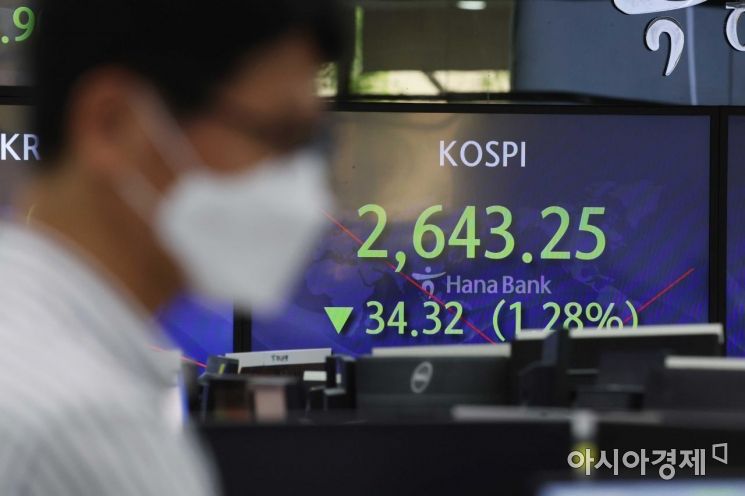
[Asia Economy Reporter Kwon Jae-hee] As the U.S. central bank, the Federal Reserve (Fed), implemented a 'big step' (a 50 basis point increase in the benchmark interest rate), forecasts emerged that additional big steps may follow, causing the domestic stock market to contract.
According to the Korea Exchange on the 8th, the average daily trading value of the KOSPI over the one-month period from the 6th of last month to the 6th of this month was approximately 10.7214 trillion won.
This is similar to the level during the same period in 2020, when the stock market was severely impacted at the beginning of the COVID-19 pandemic (10.6555 trillion won). Compared to the same period last year (16.1494 trillion won), it represents a 33.6% decrease.
The KOSDAQ market also showed sluggish performance.
From the 6th of last month to the 6th of this month, the average daily trading value of KOSDAQ was 7.553 trillion won, down 37.3% compared to the same period last year. This is even lower than the same period in early 2020 during the COVID-19 outbreak (9.5173 trillion won).
Since the beginning of this year, with the continuous pressure of U.S. interest rate hikes and the acceleration of tightening, uncertainty in the domestic stock market has increased, and investor sentiment appears to be shrinking day by day.
The KOSPI trading value, which surged to about 26.4778 trillion won daily in January last year, hit a low of 9.9195 trillion won in December and has not exceeded the 10 to 11 trillion won range this year.
From the 2nd to the 4th of this month, it remained in the 9 trillion won range for three consecutive trading days, only barely rising to 10.3308 trillion won on the 6th.
The market capitalization turnover ratio, which indicates the ratio of trading value to market capitalization, has also decreased.
The monthly average turnover rate, which recorded 24.87% in January last year, fell to 9.88% in December and has remained around 9 to 10% this year.
This shaky state of the domestic stock market is expected to continue for the time being.
The U.S. stock market rallied in relief on the 4th (local time) after Fed Chair Jerome Powell expressed skepticism about a 'giant step' (a 0.75 percentage point increase in the benchmark interest rate) following the Federal Open Market Committee (FOMC) meeting.
However, the next day, the U.S. stock market remained cautious about the strong tightening by monetary authorities, focusing on Powell's remarks that "there is a broad perception within the committee that a 50bp (1bp = 0.01 percentage point) rate hike should be considered in the next couple of meetings."
Researcher Heo Jin-wook of Samsung Securities pointed out, "It is certain that there will be two additional 50bp hikes in the June and July meetings, and more importantly, the size of the rate hike in September is flexible, ranging from 25bp to 75bp depending on future inflation indicators."
Heo added, "Market participants will undergo a fact-checking period to gauge the size of the September rate hike, during which the financial market may react sensitively depending on the U.S. inflation and employment data released over the next one to two months."
However, there is also a forecast that concerns about rate hikes may ease somewhat as expectations grow that the U.S. Consumer Price Index (CPI) inflation rate for April, to be announced on the 11th, may slow down.
Researcher Kim Yu-mi of Kiwoom Securities said, "The CPI announcement will strengthen expectations of an inflation peak out. Although the inflation level is still expected to be high, making it difficult for inflation concerns to be completely resolved, the formation of a peak out can provide relief to the financial market."
© The Asia Business Daily(www.asiae.co.kr). All rights reserved.
![Clutching a Stolen Dior Bag, Saying "I Hate Being Poor but Real"... The Grotesque Con of a "Human Knockoff" [Slate]](https://cwcontent.asiae.co.kr/asiaresize/183/2026021902243444107_1771435474.jpg)















