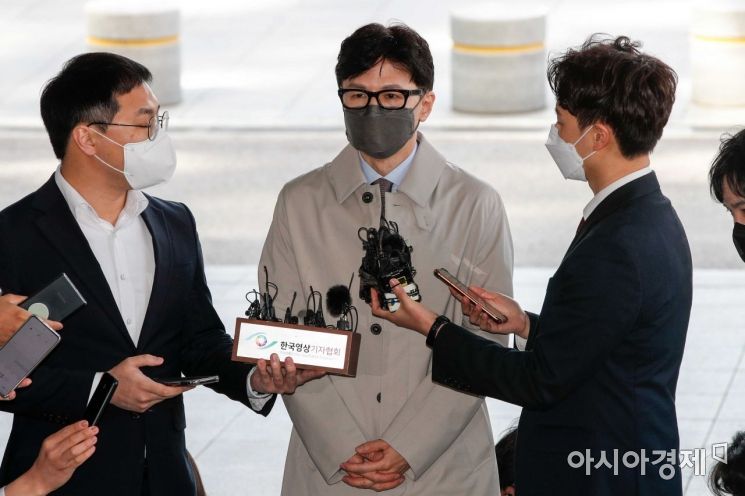
[Asia Economy Reporter Choi Seok-jin, Legal Affairs Specialist] Amid the Democratic Party of Korea's push for the separation of investigation and prosecution through the establishment of the Serious Crime Investigation Office (Jungsucheong), following amendments to the Prosecutors' Office Act and the Criminal Procedure Act, Han Dong-hoon, the nominee for Minister of Justice, stated on the 7th that "investigation and prosecution are inherently inseparable."
He also expressed concern about the recent amendments to the Prosecutors' Office Act and the Criminal Procedure Act passed by the National Assembly, warning that "a serious investigative gap regarding major crimes will occur" and "the damage will be passed on to the general public and society."
In his written response submitted to the National Assembly on the same day, Han clearly opposed the separation of investigative and prosecutorial powers in response to a question from Park Joo-min, a member of the National Assembly's Legislation and Judiciary Committee from the Democratic Party, asking, "What is the candidate's position on the separation of investigative and prosecutorial powers?" He stated, "Investigation is the activity of discovering and securing suspects and collecting and preserving evidence to decide whether to initiate and maintain prosecution. Even by this definition, I believe investigation and prosecution are inherently inseparable."
He added, "The so-called theory of separating investigation and prosecution stems from concerns that investigative prosecutors may fall into confirmation bias and proceed to prosecution, but this is a misunderstanding of investigative practice," emphasizing, "Even under the current system, a healthy tension through discussion and persuasion between the investigative team and the approver has been formed, leading to rational decision-making."
He further pointed out, "On the other hand, if investigation and prosecution are mechanically separated, in complex cases where interests sharply conflict, such as corporate crimes and financial crimes, those who did not conduct the direct investigation will find it difficult to grasp the evidence or case details, which may cause problems in making proper prosecutorial judgments or maintaining prosecution."
Regarding an additional question from Park, who asked, "The prosecution argued that the separation of investigative and prosecutorial powers is unconstitutional, but the Constitutional Court stated that whether to establish and operate an independent agency not affiliated with existing administrative organizations to perform investigative duties, and the scope of investigation or prosecution by such an agency, is a matter for the legislature to decide," Han responded, "There is an opinion that separating or excessively restricting prosecutors' investigative and prosecutorial powers without reasonable grounds may be unconstitutional, and since there are various views on this, I believe it is necessary to listen carefully to the prosecution's claims of unconstitutionality."
He also addressed a question from Park regarding the Ministry of Justice's Prosecutor's Office mentioning the prosecutor's right to request warrants as stipulated in the Constitution and raising the unconstitutionality of bills related to the adjustment of investigative powers between the police and prosecution. Park asked, "However, according to the Constitutional Court's precedents, limiting the warrant applicant to prosecutors aims to prevent human rights violations and indiscriminate warrant applications, reducing the possibility of fundamental rights infringement, and the court judged that the term 'prosecutor' does not only refer to 'prosecutors under the Prosecutors' Office Act.' Does this not deny the Constitutional Court's precedents?" Han replied, "The precedents you mentioned concern discussions on the scope of prosecutors as defined by the Constitution in relation to the establishment of the Corruption Investigation Office for High-ranking Officials (Gongsucheo), and I understand that the deprivation of prosecutors' investigative powers is not a legislative policy issue in that context."
Han also expressed concerns about the recent amendments to the Prosecutors' Office Act and the Criminal Procedure Act passed by the National Assembly.
In response to Park's question, "Regarding the recent legislation on the adjustment of investigative powers between the police and prosecution, the Ministry of Justice's Prosecutor's Office argued that it would cause a gap in the criminal justice system. Since the police are already investigating many of the six major crimes, it seems that no gap will occur. What is the candidate's opinion on this?" Han answered, "In new fields or cases requiring difficult legal theories, such as capital market disruption crimes like stock manipulation, corporate corruption such as accounting fraud, fair trade violations, defense industry corruption, and technology leakage crimes, the long investigative experience and expertise of legal professionals, i.e., prosecutors, cannot be utilized, leading to a serious investigative gap in major crimes, and the damage will inevitably be passed on to the general public and society."
Regarding another question, "The Ministry of Justice's Prosecutor's Office argued that the recent legislation on the adjustment of investigative powers between the police and prosecution destroys the coherence of the legal system due to conflicts with other laws. However, after the first adjustment of investigative powers between the police and prosecution, related laws were revised. If follow-up legislative measures are taken, wouldn't the Prosecutor's Office's opposition be resolved?" Han replied, "If prosecutors' investigative powers are deprived, the scope of laws that need to be revised compared to the first adjustment of investigative powers between the police and prosecution is considerably broader, and the content to be amended is extensive, so it is expected that legislative amendments will take a long time." He added, "I understand that concerns about legislative gaps remain."
When asked by Kim Nam-guk, a member of the Democratic Party, about his goals and achievements if appointed Minister of Justice, Han answered, "I believe the most important role of the Minister of Justice is the establishment of the rule of law that aligns with the values of justice and common sense and the guarantee of political neutrality."
In response to Kim's question, "What do you think is most important for the prosecution to maintain political neutrality?" Han replied, "To secure the prosecution's political neutrality and fairness of investigations, it is important to create systems and environments that allow prosecutors to conduct investigations fairly based on 'law and principles' without being swayed by external pressure."
To the question asked by Kim and Yoo Sang-beom, a member of the People Power Party, "What is your motto?" he answered, "'The world consists only of atoms and empty space; the rest is opinion (Democritus).'"
Regarding his view on the 'de-prosecutorization of the Ministry of Justice,' Han said, "As a result of implementing the 'de-prosecutorization of the Ministry of Justice' policy, I understand there were issues such as a decline in the Ministry's professional expertise and continuity." He added, "If appointed Minister of Justice, I will analyze these points and appoint excellent talents regardless of internal or external sources."
When asked about his position on the claim that the Prosecutor General is not subordinate to the Minister of Justice, Han replied, "I believe it is desirable for the Minister of Justice and the Prosecutor General to respect each other's constitutionally and legally granted powers, faithfully perform their respective roles, and cooperate."
Meanwhile, in response to the question, "Did you ever receive separate instructions from Kim Geon-hee during your time working at the prosecution?" Han answered, "There was no relationship where I would receive instructions, and I have never received any instructions."
© The Asia Business Daily(www.asiae.co.kr). All rights reserved.
![Clutching a Stolen Dior Bag, Saying "I Hate Being Poor but Real"... The Grotesque Con of a "Human Knockoff" [Slate]](https://cwcontent.asiae.co.kr/asiaresize/183/2026021902243444107_1771435474.jpg)















