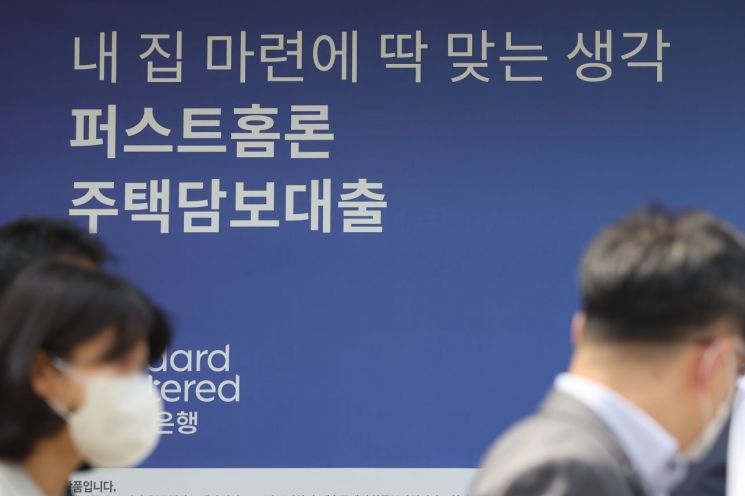
 On the 18th of last month, a banner advertising mortgage loans was displayed in front of a bank in Seoul. The banking sector expects the Bank of Korea to raise the base interest rate to at least 2.00% by the end of the year, which would push the upper limit of loan interest rates into the 7% range.
 "The interest rate isn't going up tomorrow, but I'm worried about the future. Whenever I see words like 'house poor' or 'auction' on the real estate community I visit daily, it feels like it's about me, and it really wakes me up," said newlywed office worker Mr. A, who purchased an apartment worth 670 million KRW in Dobong-gu, Seoul, in February 2020, using a total loan amount of 430 million KRW. He said, "Most of the loan is a 35-year fixed-rate mortgage, so it won't have much impact for now," but added, "I'm concerned about the possibility of house prices falling due to market adjustments following interest rate hikes and the interest on credit loans that are renewed annually."
Until last year, the '2030 Young Kkul (pulling together all their resources)' generation, who led apartment purchases in Seoul and the metropolitan area, are now losing sleep over the fear of rising interest rates. Following the US Federal Reserve's rate hikes, South Korea is also on the brink of raising interest rates. There are even forecasts that domestic banks' mortgage rates will surpass 7% for the first time in 14 years since the 2008 global financial crisis.
The Young Kkul generation has been hit hardest by the interest rate backlash. According to Bank of Korea statistics, over 80% of household loans in South Korea as of January are variable-rate products. Moreover, more than 40% of mortgage borrowers also have credit loans simultaneously. As interest rates rise, the interest burden inevitably increases significantly. This has raised warnings that some Young Kkul borrowers may become house poor, and vulnerable borrowers could face auctions in the future. In March, the number of court auction filings nationwide reversed to an upward trend after three months. Especially in Seoul, the number of filings increased significantly in areas like Nowon, Dobong, and Gangbuk-gu, where the 2030 generation's Young Kkul buying spree was concentrated.
The recent increase in auction properties, which had been declining until the end of last year, reflects the growing financial burden on gap investors and others due to interest rate hikes and loan regulations. The US recently raised its benchmark interest rate by 0.5 percentage points for the first time in 22 years and has hinted at several more 'big steps' (0.5 percentage point hikes) ahead. Reflecting this atmosphere, auction properties, which had been decreasing since the end of last year, have turned to an upward trend after three months.
According to the Korean Court Auction Information website on the 6th, the number of court auction cases filed nationwide in March was 6,477, a sharp increase of 19.55% compared to the previous month (5,418 cases). The number of court auction filings had been declining since December last year but reversed to an upward trend after three months.
The number of court auction filings refers to cases where auctions have been applied for at the respective district courts. Since it takes more than six months from appraisal to actual bidding, it shows the current economic trend relatively faster than the 'ongoing cases' based on actual bids. Court auction filings include real estate and movable properties such as houses, land, commercial buildings, factories, and vehicles, with houses typically accounting for the largest share.
In Seoul, the increase in auction filings was particularly notable in areas where the 2030 generation's Young Kkul buying spree was concentrated until last year. The Seoul Southern District Court, which has jurisdiction over Gangseo, Guro, and Geumcheon-gu, saw filings rise from 152 cases in February to 235 cases in March, a 54.6% increase. The Seoul Northern District Court, covering Nowon, Dobong, and Gangbuk, also saw an 11.63% increase from 129 to 144 cases during the same period.
Notably, Nowon, Dobong, and Gangbuk, collectively known as 'Nodogang,' have seen significant house price increases over the past two years. These areas are densely populated with apartments priced below 900 million KRW, attracting Young Kkul buyers from the 2030 generation who generally have limited financial capacity. In Nowon-gu, the 2030 generation accounted for 49.3% of total purchases last year, indicating strong demand from this age group.
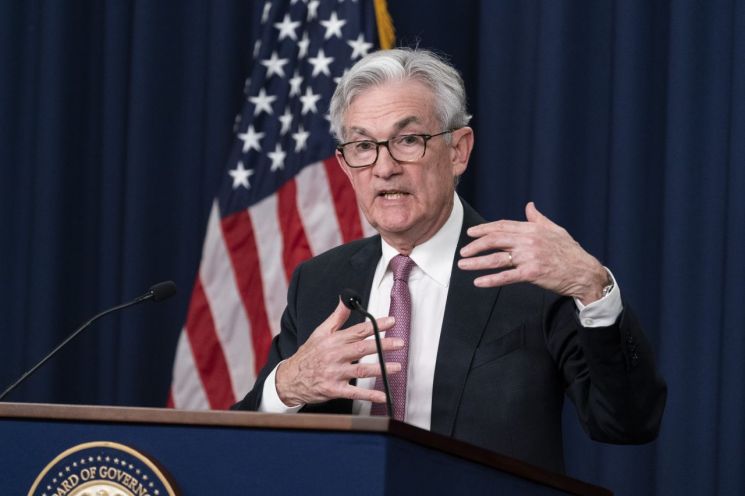 Jerome Powell Jerome Powell, Chairman of the U.S. Federal Reserve (Fed), held a press conference at the Washington DC headquarters on the 4th (local time). After concluding the two-day Federal Open Market Committee (FOMC) regular meeting, the Fed announced in a statement that it would raise the benchmark interest rate by 0.5 percentage points from the current 0.25-0.5%.
The increase in auction filings is attributed to rising interest rates and growing household loans. Shin Tae-su, CEO of Jijon, a real estate development information platform, said, "An increase in auction filings means many cases are going to auction because borrowers cannot repay their loans," adding, "It can be seen as a sign of market stagnation." He further explained, "Especially the 2030 generation who rushed to buy homes with Young Kkul and self-employed borrowers on the edge who barely managed under low interest rates can no longer endure the rate hikes, pushing their properties into the auction market." A real estate auction industry insider said, "Once a property goes to auction, it often sells for less than half its market value or even less, leading to liquidation," emphasizing, "It is crucial to prevent loan defaults and avoid situations where properties go to auction."
Experts advise a conservative approach, such as increasing equity ratios as much as possible, given the sharp interest rate hikes ahead. Professor Lim Jae-man of Sejong University's Department of Real Estate said, "Unless the government converts current loans to low-interest ones or individual borrowers' incomes increase significantly, it seems difficult for individuals to cope with the current interest rate hike period," adding, "Reducing loans is the best option." He said, "(The 2030 generation) bought into the market expecting house prices to rise, even though they didn't have enough capital, but in the worst case, they may have to sell their homes, and if that fails, they have no choice but to hold on." Park Won-gap, KB Kookmin Bank's senior real estate specialist, advised, "It is better to avoid loans exceeding 30% of the house price or monthly principal and interest repayments exceeding 30% of income," adding, "Those already heavily indebted should actively downsize their debt."
© The Asia Business Daily(www.asiae.co.kr). All rights reserved.
![Clutching a Stolen Dior Bag, Saying "I Hate Being Poor but Real"... The Grotesque Con of a "Human Knockoff" [Slate]](https://cwcontent.asiae.co.kr/asiaresize/183/2026021902243444107_1771435474.jpg)

















