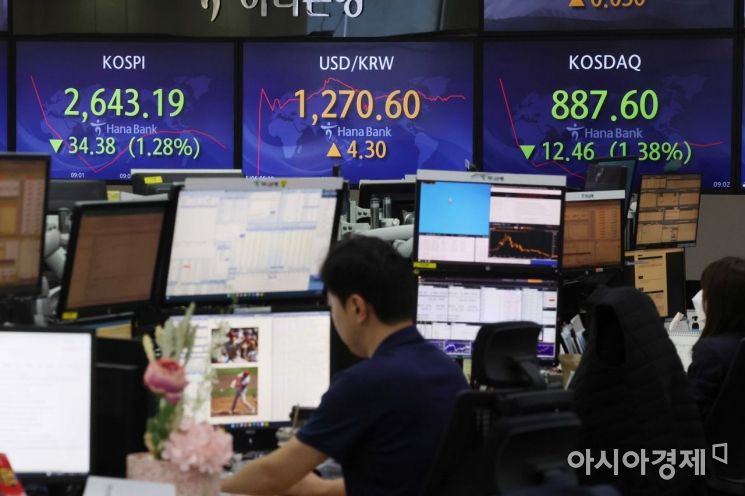
 On the 6th, dealers were busy working in the Hana Bank dealing room in Euljiro, Seoul, as the KOSPI index showed a downward trend due to the impact of the U.S. stock market crash. On that day, the KOSPI started at 2,650.89, down 26.68 points (1.00%) from the previous session. The KOSDAQ began at 888.54, down 11.52 points (1.28%). The won-dollar exchange rate started at 1,267.0 won, up 0.7 won, breaking through the 1,270 won level again. Photo by Moon Honam munonam@
[Asia Economy Sejong=Reporters Son Seon-hee, Kwon Hyun-ji] As the pace of U.S. monetary tightening accelerates and the foreign exchange market fluctuates daily, voices are growing to put a permanent currency swap between South Korea and the U.S. on the agenda at the first “Korea-U.S. Summit” under the Yoon Suk-yeol administration scheduled for the 21st. However, it is analyzed that the likelihood of this becoming a reality is low.
On the 6th, the won-dollar exchange rate in the Seoul foreign exchange market continued its upward trend in the early session and surpassed the 1,270 won level. It was the first time in four trading days since the 29th of last month that the exchange rate broke through the 1,270 won level during the session. This was a consequence of the U.S. Federal Reserve holding its Federal Open Market Committee (FOMC) regular meeting on the 4th (local time) and raising the benchmark interest rate by 0.5 percentage points from the previous 0.25-0.5% range.
The exchange rate also hovered around the 1,270 won level in March 2020, early in the COVID-19 crisis. At that time, the Bank of Korea signed a currency swap agreement with the U.S. Federal Reserve with a limit of $60 billion (March 19, 2020). Although only $20 billion was actually used, the announcement alone eased concerns about foreign currency funding, leading to a stock market rebound and a decline in the won-dollar exchange rate. Recently, as concerns over won depreciation and foreign currency outflows have increased, calls for a currency swap agreement have resurfaced. Seong Il-jong, Policy Committee Chairman of the People Power Party, said at the National Assembly’s floor meeting that “To solve the top priority task of stabilizing people’s livelihoods under the Yoon Suk-yeol administration, it is important to eliminate instability in the foreign exchange and financial markets,” adding, “For this, a currency swap agreement between Korea and the U.S. must be concluded.”
Regarding this, the government’s stance is cautious. Earlier, on the 2nd, during the National Assembly confirmation hearing, Choo Kyung-ho, nominee for Deputy Prime Minister and Minister of Economy and Finance, took a cautious attitude, saying, “Since there is also the position of the other country, it is an issue that should be reviewed from a diplomatic perspective.” Lee Chang-yong, Governor of the Bank of Korea, also said, “It’s not just that we want (a permanent swap) and it happens,” adding, “Coordination is needed on whether the U.S. central bank will accept it.”
In fact, the U.S. has established permanent swap lines only with five major reserve currency countries, including Japan, Europe (ECB), and Switzerland. This means that only currencies with actual demand arising from transactions in the international financial market, not temporary measures to respond to market instability, are eligible, making a permanent agreement with Korea realistically difficult.
Another factor lowering the possibility of an agreement is that the current won depreciation intertwined with the U.S. monetary tightening policy differs from the situation when the U.S. temporarily signed currency swaps with nine countries including Korea to supply liquidity at the early stage of the COVID-19 crisis.
An official from the Ministry of Economy and Finance’s International Finance Bureau said regarding the possibility of discussions on a Korea-U.S. currency swap between the leaders, “Nothing concrete has been progressed yet,” adding, “Of course, it would be good from our side, but even if a swap is not immediately concluded, it is not a situation that would cause problems.”
© The Asia Business Daily(www.asiae.co.kr). All rights reserved.

















