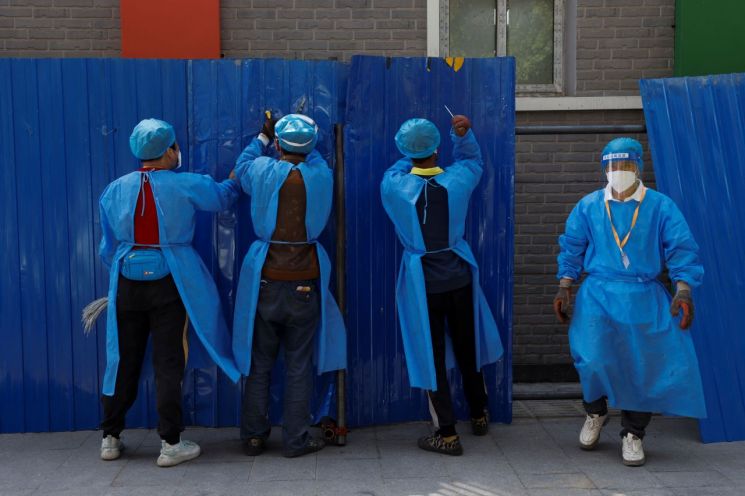
 On the 4th (local time) in Beijing, the capital of China, quarantine personnel equipped with personal protective equipment (PPE) are setting up barricades around residential areas under lockdown measures to prevent the spread of COVID-19. / Photo by Yonhap News
[Asia Economy Reporter Hwang Sumi] Controversy over government censorship has arisen as social media accounts of economic experts criticizing China's zero-COVID policy have been repeatedly blocked.
According to the Hong Kong South China Morning Post (SCMP) on the 4th (local time), the WeChat and Weibo accounts of Honghao, head of the research center at Bocom International, a securities firm affiliated with the Bank of Communications, were shut down on the 30th of last month.
Previously, Honghao posted several messages on social media highlighting the negative impacts of the Shanghai lockdown, including a video of empty roads in downtown Shanghai with the caption "Shanghai: zero movement, zero Gross Domestic Product (GDP)."
It is unclear why his social media accounts disappeared, but SCMP reported rumors that it was because he questioned China's zero-COVID policy and predicted a stock market decline.
According to SCMP, Bocom International announced on the 3rd that Honghao resigned for personal reasons. His name was also omitted from the market report published that day.
However, it is reported that Honghao's Twitter account is still active. He has updated his profile to "Former Bocom International."
Honghao is not the only economic expert to disappear from Chinese social media. The Weibo accounts of Fu Peng, chief economic expert at Northeast Securities; Dan Bin, CEO of Shenzhen Oriental Harbor Investment; and Wu Weifeng, fund manager at Beijing Funding Capital, have all been blocked.
The commonality among them is that they criticized the zero-COVID policy on social media, warning of an economic downturn caused by it.
The Weibo account of Wang Sichong, son of Wang Jianlin, chairman of the Chinese real estate conglomerate Wanda Group, was also deleted last week. It is reported that he faced sanctions after posting doubts about the efficacy of Lianhua Qingwen, a COVID treatment promoted by authorities, and Shanghai's epidemic prevention policies.
SCMP stated, "As citizens' dissatisfaction grows due to the economic burden imposed by China's strict zero-COVID policy, authorities are deploying new censorship tools to strengthen social media regulation." It added that due to this censorship, some investors are finding it increasingly difficult to obtain reliable investment information.
Meanwhile, the number of new COVID-19 cases in Beijing, the capital of China, stood at 51 as of the 3rd, maintaining a range of 30 to 60 cases since the 25th of last month.
Accordingly, a quasi-lockdown situation continues in Beijing. Authorities, judging that infections from public transportation are increasing, have closed about 40 subway stations. The controlled areas are expanding, with over 600 buildings reportedly under lockdown management. Additionally, daily testing is being conducted for all residents in 12 districts, which account for more than 90% of Beijing's population.
© The Asia Business Daily(www.asiae.co.kr). All rights reserved.
![Clutching a Stolen Dior Bag, Saying "I Hate Being Poor but Real"... The Grotesque Con of a "Human Knockoff" [Slate]](https://cwcontent.asiae.co.kr/asiaresize/183/2026021902243444107_1771435474.jpg)















