Despite the surge in mobility, the decline in the epidemic trend is expected to continue
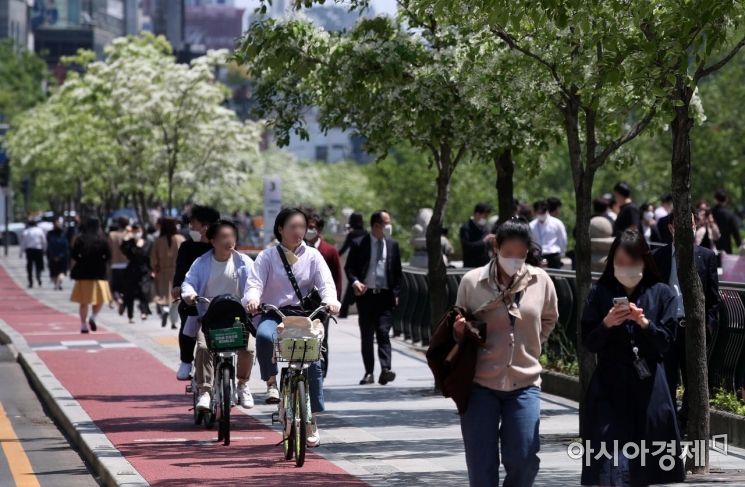 On the first day of outdoor mask restrictions being lifted, citizens are enjoying a walk at Cheonggyecheon in Seoul on the 2nd. Photo by Hyunmin Kim kimhyun81@
[Asia Economy Reporter Jo In-kyung] As the first holiday since the full lifting of social distancing and the removal of the outdoor mask mandate, the government once again emphasized the public's adherence to personal quarantine guidelines.
According to the Central Disaster and Safety Countermeasures Headquarters on the 5th, Son Young-rae, head of the Social Strategy Division at the Ministry of Health and Welfare's Central Accident Response Headquarters, said at a briefing the day before, "With holidays such as Children's Day, we expect many people to travel or gather," adding, "We once again urge everyone to strictly follow personal quarantine rules such as hand washing and mask wearing in high-risk environments."
The quarantine authorities anticipate a sharp increase in family outings and gatherings with acquaintances during the extended holiday from Thursday, Children's Day, through the weekend. Following the full lifting of social distancing on April 18, indoor eating at places like movie theaters and sports venues was permitted starting April 25, and from May 2, the outdoor mask-wearing mandate was mostly lifted. Therefore, it is expected that mobility will significantly increase during this Children's Day and holiday period.
Earlier, the Central Accident Response Headquarters analyzed mobile phone mobility data and found that during the second week after the lifting of social distancing (April 25 to May 1), nationwide mobility reached 255.16 million cases, a 2.4% increase compared to the previous week (April 18 to 24) with 249.29 million cases. However, this is still 10.1% lower than the nationwide mobility during the same period in 2019 (April 25 to May 1), which was 283.78 million cases before the COVID-19 outbreak.
Despite the increase in mobility, the current downward trend in infections is expected to continue. Son said, "Although it has been three weeks since social distancing was lifted, the number of new confirmed cases continues to steadily decline," adding, "Even if mobility increases, a significant portion of the population has immunity from vaccination or previous COVID-19 infection, so the downward trend is expected to be maintained."
It is anticipated that it will take considerable time before COVID-19 is completely eradicated. Son stated, "Once the decline reaches a certain limit, the number will likely stabilize at that level," and "It is difficult to predict exactly what the lower limit will be."
He also emphasized, "We must not forget that we will have to live with COVID-19 for a considerable period," and urged, "Since small to medium-sized outbreaks may recur and new variants may emerge, the public should continue to voluntarily comply with quarantine guidelines in their daily lives."
© The Asia Business Daily(www.asiae.co.kr). All rights reserved.
![Clutching a Stolen Dior Bag, Saying "I Hate Being Poor but Real"... The Grotesque Con of a "Human Knockoff" [Slate]](https://cwcontent.asiae.co.kr/asiaresize/183/2026021902243444107_1771435474.jpg)
















