Prime Minister Candidate Han Deok-su Faces Challenges from Appointment Approval
Reform Breakthrough Expected Through Enforcement Decrees
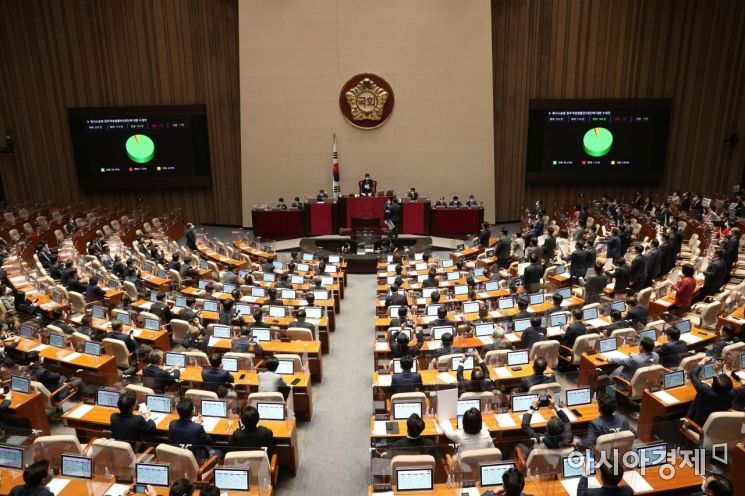 The second bill among the inspection reform bills, the amendment to the Criminal Procedure Act, passed the plenary session of the National Assembly on the 3rd. Photo by Yoon Dong-joo doso7@
[Asia Economy reporters Naju-seok, Kim Hye-min, Lee Ki-min] The so-called "complete removal of prosecution investigation rights" (Geomsu Wanbak) law passed the National Assembly as the ruling Democratic Party of Korea (DPK) intended, and the power of the 'minority ruling, majority opposition' situation is expected to become even stronger after the new government’s inauguration. For the next government and the People Power Party (PPP), they only have the minimum device of the 'veto power on bills' after the government’s launch, but various reform drives prepared for the new government’s agenda are highly likely to be blocked by the wall of minority ruling, majority opposition.
The day after the Geomsu Wanbak law was promulgated on the 4th, there was a widespread atmosphere within the PPP that they truly felt the minority ruling, majority opposition situation. A senior lawmaker said, "I felt the huge wall of minority ruling, majority opposition," adding, "I will feel the barrier even more after the government’s inauguration."
At the confirmation hearing for Prime Minister nominee Han Duck-soo, PPP lawmakers, who will be the ruling party, asked how to overcome the minority ruling, majority opposition situation. In response to questions from Joo Ho-young, the chairman of the confirmation special committee, Han said, "I will emphasize the importance of cooperation," and "I plan to communicate and talk with the DPK as much as possible and run around until the soles of my shoes wear out."
The PPP and the next government plan to actively utilize the administrative legislation (enforcement ordinances) that the president holds as a practical measure to overcome the minority ruling, majority opposition. On that day, PPP leader Lee Jun-seok said at the Supreme Council meeting, "The people already know well and criticize the DPK’s one-way traffic style of National Assembly politics," and "We will not be intimidated by the DPK’s recklessness and will boldly do what we have to do." They aim to regain political momentum early in the administration by winning the upcoming local elections next month and the by-elections for seven parliamentary seats.
Even looking at the national agenda created by the Presidential Transition Committee, it is evaluated that the minority ruling, majority opposition structure of the National Assembly was taken into account. The committee estimates about 1,000 national agenda items that require adjustments to laws, including enforcement ordinances and law amendments. Among these, orders and enforcement ordinances that do not require passage through the National Assembly are classified as 'government self-driven tasks' and prioritized in the national agenda. They plan to start revising subordinate laws such as enforcement ordinances simultaneously with the new government’s launch.
For example, to supplement the Serious Accident Punishment Act, the national agenda includes 'maintenance of industrial safety and health-related laws' instead of law amendments. The content aims to resolve uncertainties at the field level through law amendments and clarify the obligation of managers to ensure safety and health through guidelines and manuals. Since law amendments are difficult, it is interpreted as an intention to preserve the purpose of supplementing the Serious Accident Punishment Act.
There are also national agenda items that prepare countermeasures in case the passage through the National Assembly is delayed. The abolition of the Minister of Justice’s investigation command authority is a representative example. To implement this, Article 8 of the Prosecutors’ Office Act must be amended, but the committee plans to prepare a method to propose the exercise of investigation command authority before the law amendment and consider its prior implementation.
In addition, there are tasks that can be passed through cooperation with the DPK and tasks that can persuade the DPK with public support, and implementation strategies have been separately prepared. The DPK does not intend to go into confrontation unconditionally either. Park Hong-geun, the DPK floor leader, said, "We have selected common presidential election pledges such as increasing the basic pension and debt restructuring for small business owners," and "We will implement them."
Due to the presidential election decided by a 0.7 percentage point difference and consecutive local elections, the confrontation between the ruling and opposition parties is likely to intensify further. For example, Floor Leader Park has taken an offensive stance regarding some revisions and retreats of President-elect Yoon Seok-youl’s election pledges, saying, "We will correct them," and "President-elect Yoon should come to the table."
However, the PPP sees the decline in the DPK’s approval ratings during the Geomsu Wanbak law process as an opportunity. According to a Research View poll (conducted nationwide among 1,000 adults aged 18 and over from the 29th to 30th of last month), the PPP’s approval rating was 50%, and the DPK’s was 36%. Compared to the previous month, the DPK’s rating dropped by 2 percentage points, while the PPP’s rose by 5 percentage points. The political circles interpret this as reflecting not only the merger of the PPP and the People Party but also public opinion on the forcible passage of the Geomsu Wanbak law.
© The Asia Business Daily(www.asiae.co.kr). All rights reserved.
![Clutching a Stolen Dior Bag, Saying "I Hate Being Poor but Real"... The Grotesque Con of a "Human Knockoff" [Slate]](https://cwcontent.asiae.co.kr/asiaresize/183/2026021902243444107_1771435474.jpg)















