Prosecutors: "Geomsuwanbak is clearly unconstitutional... President Moon should exercise the right to request reconsideration"
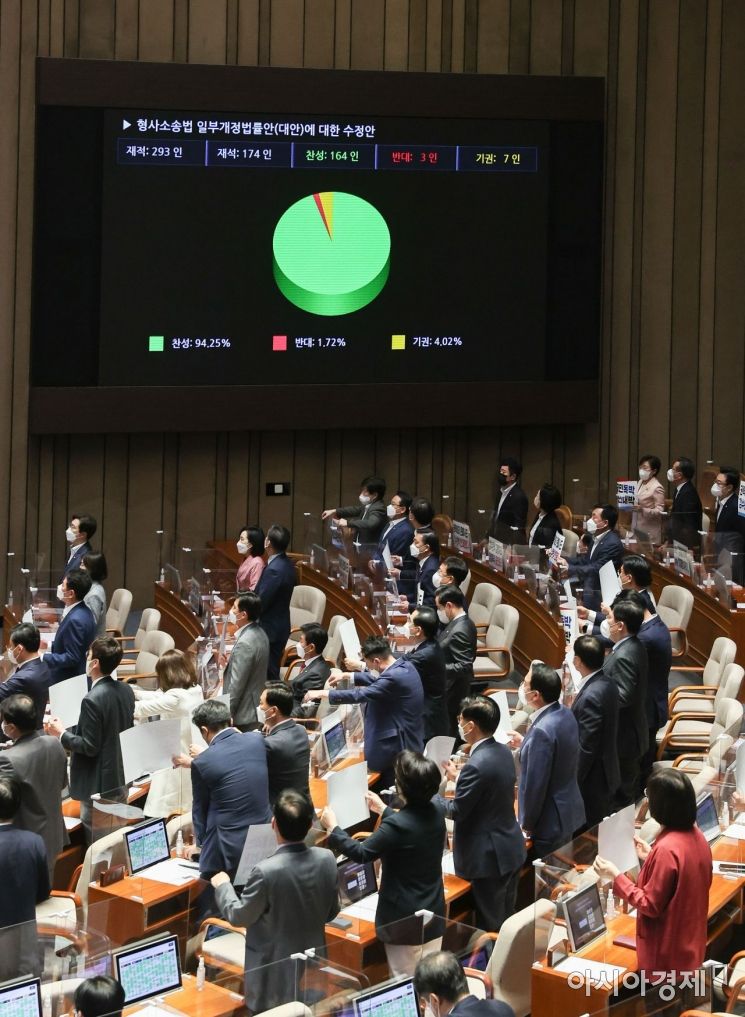 The second bill among the inspection ban laws, the amendment to the Criminal Procedure Act, passed the National Assembly plenary session on the 3rd. Photo by Yoon Dong-joo doso7@
[Asia Economy Reporter Heo Kyung-jun] As the amendment to the Criminal Procedure Act, one of the so-called ‘Geomsu Wanbak (complete deprivation of prosecutorial investigative authority)’ bills, passed the National Assembly on the 3rd, the prosecution appealed to President Moon Jae-in to "exercise the right to request reconsideration."
The Supreme Prosecutors' Office issued a statement titled ‘Position on the Passage of the Geomsu Wanbak Bill in the Plenary Session’ immediately after the Criminal Procedure Act amendment passed the plenary session, stating, "As the protector of the rule of law and democracy, we earnestly appeal to the President, who represents the people, to exercise the constitutionally stipulated right to request reconsideration so that the reform of the criminal justice system, a national long-term plan, can be carried out through in-depth discussion and deliberation based on national consensus."
According to Article 53 of the Constitution, a bill passed by the National Assembly is sent to the government and the President must promulgate it within 15 days. If the President has objections to the bill, they may attach a statement of objections and return it to the National Assembly within these 15 days to request reconsideration.
The Supreme Prosecutors' Office stated, "If the passed bill is enforced, the complainant’s right to file objections will be deprived, blocking good-faith complaints for socially vulnerable groups such as persons with disabilities or whistleblowers who courageously expose internal corruption by law," adding, "Even if the complainant or victim files an objection, investigations into the real culprit, accomplices, additional damages, and recovery of criminal proceeds cannot be conducted, eliminating the last chance to uncover the full truth of cases and alleviate the grievances of wronged citizens."
It further expressed concern, saying, "It will become impossible to properly respond to serious crimes that threaten the foundation of the nation, such as crimes by public officials, election fraud, defense industry corruption, and large-scale disasters, causing a serious gap in corruption prevention and public order."
The Supreme Prosecutors' Office reiterated that the Geomsu Wanbak bill clearly has constitutional issues. It stated, "There are clear constitutional violations, including Article 12, Paragraph 3 and Article 16 of the Constitution, which define prosecutors as investigative authorities responsible for requesting warrants; Article 11, Paragraph 1, which guarantees the principle of equality, violated by giving unreasonable privileges to important offenders such as public officials and election fraud suspects; and Article 27, Paragraph 5, which guarantees the criminal victim’s right to testify in court proceedings."
It added, "The bill was passed in less than a month without proper hearings, and in the process, the procedures stipulated by the Constitution and the National Assembly Act were rendered ineffective, damaging the essence of parliamentary democracy and the principle of due process under the Constitution."
© The Asia Business Daily(www.asiae.co.kr). All rights reserved.
![Clutching a Stolen Dior Bag, Saying "I Hate Being Poor but Real"... The Grotesque Con of a "Human Knockoff" [Slate]](https://cwcontent.asiae.co.kr/asiaresize/183/2026021902243444107_1771435474.jpg)















