"Endemic Transition Requires Tourism Revitalization Measures"
Asiana M&A "Proceeding as Planned"
Mongolia Route "Difficult to Represent LCC Position"
Russia '110 Billion Won Fine' "Prepared to File Administrative Lawsuit"
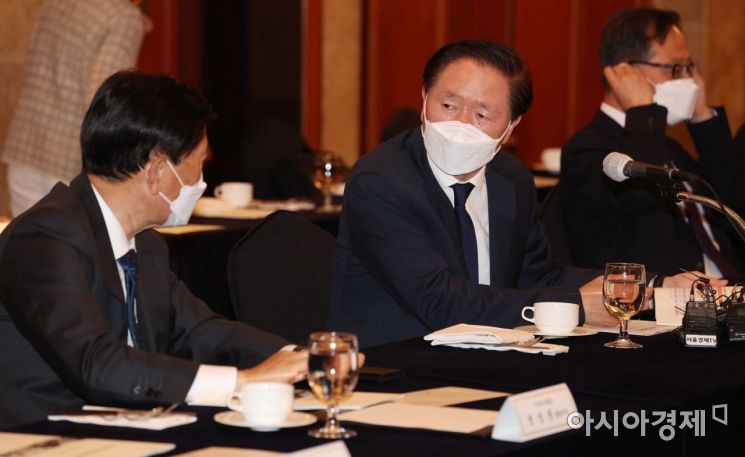 Woo Ki-hong, Chairman of the Tourism Industry Committee of the Korea Chamber of Commerce and Industry (CEO of Korean Air), is delivering a greeting at the "24th Tourism Industry Committee" hosted by the Korea Chamber of Commerce and Industry at Lotte Hotel in Jung-gu, Seoul on the 3rd. The meeting discussed tasks to revitalize the aviation and tourism industries in the post-COVID endemic era. Photo by Moon Ho-nam munonam@
[Asia Economy Reporter Moon Chae-seok]
"Europe, the United States, and Southeast Asia have expanded international air routes to 90% of pre-COVID levels, but Korea is only at 10%. To enter Korea, individuals must undergo at least two PCR tests, costing about $200 (approximately 253,000 KRW) each."
Woo Ki-hong, Chairman of the Tourism Industry Committee at the Korea Chamber of Commerce and Industry (KCCI) and CEO of Korean Air, requested the government to ease PCR testing regulations. On the 3rd, Woo attended the 24th Tourism Industry Committee meeting held by KCCI at the Lotte Hotel in Sogong-dong, Jung-gu, Seoul, stating, "Until now, we have focused on responding to the COVID-19 crisis, but now, in preparation for the endemic era, active cooperation between the tourism industry and the government is necessary." The meeting was attended by business leaders including Han Chae-yang, CEO of Chosun Hotel & Resort; Ahn Se-jin, CEO of Hotel Lotte; Oh Chang-hee, President of the Korea Association of Travel Agents; Yoo Yong-jong, President of the Korea Hotel Association; Lee Dae-sung, President of the Korea Hotel Professional Managers Association; as well as Heo Hee-young, President of Korea Aerospace University, and Lee Hoon, President of the Korea Tourism Association.
Woo pointed out that the number of inbound tourists has regressed to 970,000, the level of 1980, due to the three-year COVID-19 pandemic impact. This is only 5% of the 17.5 million visitors in 2019, before the pandemic. He explained, "The entire tourism ecosystem, including travel, accommodation, exhibitions, duty-free shops, as well as small business owners and service industries, has suffered fatal damage and is on the brink of collapse," adding, "The annual revenue loss in the tourism industry reached 30 trillion KRW."
Woo criticized that Korea’s pace of regulatory easing is slower than that of other countries. Unlike countries that have completely lifted entry restrictions and quarantine regulations, Korea is only "standing still." Currently, PCR testing is still required to enter Korea, and unquarantined entry for minors is not allowed, which inevitably restricts family travel. He emphasized, "In the endemic era, excessive quarantine regulations compared to international standards should be eased to actively attract the expected surge of global tourists, and long-term tourism industry growth strategies should be pursued together."
Meeting participants unanimously agreed that government support is crucial to restore the fundamentals of the tourism industry. They stressed that policy support must continue until the tourism industry fully recovers, beyond just easing quarantine measures. Other attendees called for support in areas such as immigration procedures and normalization of international air routes (aviation), extension of policy support and improvement of duty-free systems (duty-free shops), and support for workforce recruitment and tax rationalization (hotels).
Meanwhile, after the committee meeting, Woo told reporters that regarding the merger and acquisition (M&A) of Korean Air and Asiana Airlines, "We are proceeding as planned and focusing all efforts on reviews by competition authorities in six countries including the U.S. and the European Union (EU). We exchange data with these six authorities almost daily." Currently, Korean Air has received approval for the merger from the Korea Fair Trade Commission as well as from Turkey, Taiwan, Vietnam, and Singapore, but is awaiting reviews from the U.S., EU, Japan, China, the U.K., and Australia.
Earlier, on the 21st of last month, Cho Won-tae, Chairman of Hanjin Group, spoke at the 'Korea Business Seminar Forum 2022' hosted by the American Chamber of Commerce in Korea (AMCHAM), delivering a message requesting M&A approval from U.S. competition authorities. Cho said, "Asiana has faced significant financial difficulties, but if Korean Air acquires it, losses that could occur from Asiana’s suspension of operations can be prevented, thereby avoiding economic losses for both Korea and the U.S." He emphasized, "Korean Air operates various businesses worldwide and is ready to expand its activities in the U.S."
Regarding complaints from low-cost carriers (LCCs) such as Air Busan and Air Seoul about the M&A with Asiana, Woo said, "It is difficult for us to represent the LCCs’ position, and route allocation is handled by the Ministry of Land, Infrastructure and Transport." He added, "Air Busan, a subsidiary of Asiana, has not yet completed the merger approval process with Korean Air, so please understand the various legal circumstances." The Ministry of Land, Infrastructure and Transport held an Air Traffic Deliberation Committee meeting on the 14th of last month and allocated the Mongolia route, previously operated only by Korean Air and Asiana Airlines, to LCCs as well. Jin Air, a subsidiary of Hanjin Kal, and Air Busan and Air Seoul, subsidiaries of Asiana Airlines, failed to secure operating rights. The industry believes the ministry denied the allocation to subsidiaries because if operating rights were granted to subsidiaries amid the parent companies’ integration, monopoly issues could arise.
Regarding the 110 billion KRW fine imposed by Russian authorities, Woo said they might file an administrative lawsuit in Russian courts. He stated, "We consider the fine excessive, and if our protest is not accepted, we are even considering filing an administrative lawsuit in Russian courts." Last year on February 22, Korean Air’s cargo flight KE529 from Incheon to Moscow to Frankfurt received takeoff clearance from Moscow Sheremetyevo Airport air traffic control but was later pointed out by airport customs for missing part of the departure procedure (customs stamp). One year later, on February 24, Russian authorities imposed an 8 billion ruble (approximately 110 billion KRW) fine on Korean Air.
© The Asia Business Daily(www.asiae.co.kr). All rights reserved.
![Clutching a Stolen Dior Bag, Saying "I Hate Being Poor but Real"... The Grotesque Con of a "Human Knockoff" [Slate]](https://cwcontent.asiae.co.kr/asiaresize/183/2026021902243444107_1771435474.jpg)
















