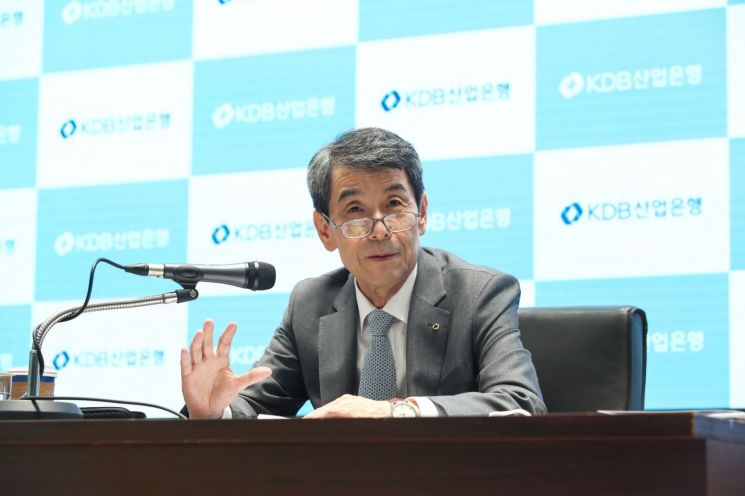
[Asia Economy Reporters Song Hwajeong and Yoo Jehoon] Lee Dong-geol, Chairman of the Korea Development Bank (KDB), stated that regarding the restructuring of Daewoo Shipbuilding & Marine Engineering (DSME), if the shipbuilding industry's big three system?Hyundai Heavy Industries, Samsung Heavy Industries, and DSME?cannot be changed into a big two system, the problem of oversupply will persist, and unless a boom continues, there is a possibility that large-scale shipbuilding insolvencies could reoccur in a few years.
He also emphasized that during the past Lee Myung-bak and Park Geun-hye administrations, only financial injections were made to struggling companies as life support without proper restructuring of insolvent companies. It was only after he himself joined KDB under the Moon Jae-in administration that corporate restructuring was properly pursued.
On the 2nd, Lee held an online press conference and made these remarks. He said, "When I took office in September 2017, KDB's warehouse was full of unresolved insolvent company issues," adding, "There were about ten large insolvent companies such as Kumho Tire, Korea GM, Daewoo Construction, DSME, and Hyundai Merchant Marine, and it seemed that the previous government had hardly resolved these problems." He pointed out, "During the Lee Myung-bak and Park Geun-hye administrations, restructuring was hardly pursued because when companies faced difficulties, funds were injected as a stopgap measure to delay the problem, effectively providing life support, which prevented proper restructuring of insolvent companies."
"Industrial restructuring necessary for DSME restructuring"
Lee pointed out that the restructuring of DSME is not a problem to be solved at the company level but must be addressed at the industry level. He said, "Unless a major global ship demand boom occurs and lasts for a considerable period, the coexistence of Korea's three shipbuilders is not sustainable," adding, "Restructuring at the shipbuilding industry level is absolutely necessary."
Although there was an opinion to reorganize into a big two system in 2015-2016, it was not implemented and ended with a stopgap measure involving large-scale financial injections. Lee explained that if a merger had been pursued under the condition of such financial injections at that time, approval from the European Union (EU) would not have been an issue. He said, "Excessive competition among the three shipbuilders is inevitable," and expressed concern, "Although the shipbuilding industry seems to be improving recently due to the LNG ship boom, this is a mistaken optimism, and there is a risk that large-scale shipbuilding insolvencies could reoccur in a few years."
Regarding additional financial support for DSME, he drew a clear line, stating it is not a solution. He said, "Some are demanding additional financial support for DSME, but this is not a solution and could cause moral hazard and other problems," adding, "Moreover, private companies are vocally critical of DSME being kept afloat with funds from KDB and the Export-Import Bank of Korea." He further added, "It is time to fundamentally reconsider the shipbuilding industry by downsizing around DSME and adjusting the industry to global demand."
Regarding Ssangyong Motor, he said, "The sale of Ssangyong Motor is managed by the rehabilitation court, so it is not a matter for KDB to decide," adding, "Potential buyers seem to expect financial support from KDB, but funding decisions should be based on the sustainability of the business." He pointed out, "Ssangyong Motor fundamentally has weak competitiveness, and without proving sustainable business viability, recovery through financial support alone is difficult and could cause another large-scale insolvency." Regarding the sale of KDB Life Insurance, he said, "I hope the resale proceeds smoothly," but added, "However, I hope there will be no unilateral dumping of KDB Life Insurance onto KDB as happened before, with the government washing its hands of the matter."
"Busan-Ulsan-Gyeongnam region must strive for self-sustainability"
Lee expressed his opinion on KDB's relocation to Busan, saying, "I think KDB's relocation to Busan is a mistake," and added, "It is being pushed forward recklessly without sufficient discussion and public debate, which is deeply concerning." He emphasized, "Relocation to local areas is not a trivial matter, and regional balanced development must be for the development of the entire country and must be sustainable. If done unsustainably, it becomes mere handouts," adding, "There must be shared regional pain and responsible roles, sustainable regional development plans, and contributions to the national economy."
In particular, Lee sharply criticized the Busan-Ulsan-Gyeongnam (Bu-Ul-Gyeong) region, saying that since it has received many benefits so far, it now needs to make efforts for self-sustainability. He said, "The Bu-Ul-Gyeong region has been the most privileged area since President Park Chung-hee's industrialization, and the concentration of key industries there was possible due to the state's intensive support," adding, "Now Bu-Ul-Gyeong must strive for self-sustainability and help other regions." He added, "If it is at least called the second economic city, it should regain competitiveness by restructuring insolvent local companies and fostering future industries rather than taking from other regions, and contribute to the development of other regions. Bu-Ul-Gyeong must not become a sinkhole for Korea's economy."
"Heads of major policy institutions should align terms with the president's term"
Regarding his recent resignation announcement, Lee said, "I expressed my intention to resign in order to align with the government's term," adding, "There is noise about replacing heads of institutions every time the government changes, and this repetitive five-year cycle of political strife is undesirable." He said, "I believe there needs to be a legal amendment to align the terms of policy institution heads appointed by the president with the president's term," adding, "It is desirable for important policy institution heads to have terms of five years or two and a half years so that teams can be naturally reorganized." His opinion is that having three-year terms that do not align and then shaking things up every government change is not desirable. He added, "Selecting important policy institutions and setting their heads' terms to five years or 2.5 years, while respecting the terms of other institutions, is a mature behavior and an advanced practice."
© The Asia Business Daily(www.asiae.co.kr). All rights reserved.
![Clutching a Stolen Dior Bag, Saying "I Hate Being Poor but Real"... The Grotesque Con of a "Human Knockoff" [Slate]](https://cwcontent.asiae.co.kr/asiaresize/183/2026021902243444107_1771435474.jpg)















