Public Institution Permanent Contract Workers 28,640 in 2016 → 66,709 in 2021
41.3% of Permanent Contract Workers "Receive 40~60% of Regular Employee Wages"
[Asia Economy Sejong=Reporter Kwon Haeyoung] The number of indefinite-term contract workers in public institutions has more than doubled under the current government. This is the result of the so-called "job government" policy that promoted the conversion of non-regular workers to regular workers mainly in the public sector. However, criticism has been raised that this focus on inflating the number of regular workers has produced "nominal regular workers" whose employment quality has deteriorated.
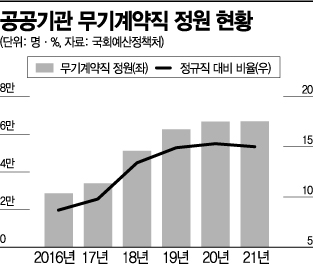
According to the "2022 Republic of Korea Public Institutions" report released by the National Assembly Budget Office on the 2nd, the number of indefinite-term contract workers in 369 public institutions (including affiliated institutions) increased by 132.9% (38,070 people), from 28,640 in 2016, just before the Moon Jae-in administration took office, to 66,709 in 2021.
Looking at the increase in indefinite-term contract workers in detail, the numbers rose by 8,180 in public enterprises, 13,120 in quasi-governmental agencies, and 16,769 in other public institutions. The ratio of indefinite-term contract workers to regular workers increased from 8.7% in 2016 to 9.8% in 2017, 14.9% in 2019, and 15.0% in 2021. In particular, the ratio jumped by 3.6 percentage points in 2018, the year after the Moon administration announced the regularization guidelines in July 2017.
The background for the sharp increase in indefinite-term contract workers lies in the Moon administration's "zero non-regular workers in the public sector" policy. The current government classifies both regular and indefinite-term contract workers as regular workers, but the problem is that while indefinite-term contract workers have the same employment period as regular workers, their wages and treatment are inferior. From the perspective of public institutions, it appears they chose to significantly increase indefinite-term contract workers, who have lower labor costs than regular workers.
Accordingly, the number of non-regular workers in public institutions decreased by 10,865, from 37,871 in 2016 to 27,006 in 2021. The ratio to regular workers also dropped from 12.3% to 6.5% during the same period. Including personnel outside public institutions, the number decreased by 59,174, from 88,928 in 2016 to 29,754 in 2021, and the ratio to regular workers fell from 28.9% to 7.1% during the same period.
The problem is that although the statistics show an increase in the number of regular workers, the quality of employment has not improved at all. According to the "Follow-up Tasks on the Conversion of Non-Regular Workers to Regular Workers in the Public Sector" report published by the Social Public Research Institute in 2020, only 1.1% of respondents said that indefinite-term contract workers in public institutions receive wages similar to those of regular workers. The largest group, 41.3%, responded that they receive 40-60% of regular workers' wages. Additionally, 15.3% said they receive 60-80%, and 10.7% said they receive 20-40% of regular workers' wages.
In the end, although jobs were increased mainly in the public sector, concerns have been raised that the management burden of public institutions worsened and that quality jobs were not created in terms of employment. Deputy Prime Minister and Minister of Economy and Finance Choo Kyung-ho stated in a written response before the National Assembly confirmation hearing, "Regarding the treatment of indefinite-term contract workers in public institutions, we will review specific improvement measures through consultations with experts and stakeholders centered on the Public Service Committee." He added, "During the rapid regularization process led by the government under the Moon Jae-in administration, side effects such as increased fiscal burden and deterioration of management in vulnerable public institutions occurred. The conversion of fixed-term, dispatched, and outsourced workers to regular workers also became an issue due to reverse discrimination and unfairness, intensifying social conflicts. It is necessary to thoroughly examine the operational performance and problems of this policy for an accurate evaluation."
© The Asia Business Daily(www.asiae.co.kr). All rights reserved.

















