MFDS to Reduce Temperature from 10°C to 5°C
Additional Refrigerator Equipment and Cost Issues Arise
All Costs to Be Borne by Self-Employed Individuals
[Asia Economy Reporter Lim Chunhan] The Ministry of Food and Drug Safety is facing controversy after proposing to lower the upper limit for refrigerated food storage and distribution temperatures from the current 10 degrees Celsius to 5 degrees. Convenience store owners and small business operators agree with the intention to fundamentally prevent food spoilage through the "installing refrigerator doors" project but argue that they cannot bear the cost.
On the 2nd, the Korea Convenience Store Industry Association expressed concerns in a phone interview with Asia Economy, saying, "There haven't been many incidents caused by food spoilage at the current 10-degree standard, and if an excessive introduction is made under the pretext of preventive measures, the damage will fall on franchise owners."
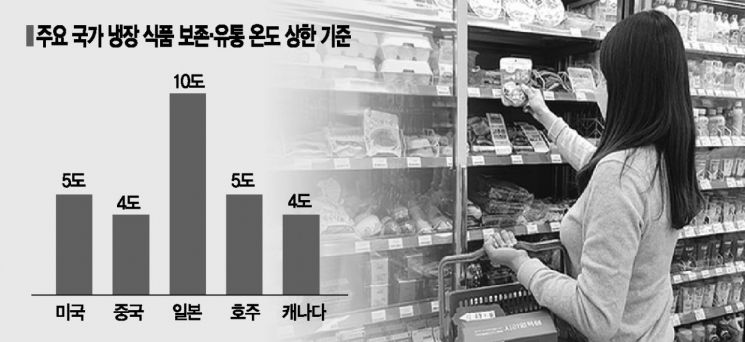
Domestic standards for the upper limit of refrigerated food storage and distribution temperatures have been maintained at 10 degrees Celsius since 1962. Currently, the U.S. and Australia apply a 5-degree standard, Canada and China 4 degrees, and Japan applies a standard below 10 degrees. According to research by the Korea Institute for Health and Social Affairs, when the ambient temperature around food rises by 1 degree, the incidence of food poisoning increases by 5.27%, and the number of patients increases by 6.18%. Based on this, the Ministry of Food and Drug Safety signed a business agreement with Lotte Mart and CU at the end of March and is conducting a pilot project to install refrigerator doors to maintain stable refrigeration temperatures and reduce energy consumption. After reviewing the operational results, they plan to expand installation and operation nationwide.
Ultimately, the issue lies in additional refrigerator equipment and costs. An industry insider criticized, "The refrigerator part is the biggest construction in convenience stores," adding, "When installing additional equipment, general products will have to be removed, which will paralyze business operations." Another insider pointed out, "While installing refrigerator doors may be possible in large stores, it is difficult to apply in small stores due to the layout," adding, "This will reduce space efficiency and customer convenience."
Concerns are even greater in small supermarkets. With sales continuously declining due to competition from convenience stores, additional costs are inevitably burdensome. A representative from the Korea Supermarket Cooperative Federation lamented, "If additional equipment is introduced, large corporations will share the cost at headquarters, but small and medium-sized supermarkets are self-employed and must bear all costs individually," adding, "We sympathize with the government's intention but hope our circumstances are also taken into consideration."
Professor Eunhee Lee of Inha University’s Department of Consumer Studies advised, "From the consumer's perspective, lowering the refrigeration temperature standard is desirable as it allows access to safer refrigerated food," but also noted, "Since small business owners and self-employed individuals are struggling, government or local government budget support seems necessary regarding the cost issue."
© The Asia Business Daily(www.asiae.co.kr). All rights reserved.
![Clutching a Stolen Dior Bag, Saying "I Hate Being Poor but Real"... The Grotesque Con of a "Human Knockoff" [Slate]](https://cwcontent.asiae.co.kr/asiaresize/183/2026021902243444107_1771435474.jpg)















