Creation of Regional Hub-Type Integrated Playgrounds Full of Adventure, Imagination, and Activities
[Asia Economy Reporter Lim Cheol-young] To mark the 100th anniversary of Children's Day this year, the Seoul Metropolitan Government announced on the 2nd that it will completely overhaul the old and hazardous children's play environments to alleviate the prolonged and intensified children's COVID-19 blues.
Children's parks are parks created within approximately 250 meters of residential areas, averaging around 1,000㎡ in size, to contribute to the improvement of children's health and emotional life, totaling 1,147 locations. Most are located near residential areas and are used as leisure spaces for play and rest, with facilities such as combination playground equipment, swings, and benches accounting for 60% of the installations. Due to the nature of these parks, which are heavily used for facilities, periodic maintenance and repairs are necessary. However, since the management responsibility lies with each autonomous district, disparities in maintenance occur depending on financial capacity, resulting in some parks having severely aged facilities.
Considering this management situation and the recent increase in citizen demand for using nearby parks due to COVID-19, Seoul is currently promoting an environment improvement project for aging children's parks targeting 50 parks across 25 autonomous districts. The city selected a total of 50 parks after comprehensively reviewing 95 parks submitted through district project applications based on ▲ facility aging ▲ usage by children and residents ▲ surrounding location conditions (residential areas and educational institutions) ▲ and district park management status.
Furthermore, in regional hub parks, sites larger than 5,000㎡ are being secured to create large-scale adventure, imagination, and integrated play spaces where children of various ages, including toddlers, elementary school students, and children with disabilities, can play together.
On April 30th, the first hub-type children's playground was established at Gwangnaru Hangang Park in Gangdong-gu, covering 6,000㎡ and equipped with large net combination playground equipment, swings, horizontal bars, and a sand play area, preparing to open on May 5th, Children's Day. By the end of this year, a 15,000㎡ hub-type playground will be created at Boramae Park in the southwestern area, followed by the discovery of suitable sites in the northeastern, northwestern, and downtown areas, aiming to establish one hub-type children's playground in each region, totaling five, by 2025.
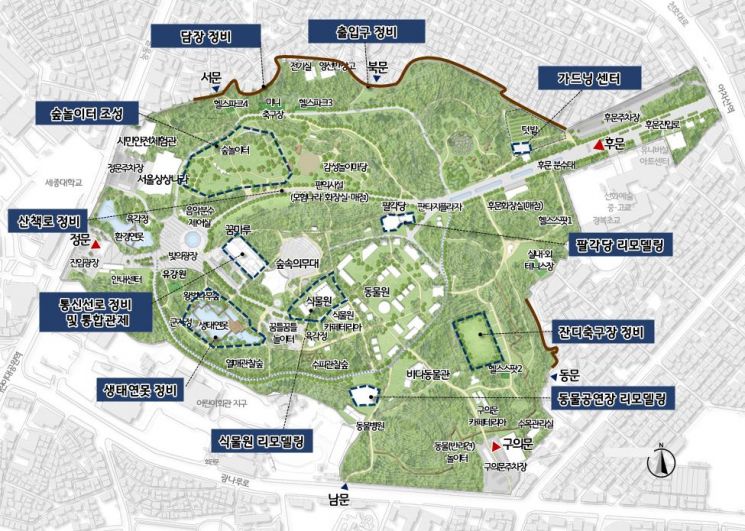
Children's Grand Park will be comprehensively renovated in phases by 2025 to transform into a child-centered family relaxation space. The city established a basic redevelopment plan in 2020 and will fully renovate aging buildings such as the octagonal pavilion, animal performance hall, and botanical garden, as well as walking trails, ponds, park facilities, and CCTV by 2025.
Additionally, Seoul plans to revitalize the park by fully renovating it into a child-centered family relaxation space befitting its status as a representative park for children that has continued for 50 years. The octagonal pavilion is being remodeled into a multipurpose complex cultural space for children, families, and citizens, with completion targeted by the end of this year. It will be designed to respond to recent climate changes (heatwaves, cold waves, fine dust, etc.) and reflect various citizen demands for children's education and play.
The animal performance hall will be remodeled into a multipurpose indoor cultural performance hall by 2023. Due to recent social perception changes regarding animal performances, the currently suspended animal performance hall will be remodeled into a cultural performance hall with fewer than 500 seats for children and local residents. The aging botanical garden will be remodeled into a theme-centered botanical garden by 2024. In addition, entrances, walking trails, park facilities, CCTV, ponds, and other aging facilities will be renovated together to provide a child-centered family relaxation space that is safe and comfortable for children, families, and socially vulnerable groups.
Meanwhile, to establish an eco-friendly safety system that blocks fine dust and environmental pollutants and to provide a complex play space where children and guardians can play and rest together without external environmental constraints, the city is promoting the creation of indoor playgrounds within parks. The indoor playgrounds within parks will be created at a total of 10 locations through new building construction or remodeling of existing buildings.
Indoor playgrounds within district parks are being promoted through new building construction, targeting six locations. Currently, design is underway aiming for completion within the year at Beolzip Children's Park (Seongbuk-gu), Jungpyeong Children's Park (Nowon-gu), Gangwol Children's Park, and Omok Neighborhood Park (Yangcheon-gu). The remaining two locations, Culture and Arts Park (Seocho-gu) and Jamsil Neighborhood Park (Songpa-gu), are under review for project implementation, so a total of eight indoor playgrounds in city and district parks will be provided to citizens in 2023.
Yu Young-bong, Director of the Seoul Metropolitan Government's Green City Bureau, said, "Children, who are the hope and precious beings leading the next generation, should be able to play freely and grow, so we will do our utmost to maintain and manage children's play environments in parks." He added, "We will also do our best to expand new concept play environments to flexibly respond to changes in perceptions of play and citizen demand for leisure."
© The Asia Business Daily(www.asiae.co.kr). All rights reserved.
![Clutching a Stolen Dior Bag, Saying "I Hate Being Poor but Real"... The Grotesque Con of a "Human Knockoff" [Slate]](https://cwcontent.asiae.co.kr/asiaresize/183/2026021902243444107_1771435474.jpg)















